


















Lesson 43 of 48 · Projects and Practice
Project 1: Write and Say Your Self-Introduction
Put your Portuguese together in a 150-word self-introduction using present, past, future and subjunctive, with a model, a builder and a checklist.
The best way to find out what you can really do is to make something. In this first project you will write a short self-introduction in Portuguese, about 100 to 150 words, and then say it aloud. It is the paragraph you will use in real life: at a language exchange, in a class, at a party, in a message to a new colleague.
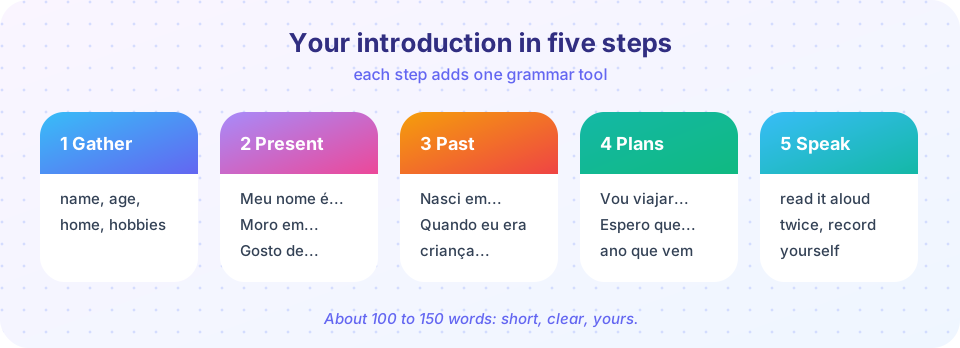
The project is deliberately built so that it uses almost everything you have learned: present tense for facts ("Moro em..."), the past for your story ("Nasci em..."), the imperfeito for childhood ("Quando eu era criança..."), the future for plans ("Vou viajar..."), a pronoun or two, and one subjunctive ("Espero que..."). When you finish, you will have a text you can keep, polish and reuse.
What you will learn
- How to plan a short text so that every sentence has a purpose.
- How to combine present, past, future and the subjunctive in one paragraph.
- How to check your text with a checklist, and how to say it aloud with a natural rhythm.
- How to adapt it for friends (casual) and for work (formal).
Key terms
Apresentação (introduction): what you say about yourself when you meet someone.
Rascunho (draft): a first version you will improve.
Revisão (revision): checking spelling, accents, agreement and tenses.
Concordância (agreement): matching gender and number (um amigo, uma amiga, meus pais).
Step 1: gather the facts
Write short notes in English or Portuguese for each point. You do not need to use all of them.
| Topic | Ideas | Useful frame |
|---|---|---|
| Name and origin | name, country, city | Meu nome é... / Eu sou do/da/de... |
| Age and place | age, where you live | Tenho ... anos. / Moro em... |
| Work or study | job, school | Sou... / Trabalho em... / Estudo... |
| Family | who lives with you | Na minha família somos... |
| Interests | hobbies, music, sports | Gosto de... |
| Past | birth, childhood, a recent event | Nasci em... / Quando eu era criança... / Ontem eu... |
| Plans | trips, goals | Vou... / Quero... / Espero que... |
| Why Portuguese | work, family, travel, love | Estou aprendendo português porque... |
Careful with countries: use do for masculine (do Brasil, do Canadá, do México), da for feminine (da Inglaterra, da França, da Alemanha), dos for plural (dos Estados Unidos), and plain de for countries without an article (de Portugal, de Angola, de Cuba).
Step 2: write the present
Start with the simplest tense. Use ser for identity, ter for age, morar, trabalhar, estudar, gostar de:
- Meu nome é Daniel e eu sou do Canadá.
- Tenho vinte e oito anos e moro em Toronto.
- Sou engenheiro e trabalho numa empresa pequena.
Remember: Tenho 28 anos, not "Sou 28 anos"; moro em a city; and gosto de + noun or infinitive: Gosto de música, Gosto de cozinhar. Men say obrigado, women say obrigada, and adjectives agree: Estou cansado/cansada.
Step 3: add the past
Use the perfeito for events (nasci, fiz, estudei) and the imperfeito for the scene in childhood (era, morava, passava):
- Nasci em Montreal, mas cresci em Toronto.
- Quando eu era criança, passava os verões na casa dos meus avós.
- Ontem fiz uma feijoada pela primeira vez.
Step 4: add plans and a wish
Use vou + infinitive for plans, and one of the triggers for the subjunctive:
- Vou viajar para o Brasil no ano que vem.
- Espero que as pessoas tenham paciência comigo.
- Se eu tiver tempo, vou visitar Salvador.
Step 5: check and speak
Read your text aloud twice. First check the grammar, then the sound: pause at commas, stress the verbs, and try to keep a steady rhythm. If you can, record yourself and compare with a Brazilian audio clip.
A model introduction
Olá! Meu nome é Daniel e eu sou do Canadá. Tenho vinte e oito anos e moro em Toronto, mas nasci em Montreal. Sou engenheiro e trabalho numa empresa pequena. Na minha família somos quatro pessoas: meus pais, minha irmã e eu. Quando eu era criança, passava os verões na casa dos meus avós. Gosto de música, de futebol e de cozinhar. Ontem fiz uma feijoada pela primeira vez e meus amigos adoraram! Estou aprendendo português porque quero viajar para o Brasil no ano que vem. Espero que as pessoas tenham paciência comigo. Vou praticar todos os dias. Muito prazer!
| Part | Portuguese | Tool used |
|---|---|---|
| Name and origin | Meu nome é Daniel e eu sou do Canadá. | ser, do/da |
| Age and home | Tenho vinte e oito anos e moro em Toronto. | ter for age, morar |
| Past | Nasci em Montreal. / Ontem fiz uma feijoada. | perfeito |
| Childhood | Quando eu era criança, passava os verões... | imperfeito |
| Plans | Vou praticar todos os dias. / ...no ano que vem. | ir + infinitive |
| Wish | Espero que as pessoas tenham paciência comigo. | subjunctive |
English meaning: "Hello! My name is Daniel and I am from Canada. I am 28 and live in Toronto, but I was born in Montreal. I am an engineer and work at a small company. There are four of us in my family: my parents, my sister and me. When I was a child I spent summers at my grandparents' house. I like music, football and cooking. Yesterday I made feijoada for the first time and my friends loved it! I am learning Portuguese because I want to travel to Brazil next year. I hope people will be patient with me. I will practice every day. Nice to meet you!"
Casual and formal versions
| Situation | Change |
|---|---|
| With friends | "Oi, tudo bem? Eu sou o Daniel, do Canadá. Moro em Toronto..." Use "Oi", "Tô aprendendo", "A gente"... |
| At work | "Bom dia. Meu nome é Daniel Souza e sou engenheiro. É um prazer conhecê-los." Use formal address and avoid slang. |
Delivering your introduction
A good introduction sounds like a conversation, not like a list. Four tips:
- Pause at commas and full stops, and breathe. Short sentences are easier to say, and easier to understand.
- Stress the verbs and key nouns: "Eu moro em Toronto, mas nasci em Montreal."
- Smile on the greeting and the closing. "Olá!" and "Muito prazer!" are social gestures as much as words.
- Watch the nasal sounds in words such as bem, também, são and mãe. Do not pronounce the final -m as a full "m"; it nasalizes the vowel.
Record yourself, and listen once for clarity and once for rhythm. If you can, ask a native speaker or a teacher to read your text aloud so that you can copy their rhythm.
A feedback checklist
When someone corrects your text, or when you correct it yourself, check these points in order:
- Verbs: is each one in the right person and tense?
- Agreement: do articles and adjectives match the noun in gender and number (minha irmã, meus pais)?
- Contractions: do you have no, na, do, da, ao, à where they belong?
- Accents and spelling: é, está, você, também, família, três.
- Natural phrasing: Tenho 28 anos is natural; Sou 28 anos is not.
Keep your corrected version. Next month, write a new introduction without looking at it and compare: the differences show your progress.
Common misconceptions
"I must use every tense." No. A natural introduction is short; the tenses are there because the content needs them.
"Sou 28 anos" is fine. Use Tenho 28 anos.
"Eu moro em Brasil." Brasil takes an article, so use no: Moro no Brasil; Sou do Brasil.
"Longer is better." A clear 120-word text beats a confused 300-word one.
Try it
First, an introduction builder. Fill in your details and press the button; the page assembles a draft with correct contractions. Edit the output afterwards: a builder gives you a skeleton, but your own words are better.
The second TryIt is a Python checklist. It checks whether your text contains the elements of the model: a greeting, your name, age, home, a past reference, a plan, a subjunctive trigger and a closing. Paste your own text into text and run it. It looks for cue words, so it cannot judge correctness, but it shows whether you covered each element.
Press Run (or Ctrl + Enter) to see the result here.
Program input · what you'd type while the program runs
Type the answers before you press Run, one per line. Each time the program reads a line (with input()), it gets the next line from this box.
Check your understanding
Quick check · 4 questions
of 4 answered You scored / 4 · perfect!
-
1. How do you say 'I am 28 years old' in Portuguese?
Portuguese uses ter for age: Tenho 28 anos. -
2. Which country phrase is correct?
Brasil takes the article, so de + o = do. -
3. Which tense fits 'Quando eu era criança, passava os verões na casa dos meus avós'?
A childhood habit is imperfeito: era, passava. -
4. Which sentence expresses a wish with the subjunctive?
After 'espero que', use the subjunctive: tenham.
Summary
- A good self-introduction is short and uses present, past, future and one subjunctive.
- Use tenho for age, moro em for where you live, sou do/da/de for origin.
- Perfeito for events (nasci, fiz), imperfeito for childhood (era, passava), vou + infinitive for plans.
- Check your text with a checklist, read it aloud twice and keep a casual and a formal version.
Track your progress
Create a free account to tick off lessons and pick up where you left off on any device.
of Portuguese for Beginners lessons completed