


















Lesson 39 of 48 · Conversation and Culture
Informal Brazilian Portuguese: Tá, Pra, Né and Slang
Understand everyday Brazilian speech: tá, tô, pra, né, a gente, common slang like valeu and beleza, regional words and the abbreviations used in WhatsApp.
If you have ever followed a textbook dialogue and then heard a real conversation in Brazil, you know the shock. Where the book says "Você está bem?", the street says "Cê tá bem?". Where it says "Nós vamos ao cinema", people say "A gente vai pro cinema". This is not careless speech. It is a regular, shared system of informal spoken Portuguese, and it is the language of friends, families, shops, buses and chat apps.
This lesson teaches you to understand that system first and to use it second. You will learn the most common spoken contractions, the very useful "a gente", the filler words that keep conversation flowing, a set of slang you will hear daily, a handful of regional words, and the abbreviations that fill WhatsApp. You will also learn when to avoid them.
What you will learn
- The common spoken contractions: tá, tô, pra, pro, cê, né, bora.
- How "a gente" replaces "nós" and takes a third-person verb.
- The most useful slang and filler words, and where they come from.
- Regional vocabulary and chat abbreviations (vc, tb, blz, kkkk).
- When casual speech is welcome and when it is not.
Key terms
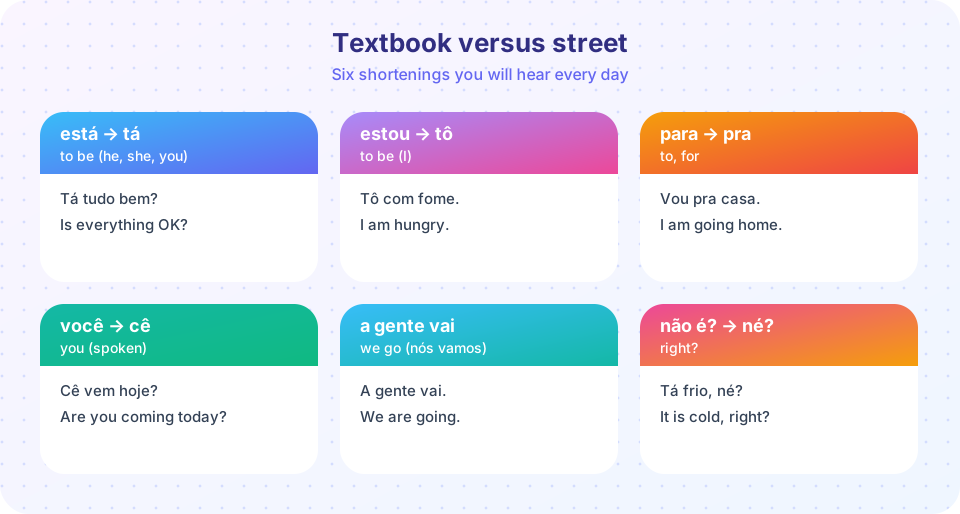
Contração oral (spoken contraction): a shortened form used in speech, such as "tá" for "está".
A gente: literally "the people"; in speech it means "we" and takes a verb in the third person singular.
Gíria (slang): informal, often regional vocabulary.
Interjeição (interjection): a short exclamation such as "nossa!" or "poxa!".
Spoken contractions
| Formal | Casual | Example |
|---|---|---|
| está | tá | Tá tudo bem? (Is everything OK?) |
| estou | tô | Tô com fome. (I am hungry.) |
| estamos | tamo | Tamo aqui. (We are here.) |
| estão | tão | Eles tão atrasados. (They are late.) |
| para | pra | Vou pra casa. (I am going home.) |
| para o | pro | Vou pro mercado. (I am going to the market.) |
| você | cê (spoken) / vc (written) | Cê vem? (Are you coming?) |
| não é? | né? | Está frio, né? (It is cold, right?) |
| vamos embora | bora | Bora! (Let's go!) |
Two other features of fast speech: the final -r of infinitives is often weak, so "falar" sounds like "fala", and unstressed syllables shrink: "Vamos lá?" sounds like "Vamo lá?". You do not need to copy these, but you do need to recognize them.
In writing, tá and tô appear in messages, comics and subtitles, but you should not write them in formal text.
"A gente": we
Brazilians say a gente much more than "nós" in everyday speech. It looks plural ("the people") but the verb is third person singular, exactly like "ele":
| Formal | Everyday |
|---|---|
| Nós vamos ao cinema. | A gente vai ao cinema. |
| Nós falamos português. | A gente fala português. |
| Nós temos tempo. | A gente tem tempo. |
| Nós somos felizes. | A gente é feliz. |
| Nós estamos aqui. | A gente está (tá) aqui. |
"Nós" remains correct and is more common in writing and in Portugal, where "a gente" is also used but less often.
Filler words and reactions
Fillers keep the conversation flowing; every language has them. Listen for:
- Então... (so...), aí (and then): "Aí eu falei pra ele..." (And then I told him...)
- Tipo (like): "É tipo uma festa" (It is like a party).
- Sei lá (I do not know): the all-purpose shrug.
- Pois é (yeah, I know), Né? (right?), Quer dizer (I mean).
- Nossa! (wow), Poxa! (gosh, what a pity), Caramba! (wow), Uau! (wow).
- Sério? (really?), Mentira! (no way! literally "lie"), Jura? (really?).
Everyday slang
| Expression | Meaning | Note |
|---|---|---|
| E aí? | Hey, what's up? | Casual greeting. |
| Beleza? | All good? | Also the reply: "Beleza." |
| Valeu! | Thanks! / See you! | From "valer", to be worth. |
| Legal | cool, nice | Also means "legal" (lawful). |
| Tranquilo / De boa | no problem, relaxed | "Tá de boa." |
| Cara | dude, guy | "Cara, que legal!" Not rude. |
| Cadê? | where is...? | "Cadê o meu celular?" |
| Bacana / Maneiro | cool | Older/regional slang. |
| Demorou | Sounds good, I'm in | Common in São Paulo. |
Cuidado! Casual speech has its limits. Do not use heavy slang with older people, in a job interview or with someone you have just met; wait until they use it first. Swear words are best avoided entirely until you are very comfortable. They are stronger than they sound, and many words that are mild in one region are offensive in another.
Regional flavors
Brazil is large, and each region has its accent (sotaque) and words:
- Carioca (Rio de Janeiro): the "s" sounds like "sh" at the end of a syllable; "mermão", "maneiro".
- Paulistano (São Paulo): "mano", "meu", "daora" (cool).
- Mineiro (Minas Gerais): "uai" (a very Minas interjection) and "trem" (used for "thing" as well as "train").
- Gaúcho (Rio Grande do Sul): "tchê" and "bah", and the use of tu.
- Nordestino (Northeast): "oxente", "massa" (cool), melodic intonation.
These are stereotypes and generalizations, but they help you place what you hear. Locals enjoy teasing about them; it is affectionate.
WhatsApp and text messages
Messaging is a huge part of daily communication in Brazil. Common abbreviations:
| Abbreviation | Meaning | Notes |
|---|---|---|
| vc | você | you |
| tb / tbm | também | also |
| pq | porque / por que | why / because |
| q | que | that / what |
| n | não | no |
| mt / mto | muito | very |
| blz | beleza | OK |
| obg | obrigado/a | thanks |
| vlw | valeu | thanks |
| flw | falou | bye |
| hj | hoje | today |
| bjs | beijos | kisses (sign-off) |
| kkkk / rsrs | laughter | Brazilians use kkkk; "hahaha" is also understood |
Brazilians also send many áudios (voice messages) and stickers. "Bom dia!" greetings with images are a daily ritual in family groups. Sign-offs include "abraço" (hug) and "beijo" (kiss), both friendly and neutral in most contexts.
A casual dialogue
| Portuguese | English |
|---|---|
| E aí, Bia! Tudo bem? | Hey, Bia! How is it going? |
| Beleza, e você? Cê vai pra festa do Rafa? | Good, and you? Are you going to Rafa's party? |
| Vou, sim! Bora juntos? A gente pega um carro por aplicativo. | Yes! Shall we go together? We will take a ride-share. |
| Demorou! Eu tô saindo daqui a pouco. | Sounds good! I am leaving in a bit. |
| Tá bom, me avisa quando chegar. | OK, tell me when you arrive. |
| Valeu, até já! | Thanks, see you soon! |
Decoding fast speech
When a sentence goes by too fast, use a three-step routine: find the rhythm, expand the contractions in your head, then match the fillers. Practice on these examples. Cover the right column, expand each sentence, and then check.
| Fast speech | Expanded form |
|---|---|
| Tô indo pra casa, cê vem? | Estou indo para casa, você vem? |
| Bora tomar um café, né? | Vamos embora tomar um café, não é? |
| A gente se vê amanhã, beleza? | Nós nos vemos amanhã, tudo bem? |
| Cadê a chave? | Onde está a chave? |
| Tá bom, valeu! | Está bem, obrigado! |
With practice the expansion becomes automatic, and one day you will stop noticing it at all. That is the moment when real Portuguese starts to feel like a language and not like a code.
Common misconceptions
"Casual Portuguese is wrong." No. It is regular and universal, but it belongs to certain situations.
"A gente" takes a plural verb. It takes the third person singular: a gente vai, not a gente vamos.
"Brazilian slang is the same everywhere." It is regional, and slang ages fast.
"I should use as much slang as possible to sound fluent." Learners who overuse slang sound odd. Aim to understand it, use a few safe items (valeu, beleza, legal, tá bom) and keep the rest for later.
Try it
The first TryIt is a Python "register converter". It rewrites a formal sentence into casual spoken Portuguese, replaces "nós" with "a gente" for a few verbs, and finally shortens words as in a text message. It is a simple rule-based demo, not a real translator, so try it on sentences similar to the examples.
Press Run (or Ctrl + Enter) to see the result here.
Program input · what you'd type while the program runs
Type the answers before you press Run, one per line. Each time the program reads a line (with input()), it gets the next line from this box.
Now a gap-fill with casual forms. Remember that these are spoken forms.
Last, match the slang with its meaning.
Check your understanding
Quick check · 6 questions
of 6 answered You scored / 6 · perfect!
-
1. What does 'a gente vai' mean?
In everyday speech 'a gente' means 'we' and takes the third person singular verb. -
2. What is 'tô' short for?
'Tô' = 'estou' (I am). 'Tá' = 'está' and 'tão' = 'estão'. -
3. Which is a casual way to say 'Let's go'?
'Bora' is a shortening of 'vamos embora'. -
4. What does 'kkkk' mean in a Brazilian message?
Brazilians write kkkk (like hahaha) to show laughter. -
5. When should you be careful with slang?
Slang is informal; wait until the other person uses it first in formal or unfamiliar situations. -
6. Which word is a regional marker of Minas Gerais?
'Uai' is the stereotype of Minas Gerais; 'bah' is gaúcho and 'oxente' is Northeastern.
Summary
- Spoken contractions: tá, tô, tamo, tão, pra, pro, cê, né, bora.
- "A gente" means "we" and uses a third-person singular verb.
- Fillers and reactions: então, aí, tipo, sei lá, pois é, nossa, poxa.
- Slang: e aí, beleza, valeu, legal, de boa, cara, cadê; regional words (uai, oxente, tchê) mark where someone comes from.
- Chat: vc, tb, pq, blz, vlw, kkkk. Use casual speech where it fits, not everywhere.
Next: Brazil and Portugal
Track your progress
Create a free account to tick off lessons and pick up where you left off on any device.
of Portuguese for Beginners lessons completed