


















Lesson 45 of 48 · Projects and Practice
Mixed Practice Drills: Chapters 5 to 8
Practice chapters 5 to 8 in mixed drills: numbers, questions, past tenses, future, pronouns, subjunctive and culture, with a quiz app and a scheduler.
Learning a language is not finished when you understand a lesson. Understanding is the easy part; retrieving the right form while someone is waiting for your answer is the hard part. This lesson is a workout for retrieval. It mixes numbers, time, questions, food, directions, past tenses, the future, pronouns, the subjunctive and culture in short drills, so that you practice choosing, not just following a lesson topic.
Mixed practice feels harder than repeating one topic, and that is why it works. Researchers call it interleaving: when you mix problem types, your brain has to decide which tool to use, which is exactly what real conversation demands.
What you will learn
- How to practice with mixed drills and why they work.
- A seven-day plan that rotates the chapter topics.
- How to use a quiz app, a gap-fill and a Leitner scheduler.
- A set of translation exercises with answers to check yourself.
Key terms
Recuperação (retrieval): pulling a word or rule from memory.
Prática intercalada (interleaved practice): mixing different types of problems in one session.
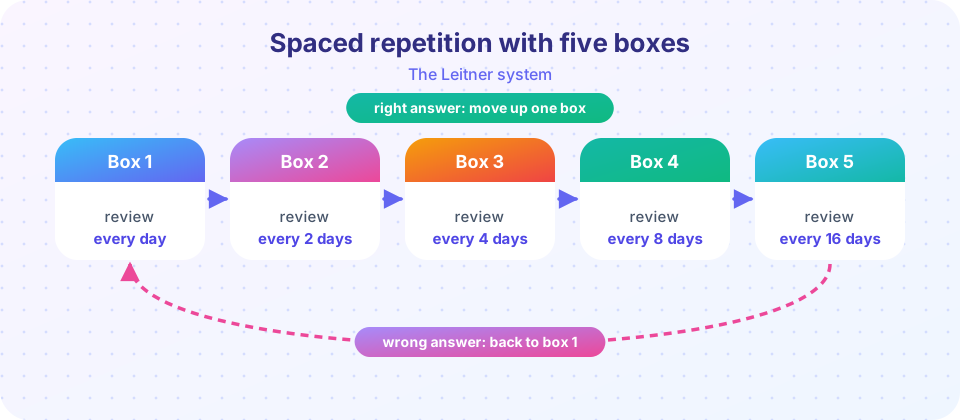
Repetição espaçada (spaced repetition): reviewing items at growing intervals.
Caixa de Leitner: a box system for flashcards; correct cards move to boxes with longer intervals.
A seven-day rotation
Fifteen to twenty minutes a day is enough. Rotate the focus but always finish with speaking.
| Day | Focus | Task |
|---|---|---|
| 1 | Numbers, time, questions | Say five prices and five times aloud; ask ten questions with different question words |
| 2 | Food, shopping, directions | Role-play ordering and asking the way; write three dialogues |
| 3 | Perfeito | Write ten sentences about yesterday; check irregular forms |
| 4 | Imperfeito and choosing | Describe your childhood, then retell it as a story with one interrupted action |
| 5 | Future and pronouns | Write your plans for next week using "vou" and "te/me" |
| 6 | Subjunctive | Write five wishes with "espero que" and "talvez" |
| 7 | Culture and speaking | Record a one-minute message to a friend using casual forms |
Drill 1: the mixed quiz app
Twenty-four questions come from every chapter. Each round picks ten at random. Say the answer aloud before you click, and note which topics you miss.
Drill 2: gap-fill across the course
Drill 3: translation, then check
Cover the right column. Translate each sentence aloud into Portuguese, then uncover the answer. If you are unsure about a form, mark the sentence and review the lesson.
| English | Portuguese (answer) |
|---|---|
| It is half past two. | São duas e meia. |
| Where is the bus station? | Onde fica a rodoviária? |
| I would like a coffee, please. | Eu queria um café, por favor. |
| Yesterday I went to the market and bought bread. | Ontem eu fui ao mercado e comprei pão. |
| When I was a child, I lived in Recife. | Quando eu era criança, eu morava em Recife. |
| I was sleeping when the phone rang. | Eu dormia quando o telefone tocou. |
| Tomorrow I am going to study with her. | Amanhã eu vou estudar com ela. |
| I will call you when I arrive. | Eu te ligo quando eu chegar. |
| I hope you like it. | Espero que você goste. |
| Maybe he will come with us. | Talvez ele venha com a gente. |
Drill 3b: find the mistake
Each sentence below has one mistake, except one that is correct. Find and fix it, then check the answer column.
| Sentence | Correction |
|---|---|
| Eu sou 28 anos. | Eu tenho 28 anos. (age uses ter) |
| Eu moro em Brasil. | Eu moro no Brasil. (em + o = no) |
| Ontem eu chegei tarde. | Ontem eu cheguei tarde. (-gar becomes -guei) |
| Quando eu era criança, eu morei em Recife. | ... eu morava em Recife. (a situation over time: imperfeito) |
| Para mim fazer isso, preciso de tempo. | Para eu fazer isso... (the subject of an infinitive is eu) |
| Espero que ele vem. | Espero que ele venha. (subjunctive after espero que) |
| Quero que eu viaje. | Quero viajar. (same subject: infinitive) |
| Vou à o mercado. | Vou ao mercado. (a + o = ao) |
| Eu não vejo ninguém. | Correct. (double negative is right) |
Keep an error log
Mistakes are useful data. Keep a small notebook or file with three columns: what I said, what it should be, the rule. Review it once a week. After a month, patterns will appear: perhaps you forget the accent in você, mix up por and para, or use the present subjunctive where the future subjunctive is needed. Each pattern is a ten-minute review topic.
Drill 4: a Leitner scheduler
A spaced-repetition scheduler decides when to review each card. This simulation uses five boxes with intervals of 1, 2, 4, 8 and 16 days, and random right or wrong answers (75 percent right). Run it to see how the due list changes over three weeks. In real life, you use the same idea with your own flashcards: right answer, move the card up a box; wrong answer, back to box 1.
Press Run (or Ctrl + Enter) to see the result here.
Program input · what you'd type while the program runs
Type the answers before you press Run, one per line. Each time the program reads a line (with input()), it gets the next line from this box.
Common misconceptions
"Cramming for hours is the best way." Short sessions spread over days beat long sessions.
"If I recognize an answer, I know it." Recognition is easier than recall. Say it first, then check.
"Mistakes mean I am failing." Mistakes tell you where to practice.
"I should only drill grammar." Speak. Record yourself and talk to people.
Check your understanding
Quick check · 4 questions
of 4 answered You scored / 4 · perfect!
-
1. Why does mixing topics in one session help learning?
Interleaved practice trains the choice between forms. -
2. In a Leitner system, what happens to a card you answer wrongly?
Wrong answers go back to box 1 and are reviewed again soon. -
3. How do you say 'Tomorrow I am going to study' in everyday Portuguese?
ir + infinitive is the everyday future. -
4. What should you do before you click an answer in a quiz?
Retrieval practice works best when you produce the answer first.
Summary
- Mixed (interleaved) drills train retrieval and choice, the real conversation skill.
- Rotate topics across seven days and always end with speaking.
- Use quizzes, gap-fills, translation and a Leitner schedule for spaced repetition.
- Say answers before you check them; mistakes show where to practice.
Next: Glossary
Track your progress
Create a free account to tick off lessons and pick up where you left off on any device.
of Portuguese for Beginners lessons completed