


















Lesson 1 of 48 · Getting Started
Course Map: How This Portuguese Course Works
Meet the nine-chapter plan for Portuguese for beginners: who the course is for, how each lesson works, and how to study Brazilian Portuguese well.
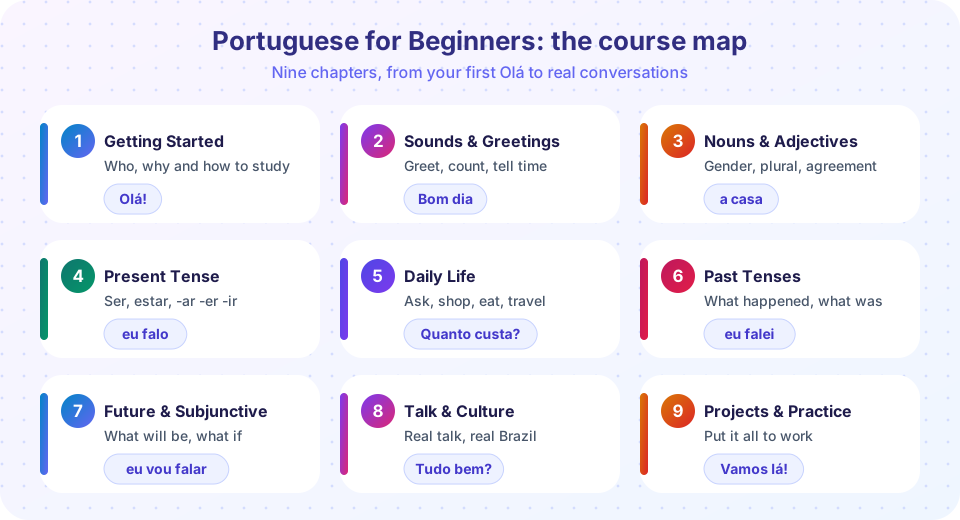
Welcome to Portuguese for Beginners. This course takes you from your first "Olá!" to simple, real conversations, one clear step at a time. Every explanation is in English, every Portuguese example comes with a translation, and every lesson has something to look at and something to try.
Portuguese is the sixth or seventh most spoken language on Earth, the main language of a whole continent's largest country, and a gateway to music, football, literature, and business across four continents. It is also friendlier to English speakers than you might expect. Thousands of words look familiar, the alphabet is the one you already know, and the grammar follows patterns you can learn in a few weeks. This first lesson is your map: who the course is for, how it is organized, and how to get the most from it.
What you will learn
- Who this course is for and what you need before you start.
- Which variety of Portuguese the course teaches, and how European differences are handled.
- How the nine chapters build on each other.
- How every lesson is laid out, and how to use the practice tools.
- A realistic way to study, including what a course cannot do for you.
Key terms
Brazilian Portuguese (BP): the variety spoken in Brazil, and the base of this course.
European Portuguese (EP): the variety spoken in Portugal; we note where it differs.
IPA: the International Phonetic Alphabet, a set of symbols for sounds, written between slashes like /ˈkazɐ/.
Cognate: a word that looks and means almost the same in two languages, such as hospital and hospital, or animal and animal.
Respelling: an English-style spelling of how to say a word, used beside the IPA so you can read it quickly.
Who this course is for
This course is for absolute beginners. You do not need any Portuguese, any Spanish, or any grammar vocabulary. If you can read English and you are curious, you are ready. It suits travelers heading to Brazil or Portugal, people with Portuguese-speaking family or friends, students who want a third or fourth language, and professionals who work with Brazilian, Portuguese, Angolan, or Mozambican colleagues.
Each new grammar word is explained the first time it appears. When we say noun, you will see an example. When we say conjugate, we will tell you it means "change a verb to match who is doing the action." You never have to look up a term elsewhere to follow a lesson.
If you already know Spanish, Italian, or French, you will move faster, but do not assume anything: the languages share roots, not rules, and Portuguese has its own sounds, its own spelling, and its own surprises. We flag the big traps as we go.
Which Portuguese do we teach?
Portuguese has two main standard varieties: Brazilian and European. They share one written grammar, one core vocabulary, and one literature, but they sound quite different and differ in everyday words and in some verb habits. Imagine American and British English, with a little more distance in pronunciation.
This course uses Brazilian Portuguese as its base because roughly four in five speakers of the language live in Brazil. Wherever European Portuguese differs in a way that matters to a beginner, there is a short note. For example, Brazilians say o café da manhã for breakfast and Portuguese people say o pequeno-almoço; Brazilians say Estou falando ("I am speaking") and Portuguese people say Estou a falar. You will learn the Brazilian form first and be able to recognize the European one. Either way, a speaker of one variety understands the other with a little patience.
The nine chapters
The first steps
- Getting started
- Sounds and greetings
Building blocks
- Nouns and adjectives
- Present tense
Real life
- Daily life and questions
- Past tenses
Speaking and culture
- Future and subjunctive
- Conversation and culture
- Projects and practice
Chapters 1 to 4 (the first half of the course) get you from zero to a working base: you can read the language, pronounce it sensibly, greet people, count, tell the time, name things, describe them, and say what people are and do. Chapters 5 to 9 add questions, shopping, food and travel, the past, the future, polite requests, and a final set of projects. Each chapter has the same rhythm: an overview, two to four content lessons, and a review with a larger quiz.
Here is what the first four chapters contain:
| Chapter | What you can do afterwards |
|---|---|
| 1. Getting Started | Explain where Portuguese is spoken, spot cognates and false friends, and plan your study. |
| 2. Sounds, Greetings and Basics | Pronounce words from spelling, greet and introduce yourself, count to 100, tell time. |
| 3. Nouns, Articles and Adjectives | Use o and a correctly, make plurals, and match adjectives. |
| 4. Present Tense Verbs | Use ser, estar, and regular and common irregular verbs in simple sentences. |
How each lesson works
Every content lesson follows the same layout, so you always know where you are:
- What you will learn lists the outcomes in plain words.
- Key terms gives short definitions in a box.
- The body teaches with examples and at least one picture.
- Common misconceptions warns you about mistakes that learners make again and again.
- Try it gives you interactive practice, such as flashcards, gap-fill games, and small programs.
- Check your understanding is a short quiz with explanations.
- Summary repeats the key points, with a link to the next lesson.
How we write Portuguese here
Portuguese examples are in bold or in code-style blocks, with the English meaning in plain text or quotation marks right beside them. Where pronunciation needs help, you will see the IPA between slashes, like /obɾiˈɡadu/, and a respelling, like "oh-bree-GAH-doo". Capital letters in respellings mark the stressed syllable. Do not worry if IPA looks scary now; you will meet only a few symbols, and the next chapter explains them.
Some practice tools have a "Listen" button that asks your browser to read a Portuguese word aloud. Browsers may not offer a Portuguese voice inside the sandbox where examples run, so the buttons are optional extras. Every lesson works without them, because we always give the pronunciation in writing.
Common misconceptions
"Portuguese is just Spanish said differently." The two share many roots, but Portuguese has nasal vowels, different spelling, and many words that differ completely, for example obrigado ("thank you") against gracias, and janela ("window") against ventana. Learn Portuguese as its own language.
"Brazilians and Portuguese people cannot understand each other." They can. Differences in sound and some everyday words can confuse a first conversation, but written Portuguese is nearly the same, and Brazilian television, music, and films are well known in Portugal.
"A course will make me fluent." A course gives you structure, vocabulary, and grammar. Fluency comes from speaking with real people, listening to real speech, and making mistakes in public. Treat this course as your training ground, and find a conversation partner, a tutor, or an exchange group as early as you can.
Study advice before you begin
Fifteen to twenty minutes a day beats a three-hour session once a week. Read a lesson, try the practice tools, and come back the next day to redo the quiz without looking. Say every Portuguese example out loud, even if you are alone; your mouth needs to learn the sounds as much as your brain needs the words. The next lessons show a full study plan, but the habit starts now.
Finally, an honest note: this course teaches you the language, but a course cannot replace speaking with people. Plan to talk to someone, even briefly, within your first two weeks.
Try it
The first tool is a set of ten flashcards. Press Show meaning to see the English, Next card to move on, and Listen to hear the word if your browser has a Portuguese voice.
The second tool is a small planner. It is a simple calculation, not a prediction: change the numbers to match your life and see how long a set of lessons takes at your pace.
Press Run (or Ctrl + Enter) to see the result here.
Program input · what you'd type while the program runs
Type the answers before you press Run, one per line. Each time the program reads a line (with input()), it gets the next line from this box.
Check your understanding
Quick check · 4 questions
of 4 answered You scored / 4 · perfect!
-
1. Which variety of Portuguese does this course use as its base?
Brazil has roughly four in five of all Portuguese speakers, so the course teaches Brazilian Portuguese and adds notes on European differences. -
2. What does a word between slashes, like /ˈkazɐ/, show?
Slashes mark IPA, the phonetic alphabet. The course also gives a respelling so you can read the sound quickly. -
3. What is the best study rhythm suggested in this lesson?
Short, regular sessions build memory better than rare long ones, and speaking aloud trains your mouth as well as your memory. -
4. True or false: finishing a course is enough to become fluent.
Fluency needs real conversations and listening. A course gives structure and tools, but cannot replace speaking with people.
Summary
- The course teaches Brazilian Portuguese, with notes on European Portuguese.
- It has nine chapters; this first half covers the basics through the present tense.
- Every lesson has outcomes, key terms, examples, pictures, practice, a quiz, and a summary.
- Pronunciation is shown with IPA and respelling; audio buttons are optional.
- A course cannot replace speaking with people: plan to talk to someone early.
Track your progress
Create a free account to tick off lessons and pick up where you left off on any device.
of Portuguese for Beginners lessons completed