


















Lesson 15 of 48 · Nouns, Articles and Adjectives
Adjectives, Possessives and Demonstratives
Describe things in Portuguese: adjective agreement and position, colors, meu/minha, seu/dele, and este/esse/aquele, with examples and Brazil/Portugal notes.
A noun names a thing, and an adjective tells you something about it: big, new, red, mine, this one. In Portuguese, those descriptive words follow the noun and change their ending to match its gender and number, exactly like the articles you met in the last lesson.
This lesson covers three families of describing words. Adjectives (bonito, grande, vermelho) say what something is like. Possessives (meu, seu, nosso) say whose it is. Demonstratives (este, esse, aquele) point to something near or far. All three agree with the noun, so once you have the rule in your fingers you can use hundreds of words.
What you will learn
- How adjectives agree in gender and number, and where they go.
- Common adjectives and colors.
- The possessives meu, teu, seu, nosso and how to avoid the confusion with seu.
- The demonstratives este, esse, aquele and their neuter forms.
Key terms
Adjective (adjetivo): describes a noun and agrees with it.
Possessive (possessivo): shows ownership: my, your, his, her, our, their.
Demonstrative (demonstrativo): points out a thing: this, that.
Invariable: a word with one form only, whatever the gender or number.
How adjectives agree
Adjectives ending in -o
Most adjectives that end in -o have four forms:
| Masculine | Feminine | |
|---|---|---|
| Singular | novo | nova |
| Plural | novos | novas |
So: um carro novo (a new car), uma casa nova (a new house), os carros novos, as casas novas. Other adjectives of this type include bonito (pretty), pequeno (small), alto (tall), baixo (short, low), caro (expensive), barato (cheap), cansado (tired), simpático (nice), and velho (old).
Adjectives with one form for both genders
Adjectives that end in -e, -l, -z, or -m do not change for gender, only for number: jovem / jovens (young), grande / grandes (big), inteligente / inteligentes (smart), feliz / felizes (happy), fácil / fáceis (easy), difícil / difíceis (difficult), azul / azuis (blue), verde / verdes (green). So um livro grande and uma casa grande.
Adjectives that add -a for the feminine
Adjectives ending in -or or -ês add -a for the feminine: trabalhador / trabalhadora (hard-working), português / portuguesa, inglês / inglesa. The same rule gives o professor simpático and a professora simpática.
The adjective follows the noun
In Portuguese the usual order is noun + adjective: uma casa bonita, um livro interessante, os alunos novos. Quantity words and numbers come before the noun: muitos amigos (many friends), poucas pessoas (few people), três gatos.
A few common adjectives can come before the noun for emphasis or a figurative meaning, and sometimes the meaning changes:
| Before the noun | After the noun |
|---|---|
| um grande homem (a great man) | um homem grande (a big man) |
| um velho amigo (a longtime friend) | um amigo velho (an old, aged friend) |
| um pobre homem (an unfortunate man) | um homem pobre (a man without money) |
The verb with adjectives
You use ser or estar with adjectives: A casa é grande. (The house is big.) Os meninos estão cansados. (The boys are tired.) The adjective still agrees. Chapter 4 explains the verbs.
Intensifiers
Muito means "very" when it modifies an adjective, and it does not change: muito bonita, muito caros. But when muito means "many/much" before a noun, it is an adjective and agrees: muitas casas, muito tempo. Other helpers: mais (more), menos (less), tão (so), bem (well, very): tão grande, mais novo.
Colors
| Portuguese | English | Notes |
|---|---|---|
| vermelho / vermelha | red | four forms |
| amarelo / amarela | yellow | four forms |
| preto / preta | black | four forms |
| branco / branca | white | four forms |
| roxo / roxa | purple | four forms |
| azul | blue | plural: azuis |
| verde | green | plural: verdes |
| laranja | orange | invariable |
| rosa | pink | invariable |
| cinza | gray | invariable |
| marrom | brown | Brazil; Portugal says castanho |
Colors are masculine as nouns (o azul), and as adjectives they agree: a camisa vermelha, os sapatos pretos, as flores amarelas. The colors that come from nouns, laranja, rosa, cinza, do not change: as camisas rosa.
Possessives
| Owner | Masculine singular | Feminine singular | Masculine plural | Feminine plural |
|---|---|---|---|---|
| my | meu | minha | meus | minhas |
| your (informal, tu) | teu | tua | teus | tuas |
| his, her, your (você), their | seu | sua | seus | suas |
| our | nosso | nossa | nossos | nossas |
Possessives agree with the thing owned, not with the owner: meu livro (my book), minha casa (my house), meus amigos, minhas amigas. A woman and a man both say minha casa.
The problem with seu and sua
Seu and sua can mean "your", "his", "her", or "their", so seu carro can be ambiguous. To be clear, use dele (his), dela (her), deles (their, masculine or mixed), delas (their, feminine), and de vocês (your, plural): o carro dele (his car), a casa dela (her house), o carro de vocês (your car, said to several people). In Brazil, seu and sua usually mean "your" (você), and dele/dela handle the third person.
Brazil and Portugal
In Brazil, possessives usually appear alone: meu livro. In Portugal, they normally take an article: o meu livro, a minha casa. In Brazil, o meu livro is also correct, but it sounds more formal. The word teu/tua goes with tu, so it is common in Portugal and some regions of Brazil.
Demonstratives
| Masculine | Feminine | Neutral | |
|---|---|---|---|
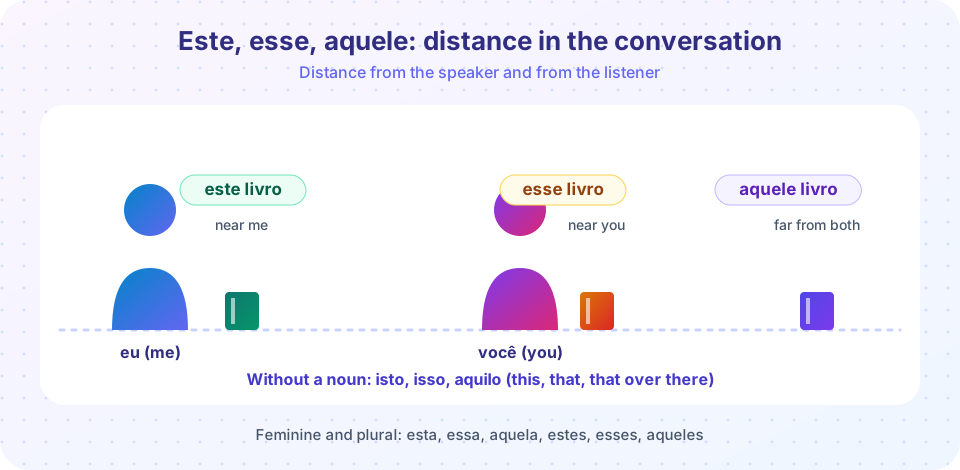
| near me (this) | este, estes | esta, estas | isto |
| near you, or already mentioned (that) | esse, esses | essa, essas | isso |
| far from both (that over there) | aquele, aqueles | aquela, aquelas | aquilo |
Use este for what is near the speaker: Este livro é meu. Use esse for what is near the listener: Esse livro é seu? Use aquele for something far from both: Aquela casa é grande.
The neutral forms isto, isso, aquilo do not refer to a particular noun. They mean "this thing, that thing" when you do not name it: O que é isso? (What is that?) Isso é muito bom. (That is very good.) Aquilo é um problema. (That is a problem.)
In everyday Brazilian speech, esse/essa are used for both "this" and "that", and este/esta are less common outside writing. In Portugal the three-way difference is kept more clearly.
Contractions
The demonstratives contract with de and em: deste, desse, daquele (of this, that, that); neste, nesse, naquele (in this, that, that). Moro naquela casa. (I live in that house.) Gosto disso. (I like that. de + isso.) Neste momento. (At this moment.)
A short dialogue
| Portuguese | English |
|---|---|
| A: Esse livro é seu? | Is that book yours? |
| B: Não, é da minha irmã. | No, it is my sister's. |
| A: E aquela casa? Que casa grande! | And that house over there? What a big house! |
| B: É a casa dos meus avós. | It is my grandparents' house. |
| A: Ela é muito bonita. | It is very beautiful. |
Describing people and places
Now put the three families together. Here is a short description: Minha irmã é alta, simpática e muito inteligente. Meus irmãos são baixos e engraçados. ("My sister is tall, nice, and very smart. My brothers are short and funny.") Every adjective agrees with the noun it describes: alta, simpática, inteligente with irmã, and baixos, engraçados with irmãos.
A place can be described the same way: Aquela casa é grande e antiga, mas esta é pequena e nova. ("That house is big and old, but this one is small and new.") Words such as grande and inteligente serve both genders, which makes them easy to use.
You will soon want to compare things. Use mais ... (do) que for "more than", menos ... (do) que for "less than", and tão ... quanto for "as ... as": Ela é mais alta que ele. Esta casa é tão grande quanto aquela. A few comparatives are irregular: melhor ("better") and pior ("worse"), maior ("bigger") and menor ("smaller"). Chapter 5 returns to comparisons, so for now just notice the pattern when you see it.
Common misconceptions
"Adjectives go before the noun, as in English." Usually they go after: uma casa bonita.
"Possessives agree with the owner." They agree with the thing owned: minha casa is "my house", even if the owner is a man.
"Seu always means his." It means "your" for você and, with a third person owner, can be his/her/their. Use dele/dela to be sure.
"Muito never changes." It does not change before an adjective (muito bonita) but it agrees before a noun (muitas casas).
"Isto, isso, aquilo are masculine." They are neutral and refer to an unnamed thing or an idea.
Try it
The first tool builds noun phrases that agree. Choose a noun, an adjective, and singular or plural, and watch every word change.
The second tool prints every possessive for a noun, with the owner and the gender of the noun as input. It applies the table above.
Press Run (or Ctrl + Enter) to see the result here.
Program input · what you'd type while the program runs
Type the answers before you press Run, one per line. Each time the program reads a line (with input()), it gets the next line from this box.
Check your understanding
Quick check · 6 questions
of 6 answered You scored / 6 · perfect!
-
1. How do you say 'the new houses'?
Article, noun and adjective all agree: feminine plural, as casas novas. -
2. Which adjective has the same form for masculine and feminine?
Adjectives ending in -e, such as grande, change only for number. -
3. A man says 'my house'. What does he say?
Possessives agree with the thing owned. Casa is feminine, so minha casa. -
4. Which demonstrative points to something far from both speakers?
Aquele/aquela/aquilo is for things far from both speaker and listener. -
5. How do you say 'her car' without ambiguity?
Dela clearly means her. Seu can mean your, his, her or their. -
6. Which is correct?
After the noun, grande is literal (big); before the noun it is figurative (great).
Summary
- Adjectives agree with the noun and normally follow it: uma casa nova.
- Adjectives in -o have four forms; those in -e, -l, -z, -m have two; -or and -ês add -a.
- Colors agree; laranja, rosa, cinza do not change.
- Possessives (meu/minha/meus/minhas, seu/sua, nosso/nossa) agree with the thing owned; use dele/dela to avoid ambiguity.
- Este/esse/aquele (and isto/isso/aquilo) show distance; they contract: deste, nesse, naquele, disso.
Next: Chapter 3 review
Track your progress
Create a free account to tick off lessons and pick up where you left off on any device.
of Portuguese for Beginners lessons completed