


















Lesson 26 of 48 · Daily Life and Questions
Places, Directions and Transport in Portuguese
Ask where things are, understand directions like 'vire à direita', use prepositions of place, contractions (no, na, do, da, ao) and basic transport words.
Getting around a new city is where beginners feel the biggest gap between a textbook and real life. People answer fast, they point, and they use small words you may have skipped: no, na, ao, pelo. This lesson gives you the vocabulary of places and transport, the key phrases for asking and understanding directions, and the small contractions that glue Portuguese sentences together.
You will not need many verbs. Most directions use a handful of commands (siga, vire, atravesse) and a handful of location phrases (ao lado de, em frente a, na esquina). Learn those chunks and you can follow almost any answer.
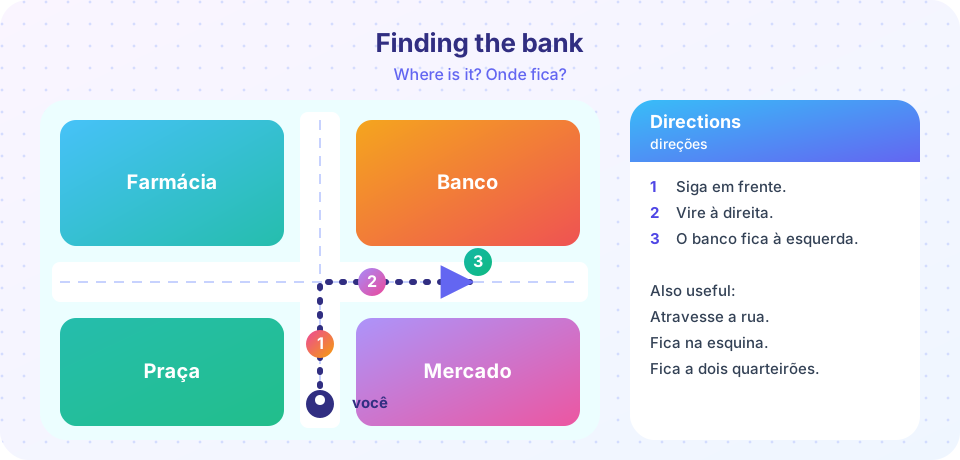
What you will learn
- Ask where something is with "Onde fica...?" and "Como chego a...?".
- Understand and give simple directions.
- Use prepositions of place and the contractions em+o = no, de+a = da, a+o = ao.
- Name common places and ways to travel.
Key terms
Ficar: in everyday Portuguese, to be located (for buildings and places) as well as to stay or to become.
Contração (contraction): two words joined into one, for example em + o = no.
Quarteirão or quadra: a city block. Brazil uses both.
Esquina: a street corner.
Where is it? Ficar, estar and ser
To ask where a building or place is, Brazilians use ficar: "Onde fica a farmácia?" (Where is the pharmacy?). The answer repeats the verb: "Fica na Rua das Flores" (It is on Flower Street). You can also use estar for temporary or movable things and people: "Onde está o Pedro?" "Ele está em casa." Use ser for events: "Onde é a festa?" (Where is the party?).
Related questions:
- Onde fica...? Where is...?
- Como chego a...? How do I get to...? (formal writing: "Como chego ao museu?", but Brazilians often say "Como chego no museu?")
- É longe / perto daqui? Is it far / near from here?
- Dá para ir a pé? Is it possible to go on foot?
- Quanto tempo leva? How long does it take?
- Você pode me mostrar no mapa? Can you show me on the map?
Prepositions of place
| Portuguese | English |
|---|---|
| perto de / longe de | near / far from |
| ao lado de | next to |
| em frente a (or em frente de) | opposite, in front of |
| atrás de | behind |
| na frente de | in front of (the front of) |
| entre | between |
| em cima de | on top of |
| embaixo de / debaixo de | under |
| dentro de / fora de | inside / outside |
| na esquina | on the corner |
| no final da rua | at the end of the street |
The contractions you cannot avoid
When certain prepositions meet the articles o, a, os, as, they merge. Portuguese writes them as one word and always speaks them that way. You must know them.
| Preposition | + o | + a | + os | + as |
|---|---|---|---|---|
| em (in, on) | no | na | nos | nas |
| de (of, from) | do | da | dos | das |
| a (to, at) | ao | à | aos | às |
| por (through, by) | pelo | pela | pelos | pelas |
Examples: "no banco" (in the bank), "na praça" (in the square), "do centro" (from the center), "da escola" (from the school), "ao mercado" (to the market), "à farmácia" (to the pharmacy), "pelo parque" (through the park).
The accent in à is called the crase and is not decoration: it marks "a + a". Compare "Vou ao banco" (a + o) with "Vou à praça" (a + a). Also note the useful à direita (on the right) and à esquerda (on the left): the accent comes from "a + a" because direita and esquerda are feminine ("a mão direita", the right hand).
Prepositions with the demonstratives also merge: neste, nesse, naquele (in this, in that, in that far one) and deste, desse, daquele (of this...). And in speech, para o is usually pronounced pro and para a as pra: "Vou pra casa" (I am going home).
Which preposition after "ir"?
Use a or para after ir for destinations: "Vou ao mercado" (I go to the market) and "Vou para casa" (I go home). In Brazilian speech para and its short form pra dominate. Use em when you are already there: "Estou no mercado". Use de for how you travel: "Vou de ônibus", "Vou de carro", "Vou a pé" (on foot). When you are inside the vehicle you can say no ônibus, no metrô, no trem.
Following directions
Directions are mostly commands in the você form. You will learn commands properly in the chapter on the subjunctive; for now treat them as ready-made chunks.
| Portuguese | English |
|---|---|
| Siga em frente. / Siga reto. | Go straight ahead. |
| Vire à direita. | Turn right. |
| Vire à esquerda. | Turn left. |
| Pegue a primeira rua à esquerda. | Take the first street on the left. |
| Atravesse a rua / a praça. | Cross the street / the square. |
| Continue até o final da rua. | Continue to the end of the street. |
| Passe pelo banco. | Go past the bank. |
| Fica a dois quarteirões daqui. | It is two blocks from here. |
| Fica na esquina, ao lado da farmácia. | It is on the corner, next to the pharmacy. |
| É logo ali. | It is just over there. |
| Você não tem como errar. | You cannot miss it. |
In Portugal you will hear Siga sempre em frente and Vire à direita as well, and distances in metres ("a cem metros") more than blocks, because European cities have fewer regular blocks.
Transport
| Portuguese (Brazil) | English | Portugal |
|---|---|---|
| o ônibus | the bus | o autocarro |
| o metrô | the subway | o metro |
| o trem | the train | o comboio |
| o táxi | the taxi | o táxi |
| o carro por aplicativo | the ride-hailing car | o TVDE |
| o avião / o aeroporto | the plane / the airport | same |
| o ponto de ônibus | the bus stop | a paragem |
| a rodoviária | the long-distance bus station | a central de camionagem |
| a passagem | the ticket (fare) | o bilhete |
Useful ticket phrases: "Uma passagem para o Rio, por favor." "De ida e volta, por favor" (round trip) and "Só de ida" (one way). "Qual é a plataforma?" (Which platform?). "A que horas sai o próximo ônibus?" (When does the next bus leave?). "Preciso fazer baldeação?" (Do I need to change?).
Places you will often ask for: o banco, o correio (post office), a farmácia, o hospital, a delegacia (police station, Brazil), o banheiro (restroom; PT: a casa de banho), a estação, o supermercado, a escola, a igreja, o museu, a praia (beach).
A dialogue
| Portuguese | English |
|---|---|
| Com licença, onde fica o metrô? | Excuse me, where is the subway? |
| A estação fica em frente à praça. Siga em frente por dois quarteirões e vire à esquerda. | The station is opposite the square. Go straight for two blocks and turn left. |
| É longe? | Is it far? |
| Não, são uns dez minutos a pé. | No, it is about ten minutes on foot. |
| Muito obrigado! | Thank you very much! |
| De nada. Boa viagem! | You are welcome. Have a good trip! |
Common misconceptions
"No" is just the word for "no". After a preposition it is a contraction: "no banco" is "in the bank". Context makes it clear.
"Vou à o mercado" is how you write it. Never: a + o must merge to "ao": "Vou ao mercado".
"Ficar" only means "to stay". It also means "to be located" and "to become" ("ficar feliz").
"Estou em casa" and "Vou em casa" are the same. For a destination use "para/pra" or "a": "Vou para casa".
Try it
First, a small game. Give commands in Portuguese to walk the person to the star. Write one command per line: siga em frente, siga 3 quarteirões, vire à direita, vire à esquerda. Accents are optional.
Next, a Python helper that forms the contractions for you. Try new places and relations.
Press Run (or Ctrl + Enter) to see the result here.
Program input · what you'd type while the program runs
Type the answers before you press Run, one per line. Each time the program reads a line (with input()), it gets the next line from this box.
Finally, flashcards for directions to say aloud.
Check your understanding
Quick check · 6 questions
of 6 answered You scored / 6 · perfect!
-
1. What do em + a form?
em + a = na (in the, feminine). em + o = no, de + a = da. -
2. Which sentence is correct?
'Praça' is feminine, so a + a = à (with the crase accent). -
3. Which pair means 'Turn right' and 'Turn left'?
'Vire' is the command for 'turn', and 'à direita/à esquerda' means 'to the right/left'. -
4. How do you say 'I go by bus'?
Means of transport use 'de': de ônibus, de carro, de trem. (On foot is 'a pé'.) -
5. What does 'Fica a dois quarteirões daqui' mean?
'Ficar' means to be located here, and 'quarteirão' is a block. -
6. What is the Portuguese (Portugal) word for 'bus'?
'Autocarro' is the bus; 'comboio' is the train and 'paragem' the stop.
Summary
- Ask "Onde fica...?" for places, "Onde é...?" for events, "Como chego a...?" for the route.
- Prepositions of place: perto de, ao lado de, em frente a, atrás de, entre, na esquina.
- Contractions are obligatory: no/na, do/da, ao/à, pelo/pela. "à" (crase) is a + a.
- Directions: siga em frente, vire à direita/esquerda, atravesse, fica a dois quarteirões.
- Travel with "ir de ônibus / de carro / a pé"; Portugal says autocarro, comboio, paragem.
Next: Chapter review
Track your progress
Create a free account to tick off lessons and pick up where you left off on any device.
of Portuguese for Beginners lessons completed