


















Lesson 19 of 48 · Present Tense Verbs
Regular Present Tense Verbs: -ar, -er and -ir
Conjugate regular Portuguese verbs in the present tense, with endings for -ar, -er and -ir, negatives, questions, gostar de, and the most useful everyday verbs.
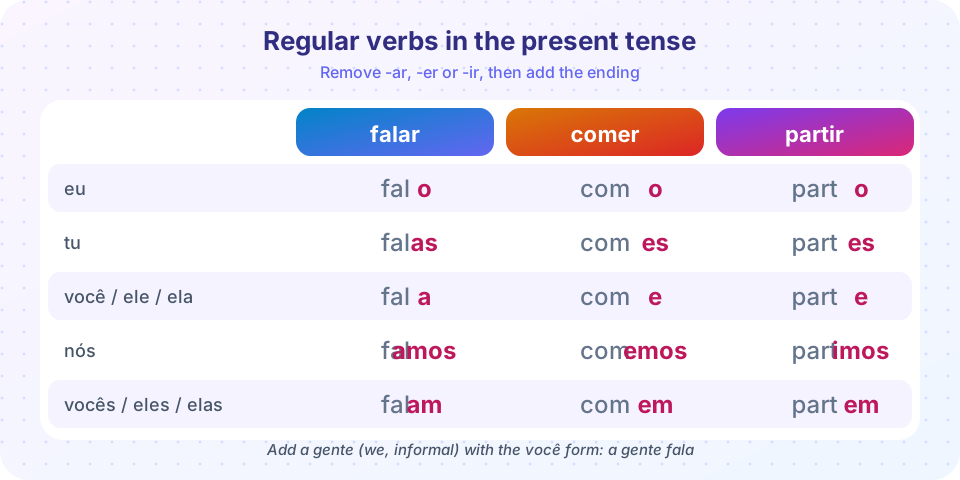
Once you know the endings for -ar, -er, and -ir verbs, you can conjugate hundreds of verbs you have never seen before. Regular verbs make up the large majority of the language, so this is one of the most valuable lessons in the course. The pattern is easy: remove the ending of the infinitive, keep the stem, and add the ending that matches who is acting.
In this lesson you will learn the three tables, the verbs worth learning first, the small spelling adjustments, how to make negatives and questions, and how to talk about habits and plans. You will also use gostar de ("to like"), one of the most useful verbs for expressing your opinions.
What you will learn
- The present tense endings for -ar, -er, and -ir verbs.
- Twenty common regular verbs.
- Spelling changes in a few eu forms.
- Negatives, questions, and question words.
- Gostar de and frequency adverbs.
Key terms
Regular verb: a verb that follows the standard endings of its family.
Stem: the infinitive minus -ar, -er, or -ir: fal-, com-, part-.
Person and number: who acts (I, you, he) and how many (one or more).
Frequency adverb: a word telling how often: sempre (always), nunca (never).
The three families
| Pronoun | falar (-ar) | comer (-er) | partir (-ir) |
|---|---|---|---|
| eu | falo | como | parto |
| tu | falas | comes | partes |
| você / ele / ela / a gente | fala | come | parte |
| nós | falamos | comemos | partimos |
| vocês / eles / elas | falam | comem | partem |
Look at what repeats:
- The eu form always ends in -o.
- The tu form ends in -s: -as (-ar), -es (-er and -ir).
- The você/ele/ela form is -a for -ar and -e for -er/-ir.
- The nós form is -amos, -emos, -imos.
- The vocês/eles/elas form is -am for -ar and -em for -er/-ir.
-er and -ir verbs share the same endings, except in the nós form (-emos versus -imos). A handy trick: the vowel flips between the families. In -ar verbs the third person singular ends in -a (ele fala), while in -er and -ir verbs it ends in -e (ele come, ele parte).
Stress
In the present tense, the stress falls on the stem for eu, você, vocês: FA-lo, FA-la, FA-lam. It falls on the ending in nós: fa-LA-mos. For tu, it is on the stem too: FA-las.
Pronunciation reminders
- falo "FAH-loo", falamos "fah-LAH-moos", falam "FAH-lowng".
- como "KOH-moo", comem "KOH-mayng".
- parto "PAR-too", partimos "par-CHEE-moos" (t before i becomes "ch" in most of Brazil).
Twenty useful verbs
| -ar | Meaning | -er | Meaning | -ir | Meaning |
|---|---|---|---|---|---|
| falar | to speak | comer | to eat | partir | to leave |
| morar | to live (in a place) | beber | to drink | abrir | to open |
| trabalhar | to work | vender | to sell | decidir | to decide |
| estudar | to study | aprender | to learn | assistir | to watch |
| gostar (de) | to like | escrever | to write | subir | to go up |
| comprar | to buy | correr | to run | dividir | to divide, share |
| cantar | to sing | entender | to understand | existir | to exist |
| viajar | to travel | responder | to answer |
Assistir means "to watch" (a film, a game): Assisto a filmes or, in Brazil, Assisto filmes. Remember that assistir is a false friend of "to assist".
Spelling adjustments in the eu form
A few verbs change spelling in the eu form only, to keep the sound:
- -cer verbs: conhecer → conheço (I know, I am familiar with), parecer → pareço. The ç keeps the s sound before o.
- -gir verbs: dirigir → dirijo (I drive), fingir → finjo. The j keeps the zh sound before o.
- -ear verbs add an i: passear → passeio, passeias, passeia, passeamos, passeiam (I walk, I stroll).
The other forms use the normal endings: conheces, conhece, conhecemos, conhecem.
What the present tense means
The Portuguese present covers three things English splits up:
- Habits and facts: Eu estudo todos os dias. (I study every day.) Ela trabalha num banco. (She works at a bank.)
- Right now (usually with the progressive in Brazil): Estou estudando agora. (I am studying now.)
- Near future: Amanhã eu viajo. (Tomorrow I travel.) Quando você chega? (When do you arrive?)
There is no separate "do" like in English: Eu falo means "I speak" and "I do speak". For "I am speaking right now," Brazilians usually say Estou falando.
Negatives
Place não before the verb: Eu não falo francês. (I do not speak French.) Eles não comem carne. (They do not eat meat.)
Portuguese accepts double negatives. When a negative word like nada, nunca, ninguém comes after the verb, you also need não before it:
| Portuguese | English |
|---|---|
| Não como nada. | I do not eat anything. |
| Não vou nunca. | I never go. |
| Não vejo ninguém. | I do not see anyone. |
| Nunca bebo café. | I never drink coffee. (no não when the negative comes first) |
Questions
Make a yes-or-no question by raising your voice at the end, with the same word order as a statement: Você mora aqui? (Do you live here?) You can answer with the verb alone: Moro. (I do.) or Não moro. (I do not.)
Question words come first:
| Word | Meaning | Example |
|---|---|---|
| o que | what | O que você come? What do you eat? |
| quem | who | Quem fala inglês? Who speaks English? |
| onde | where | Onde você mora? Where do you live? |
| quando | when | Quando você viaja? When do you travel? |
| como | how | Como você estuda? How do you study? |
| por que | why | Por que você estuda português? Why do you study Portuguese? |
| qual / quais | which | Qual é o seu nome? What is your name? |
Answer Por que...? with Porque... (one word, "because"): Porque gosto do Brasil.
Gostar de and other verbs with prepositions
Gostar always takes de: Gosto de café. (I like coffee.) Ela gosta de música. (She likes music.) Gosto de ler. (I like to read.) When de meets an article, it contracts: Gosto do Pedro (I like Pedro), Eles gostam da cidade (They like the city). Similar verbs: precisar de (to need), depender de (to depend on), pensar em (to think about).
How often?
| Word | Meaning |
|---|---|
| sempre | always |
| geralmente | usually |
| às vezes | sometimes |
| raramente | rarely |
| nunca | never |
| todos os dias | every day |
Sempre como em casa. (I always eat at home.) Às vezes ela trabalha aos sábados. (Sometimes she works on Saturdays.)
A dialogue
| Portuguese | English |
|---|---|
| A: Onde você trabalha? | Where do you work? |
| B: Trabalho em um banco. E você? | I work at a bank. And you? |
| A: Eu estudo português e moro com meus amigos. | I study Portuguese and live with my friends. |
| B: Você gosta do Brasil? | Do you like Brazil? |
| A: Gosto muito! Aprendo todos os dias. | I like it a lot! I learn every day. |
Putting verbs together in sentences
Now combine the verbs with time words and objects to describe a day. Here is a short paragraph using only regular verbs: Eu acordo às sete, tomo café, trabalho das nove às cinco, janto com a família e leio antes de dormir. ("I wake up at seven, have coffee, work from nine to five, have dinner with my family, and read before sleeping.") Note that ler and dormir appear in the infinitive after antes de, and that tomar café ("to have coffee") is the usual expression for breakfast or a coffee.
New verbs are easy to add. Most borrowed or new verbs are regular verbs in -ar, such as visitar, usar, preparar, organizar, comunicar, so once you know the -ar table you can use them at once: Eu uso o computador. Ela visita a avó. Look for English verbs ending in -ate or -ize, because they often become Portuguese -ar verbs: organize → organizar.
A final tip is to practice one family at a time. Spend a day building sentences with -ar verbs, another day with -er, another with -ir, and then mix them. Because the endings repeat, the conjugation becomes a reflex surprisingly quickly.
Common misconceptions
"Você takes the tu ending." Você uses the ele/ela form: você fala, not você falas.
"Portuguese needs the pronoun." It does not: Falo português is natural.
"There is an auxiliary 'do'." No: Você fala inglês? is "Do you speak English?"
"Não goes after the verb." It comes before: não falo.
"Gostar is followed by no preposition." It needs de.
Try it
The first tool is a typing drill. Type the correct present form.
The second tool is a conjugator for regular verbs. It applies the endings and the spelling adjustments from this lesson, and it will be wrong for irregular verbs, which you meet in the next lesson.
Press Run (or Ctrl + Enter) to see the result here.
Program input · what you'd type while the program runs
Type the answers before you press Run, one per line. Each time the program reads a line (with input()), it gets the next line from this box.
Check your understanding
Quick check · 6 questions
of 6 answered You scored / 6 · perfect!
-
1. What is the 'eu' form of 'comer'?
The eu form of regular verbs ends in -o: como. -
2. Which form goes with 'nós' for 'partir'?
The nós ending for -ir verbs is -imos: partimos. -
3. How do you say 'I do not speak French'?
Put não before the verb: Eu não falo francês. -
4. How do you say 'I like coffee'?
Gostar needs de: Gosto de café. -
5. What is the 'eu' form of 'conhecer'?
The ç keeps the s sound before o: conheço. -
6. What is the answer to 'Por que você estuda português?'
Use porque, one word, for 'because'.
Summary
- Regular endings: -ar → o, as, a, amos, am; -er → o, es, e, emos, em; -ir → o, es, e, imos, em.
- Você takes the ele/ela form; the pronoun is optional.
- Spelling adjustments appear in the eu form: conheço, dirijo, and -ear verbs add i.
- Negatives use não before the verb; questions use intonation or a question word.
- Gostar de needs de; adverbs such as sempre and nunca tell how often.
Next: Irregular present verbs
Track your progress
Create a free account to tick off lessons and pick up where you left off on any device.
of Portuguese for Beginners lessons completed