


















Lesson 6 of 48 · Sounds, Greetings and Basics
Chapter 2 Overview: Sounds, Greetings and Basics
Preview chapter 2 of Portuguese for Beginners: pronunciation, accents, greetings, introductions, numbers and time, with a roadmap of every lesson.
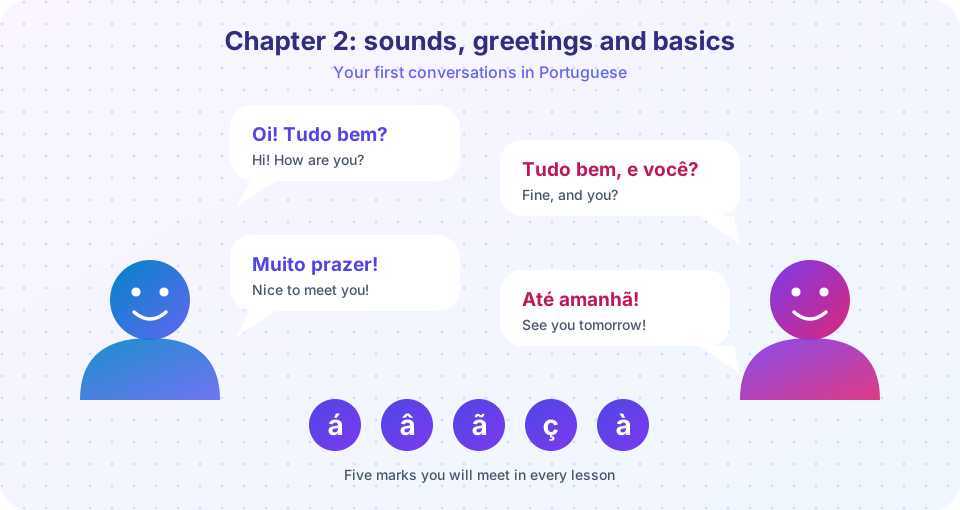
Now the language starts to speak. Chapter 2 gives you the sounds of Portuguese, the accent marks that guide them, and the phrases that open every conversation: hello, thank you, my name is, see you tomorrow. By the end you will be able to read a Portuguese word aloud with confidence, greet someone politely, count to one hundred, and tell the time.
Portuguese spelling is more regular than English spelling. Once you know the handful of rules in this chapter, you can pronounce almost any new word correctly just by looking at it. That is a big advantage, and it means that time spent on sounds now repays you in every later chapter.
What you will learn
- How Portuguese vowels, consonants, and nasal sounds work.
- How stress and accent marks tell you where to put the emphasis.
- How to greet people, introduce yourself, and be polite.
- Numbers from 0 to 100, days, months, and the time.
Key terms
Vowel: a sound made with open air flow: a, e, i, o, u. Consonant: a sound made by blocking or narrowing the air.
Syllable: a unit of sound with one vowel sound, as in ca-sa (two syllables).
Stress: the syllable said louder, longer, or higher: ca-FÉ.
Diacritic: a mark added to a letter, such as á, ê, ã, ç.
The big picture
Portuguese has a reputation for sounding "difficult", but most of the difficulty comes from three features that English lacks. Learn them one at a time and they become familiar.
- Nasal vowels. Words like pão (bread) and bom (good) send air through the nose as well as the mouth. English has only a hint of this, as in "sing".
- Reduced unstressed vowels. A final unstressed -e sounds like "ee" and a final -o sounds like "oo" in Brazil, so leite ("milk") is close to "LAY-chee" and livro is close to "LEE-vroo".
- A few special letters. ç, lh, nh, rr, and ão have fixed sounds that you learn once.
Everything else is straightforward. Letters have stable sounds, and the spelling tells you where the stress falls once you know four simple rules.
Say it right
Use it
Check it
The lessons in this chapter
| Lesson | What it covers |
|---|---|
| Vowels and nasal sounds | Seven oral vowels, how é and ê differ, and nasal vowels with the tilde or m/n. |
| Consonants, stress and accents | Letters like ç, ch, lh, nh, rr; the four stress rules; all the accent marks. |
| Greetings and introductions | Hello, good morning, how are you, my name is, politeness, goodbyes. |
| Numbers, days and time | Counting to 100, days, months, and telling time. |
| Chapter 2 review | A one-picture summary and a ten-question quiz. |
How to read the pronunciation notes
Two systems show up beside Portuguese words. The IPA (International Phonetic Alphabet) is the precise one, written between slashes: pão is /ˈpɐ̃w̃/. A respelling is a friendly guess in English letters: "powng". The stressed syllable is in capitals: "kah-FEH". The respellings are approximations of the Brazilian pronunciation; no English spelling can match every Portuguese sound, so they are only a bridge, and live listening is the best teacher. Where Portugal differs, a note says so.
Listening matters in this chapter. Whenever you can, find a short video or a Portuguese-speaking friend, listen to the same word several times, and then say it aloud. Some practice tools here include a "Listen" button that asks your browser to speak the text; it is optional, and it may not have a Portuguese voice on every device.
Common misconceptions
"Portuguese is pronounced like Spanish." It is not. Portuguese has nasal vowels, different consonant sounds (lh, nh, ch, j), and softer endings. Spanish speakers need to learn the sounds too.
"Accents are decorative." Accent marks change pronunciation and sometimes meaning. For example, avó is "grandmother" and avô is "grandfather", and pode (can, present) is not the same as pôde (could, past).
"I need a perfect accent." Communication matters far more than perfection. A clear accent with a few foreign touches is completely understandable.
Try it
The first tool is a set of cards for the accent marks, which appear on almost every page of this course.
The second tool is a tiny program that finds every accented letter in a sentence and names its mark. It uses Unicode to split a letter such as ã into a and a tilde.
Press Run (or Ctrl + Enter) to see the result here.
Program input · what you'd type while the program runs
Type the answers before you press Run, one per line. Each time the program reads a line (with input()), it gets the next line from this box.
Check your understanding
Quick check · 3 questions
of 3 answered You scored / 3 · perfect!
-
1. What is a nasal vowel?
Nasal vowels, as in pão and bom, send air through both mouth and nose. -
2. What does the difference between 'avó' and 'avô' show?
Avó is grandmother and avô is grandfather. The marks show different vowel sounds. -
3. Which tool describes the sound of a word exactly, between slashes?
IPA, the International Phonetic Alphabet, is the precise system; respellings are friendly approximations.
Summary
- Chapter 2 teaches sounds, accents, greetings, numbers, and time.
- Portuguese spelling is regular; a few rules unlock the pronunciation of almost any word.
- Three things are new for English speakers: nasal vowels, reduced final vowels, and special letters.
- Respelling is a bridge; IPA is exact; listening to real speech is best.
Next: Vowels and nasal sounds
Track your progress
Create a free account to tick off lessons and pick up where you left off on any device.
of Portuguese for Beginners lessons completed