


















Lesson 46 of 48 · Projects and Practice
Glossary: Grammar Terms and Key Vocabulary
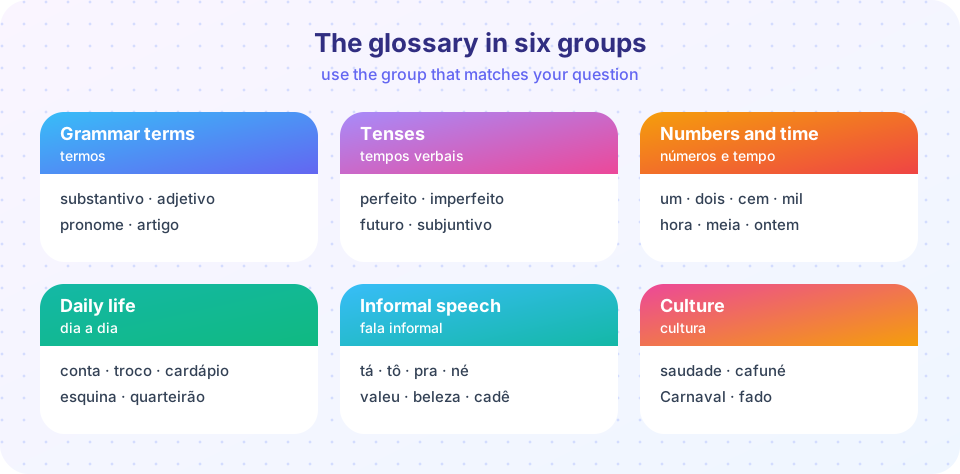
A glossary of the grammar terms and key vocabulary from chapters 5 to 9: numbers, questions, food, directions, tenses, pronouns, informal speech and culture.
This glossary collects the terms and words from chapters 5 to 9 in one place. It has two jobs. First, it is a reference: when you meet a grammar word such as pretérito imperfeito or oblíquo, you can look it up. Second, it is a review list: read down a table, cover one column, and test yourself.
Nouns are listed with their article so you also learn the gender: o for masculine and a for feminine. Where Brazil and Portugal differ, both forms are given as "BR / PT".
What you will learn
- The Portuguese names of the grammar terms used in this course.
- The key vocabulary from chapters 5 to 9, by theme.
- How to use a glossary as a self-test.
Key terms
Glossário: a list of terms with explanations.
Gênero (BR) / género (PT): gender: masculine or feminine.
Número: singular or plural.
Registro (BR) / registo (PT): the level of formality.
Grammar terms
| Portuguese | English | In one line |
|---|---|---|
| o substantivo | noun | names a person, place or thing |
| o adjetivo | adjective | describes a noun |
| o verbo | verb | an action or state |
| o pronome | pronoun | replaces a noun (eu, te, o) |
| o artigo | article | o, a, um, uma |
| a preposição | preposition | em, de, para, com |
| a contração | contraction | em + o = no |
| o tempo verbal | tense | when something happens |
| o modo | mood | the speaker's attitude |
| o indicativo | indicative | the mood of facts |
| o subjuntivo | subjunctive | the mood of wishes and doubts |
| o imperativo | imperative | commands |
| o infinitivo | infinitive | falar, comer, partir |
| o gerúndio | gerund | falando, comendo |
| o particípio | participle | falado, comido |
| o radical | stem | the verb without -ar/-er/-ir |
| a terminação | ending | the part that shows person and tense |
| a concordância | agreement | matching gender and number |
| o objeto direto | direct object | whom or what the verb acts on |
| o objeto indireto | indirect object | to or for whom |
| a próclise / a ênclise | pronoun before / after the verb | Eu te vejo / Vejo-te |
Verb tenses and forms
| Portuguese | English | Example |
|---|---|---|
| o presente | present | falo |
| o pretérito perfeito | simple past (events) | falei |
| o pretérito imperfeito | imperfect (habits, scenes) | falava |
| o mais-que-perfeito composto | past perfect (tinha + participle) | tinha falado |
| o futuro do presente | simple future | falarei |
| o futuro perifrástico | ir + infinitive | vou falar |
| o futuro do pretérito | conditional | falaria |
| o presente do subjuntivo | present subjunctive | fale |
| o futuro do subjuntivo | future subjunctive | quando eu falar |
| o verbo irregular | irregular verb | fazer: fiz |
| o verbo reflexivo | reflexive verb | chamar-se: me chamo |
Numbers, time and questions
| Portuguese | English | Note |
|---|---|---|
| zero, um/uma, dois/duas | 0, 1, 2 | um and dois have gender |
| dez, vinte, cem, mil | 10, 20, 100, 1,000 | cem alone, cento + more |
| a hora | hour; o'clock | São duas horas |
| o minuto / o quarto | minute / quarter | e um quarto |
| meio-dia / meia-noite | noon / midnight | É meio-dia. |
| e meia | half past | São três e meia. |
| a segunda-feira ... o domingo | Monday ... Sunday | lowercase |
| janeiro ... dezembro | January ... December | lowercase |
| hoje / amanhã / ontem | today / tomorrow / yesterday | |
| quem | who | |
| o que | what | o quê at the end |
| qual / quais | which | |
| quando | when | |
| onde | where | de onde = from where |
| como | how | |
| quanto/a/os/as | how much / many | agrees |
| por que / porque / por quê / porquê | why / because / why (end) / the reason |
Food, shopping and money
| Portuguese | English | Note |
|---|---|---|
| o café da manhã / o pequeno-almoço | breakfast | BR / PT |
| o almoço, o jantar, o lanche | lunch, dinner, snack | |
| o pão, o queijo, o arroz, o feijão | bread, cheese, rice, beans | |
| a carne, o frango, o peixe | meat, chicken, fish | |
| o suco / o sumo | juice | BR / PT |
| a água com gás / sem gás | sparkling / still water | |
| o cardápio / a ementa | menu | BR / PT |
| a conta | the bill | |
| a gorjeta | the tip | |
| o troco | change (money) | |
| o dinheiro, o cartão, o Pix | cash, card, instant payment | Pix is Brazilian |
| o real (os reais), o centavo | the Brazilian currency | R$ |
| caro / barato | expensive / cheap | |
| o quilo, o litro, a fatia, a porção | kilo, liter, slice, portion | |
| queria, vou querer, gostaria de | I would like (polite) |
Places, directions and transport
| Portuguese | English | Note |
|---|---|---|
| onde fica...? | where is...? | ficar = to be located |
| perto de / longe de | near / far from | |
| ao lado de, em frente a, atrás de, entre | next to, opposite, behind, between | |
| a esquina, o quarteirão | corner, block | |
| siga em frente | go straight | |
| vire à direita / à esquerda | turn right / left | |
| atravesse | cross | |
| o ônibus / o autocarro | bus | BR / PT |
| o trem / o comboio | train | BR / PT |
| o metrô / o metro | subway | |
| a rodoviária | long-distance bus station | |
| a passagem / o bilhete | ticket (fare) | BR / PT |
| de ida e volta / só de ida | round trip / one way | |
| a pé | on foot |
Past, future and time words
| Portuguese | English |
|---|---|
| ontem, anteontem | yesterday, the day before yesterday |
| na semana passada, no ano passado | last week, last year |
| de repente | suddenly |
| uma vez, duas vezes | once, twice |
| há dois dias | two days ago |
| sempre, todo dia, às vezes | always, every day, sometimes |
| antigamente, naquela época | in the old days, at that time |
| quando eu era criança | when I was a child |
| amanhã, depois de amanhã | tomorrow, the day after tomorrow |
| semana que vem, ano que vem | next week, next year |
| em breve, daqui a pouco | soon, in a little while |
| daqui a dois dias | in two days |
Pronouns
| Portuguese | English |
|---|---|
| me, te, o, a, nos, os, as | direct object pronouns |
| me, te, lhe, nos, lhes | indirect object pronouns |
| comigo, contigo, conosco (BR) / connosco (PT) | with me, with you, with us |
| para mim / para ti | for me / for you |
| se | reflexive he/she/they |
Informal speech
| Portuguese | English | Note |
|---|---|---|
| tá, tô, tão, tamo | está, estou, estão, estamos | spoken forms |
| pra, pro | para, para o | |
| cê, vc | você | spoken, written |
| né? | não é? | tag question |
| a gente | we | third-person singular verb |
| bora | let's go | from vamos embora |
| e aí? / beleza? | hey / how are you? | |
| valeu | thanks | |
| legal | cool | |
| cadê? | where is...? | |
| sei lá | I do not know | |
| de boa | fine, relaxed | |
| kkkk | laughter | in messages |
Culture words
| Portuguese | English |
|---|---|
| a saudade | longing for what is absent |
| o cafuné | gently running fingers through someone's hair |
| o jeitinho brasileiro | a flexible, creative way of solving problems |
| o churrasco | Brazilian barbecue |
| a feijoada | black bean and pork stew |
| o Carnaval | Carnival, before Lent |
| a festa junina | June festival |
| o Réveillon | New Year's Eve |
| o fado | Portuguese song genre |
| a Dona / o Seu | respectful titles with first names (Dona Maria, Seu João) |
| o sotaque | accent |
| a gíria | slang |
Common misconceptions
"A glossary replaces practice." It helps you check, but you must use the words in sentences.
"The English meaning is the whole meaning." Many words have wider or different uses. "Legal" means cool and lawful, and "fica" means stays, is located and becomes.
"BR / PT pairs are wrong in the other country." Both are understood; use the local one when you can.
"Every word needs an article." Nouns are learned with an article; in sentences it depends.
Try it
First, a flashcard deck of the grammar terms in Portuguese and English. Say the Portuguese term, then the meaning.
The second TryIt is a Python glossary builder. It stores entries in a dictionary, sorts them alphabetically ignoring accents (so "é" sorts with "e"), groups them by initial letter, and lets you search. Add your own entries.
Press Run (or Ctrl + Enter) to see the result here.
Program input · what you'd type while the program runs
Type the answers before you press Run, one per line. Each time the program reads a line (with input()), it gets the next line from this box.
Check your understanding
Quick check · 4 questions
of 4 answered You scored / 4 · perfect!
-
1. What is the Portuguese term for 'subjunctive'?
Subjunctive = subjuntivo, the mood of wishes and doubts. -
2. What is 'a ênclise'?
Ênclise = pronoun after the verb (with a hyphen); próclise = before. -
3. Which pair is correct?
'Troco' is change; the tip is 'gorjeta' and the bill is 'conta'. -
4. What does 'cadê' mean?
'Cadê' is the casual 'where is...?'
Summary
- The glossary lists grammar terms, tenses, numbers and questions, food, directions, time words, pronouns, informal speech and culture words.
- Nouns carry their article (o/a); BR / PT pairs show variety differences.
- Use the tables as self-tests: cover a column and say the missing part.
Next: Cheat sheet
Track your progress
Create a free account to tick off lessons and pick up where you left off on any device.
of Portuguese for Beginners lessons completed