


















Lesson 47 of 48 · Projects and Practice
Cheat Sheet: Portuguese Chapters 5 to 9 on One Page
A one-page Portuguese cheat sheet: numbers, questions, ordering, directions, past, future, pronouns, subjunctive, informal speech, plus a conjugator.
This is the page to print, bookmark or copy into your notes. It compresses chapters 5 to 8 into one big picture, a set of compact tables and a conjugator that writes out any regular verb in six tenses. Use it for quick lookups and for warm-ups before you speak. It does not replace the lessons: when something here looks unclear, follow the link to the full explanation.
The cheat sheet follows the order of the chapters. Each block has the rule, the key forms and one example.
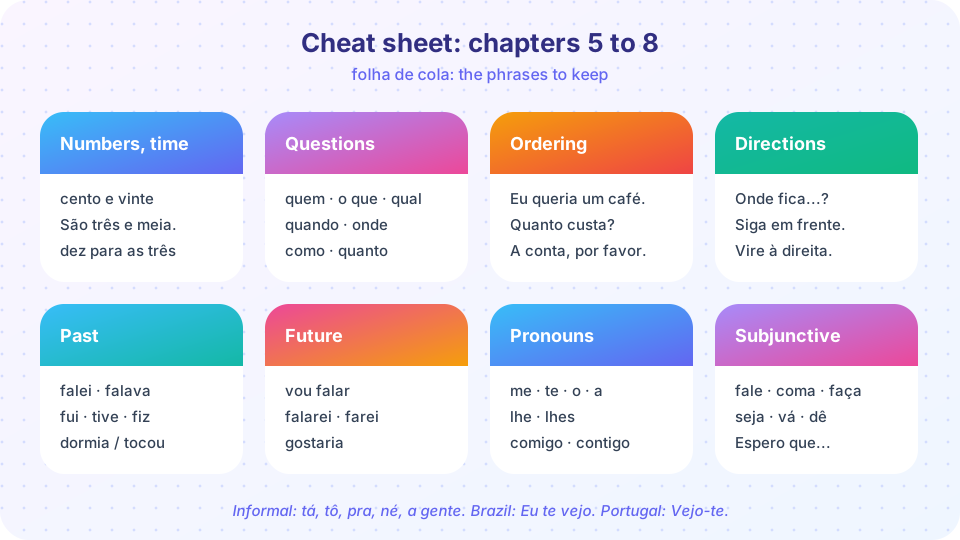
What you will learn
- Where to look for each rule.
- How to check regular forms in all tenses with a conjugator.
- Which ten items to review before a conversation.
Key terms
Cola (cheat sheet): a short summary for quick consultation.
Conjugação (conjugation): the forms of a verb for each person and tense.
Regra de ouro (golden rule): the one rule that explains most cases.
Numbers, time and dates
| Rule | Example |
|---|---|
| Tens and units join with e | trinta e cinco |
| cem alone, cento + more | cem reais; cento e vinte |
| mil never changes; e only if the rest is under 100 or a round hundred | mil e cem; mil duzentos e cinquenta |
| Prices: comma for decimals, period for thousands | R$ 1.250,50 |
| Time: Que horas são? | São três e meia. É meio-dia. Quinze para as quatro. |
| Dates: day, month, year, lowercase | 14 de novembro de 2026 |
Questions and answers
| Rule | Example |
|---|---|
| Same order, rising voice | Você fala inglês? |
| Words: quem, o que, qual, quando, onde, como, quanto, por que | Onde você mora? |
| Preposition first | De onde? Com quem? Há quanto tempo? |
| Answer by repeating the verb | Você tem irmãos? Tenho. |
| Double negative | Não vejo ninguém. |
Ordering, shopping, directions
| Rule | Example |
|---|---|
| Polite requests: queria, vou querer, gostaria de | Eu queria um café, por favor. |
| Prices and payment | Quanto custa? Aceita cartão? Posso pagar com Pix? |
| Contractions: em+o=no, de+a=da, a+o=ao, a+a=à | Vou ao banco. Vou à praça. |
| Directions: siga, vire, atravesse; fica a... | Vire à direita. Fica a dois quarteirões. |
Past tenses
| Tense | Endings | Use |
|---|---|---|
| Perfeito -ar | -ei, -aste, -ou, -amos, -aram | events |
| Perfeito -er / -ir | -i, -este/-iste, -eu/-iu, -emos/-imos, -eram/-iram | events |
| Imperfeito -ar | -ava, -avas, -ava, -ávamos, -avam | background |
| Imperfeito -er / -ir | -ia, -ias, -ia, -íamos, -iam | background |
Irregular perfeito: ser/ir fui, ter tive, estar estive, fazer fiz, dizer disse, poder pude, querer quis, saber soube, vir vim, ver vi, dar dei, trazer trouxe. Irregular imperfeito: ser era, ter tinha, vir vinha, pôr punha. Spelling: -car toquei, -gar paguei, -çar comecei.
Choose: event with an end = perfeito; scene, habit, ongoing = imperfeito; dormia quando tocou. Meaning shifts: sabia/soube, conhecia/conheci, queria/quis.
Future and conditional
| Form | Rule | Example |
|---|---|---|
| Everyday | vou/vai/vamos/vão + infinitive | Vou viajar amanhã. |
| Simple future | infinitive + -ei, -ás, -á, -emos, -ão | falarei; farei, direi, trarei |
| Conditional | stem + -ia, -ias, -ia, -íamos, -iam | gostaria, poderia, seria |
| Time words | amanhã, semana que vem, em breve, daqui a pouco | Daqui a dois dias |
Pronouns
| Rule | Example |
|---|---|
| Direct: me, te, o, a, nos, os, as | Eu te vejo. |
| Indirect: me, te, lhe, nos, lhes | Ela me deu um livro. |
| Brazil: before the verb; Portugal: after with a hyphen | Vou te ligar. / Vejo-te. |
| With prepositions | comigo, contigo, conosco; para eu fazer |
| Infinitive + o/a | comê-la, falá-lo |
Subjunctive
| Rule | Example |
|---|---|
| Recipe: eu form, drop -o, flip the vowel (-ar → -e; -er/-ir → -a) | falo → fale; como → coma; faço → faça |
| Irregular | seja, esteja, vá, dê, saiba, queira |
| Triggers: wishes, emotions, doubt, impersonal, conjunctions | Quero que você venha. Talvez ele venha. |
| Same subject: infinitive | Quero viajar. |
| Future subjunctive: eles-perfeito stem + -r | quando eu chegar; se eu tiver |
Informal speech and the two varieties
| Rule | Example |
|---|---|
| Spoken: tá, tô, pra, cê, né, bora | Tô com fome. |
| a gente + 3rd person singular | A gente vai. |
| Chat: vc, tb, pq, blz, vlw, kkkk | vc vem? |
| Brazil / Portugal | estou falando / estou a falar; ônibus / autocarro; fato / facto |
Etiquette in one breath
Be polite (por favor, com licença, obrigado/a); use first names with titles like Dona and Seu; check whether the service charge is on the bill; arrive on time for business, a little late for parties; do not use the "OK" sign in Brazil; accept the cafezinho.
Ten mistakes to avoid
| Mistake | Correct | Rule |
|---|---|---|
| Eu sou 28 anos | Eu tenho 28 anos | age uses ter |
| cem e vinte | cento e vinte | cem only alone |
| em o banco | no banco | contractions are obligatory |
| Vou à o mercado | Vou ao mercado | a + o = ao |
| Eu chegei | Eu cheguei | -gar becomes -guei |
| Eu estava dez anos | Eu tinha dez anos | age is a description with ter |
| Para mim fazer | Para eu fazer | subject of an infinitive |
| Espero que ele vem | Espero que ele venha | subjunctive after triggers |
| Eu vi-te (Brazil) | Eu te vi | Brazil: pronoun before the verb |
| Quando eu chego, ligo | Quando eu chegar, ligo | future subjunctive after quando |
Try it
The Python TryIt is a complete regular conjugator. It prints the present, perfeito, imperfeito, future, conditional and present subjunctive of any regular -ar, -er or -ir verb, including the spelling changes for -car, -gar and -çar. Try your own verbs.
Press Run (or Ctrl + Enter) to see the result here.
Program input · what you'd type while the program runs
Type the answers before you press Run, one per line. Each time the program reads a line (with input()), it gets the next line from this box.
Next, flashcards for the ten items to review before any conversation.
Check your understanding
Quick check · 4 questions
of 4 answered You scored / 4 · perfect!
-
1. Which form completes 'Quando eu ___, eu te ligo'?
After 'quando' for a future event, Portuguese uses the future subjunctive: chegar. -
2. How is the imperfeito of 'comer' (nós) written?
-er verbs take -íamos in the imperfeito nós form. -
3. What is the recipe for the present subjunctive?
falo → fal- → fale; como → com- → coma. -
4. Which phrase is a polite request?
'Gostaria de' (and 'queria') are polite.
Summary
- The cheat sheet follows the chapter order: numbers and time, questions, ordering and directions, past, future, pronouns, subjunctive, informal speech and etiquette.
- Golden rules: cem/cento; ask by voice; queria for politeness; event versus background; ir + infinitive; pronoun before the verb in Brazil; flip the vowel for the subjunctive.
- Use the conjugator to check any regular verb in six tenses.
Next: Further study
Track your progress
Create a free account to tick off lessons and pick up where you left off on any device.
of Portuguese for Beginners lessons completed