


















Lesson 10 of 48 · Sounds, Greetings and Basics
Numbers, Days, Months and Telling Time
Count from 0 to 100 in Portuguese, name the days and months, say dates, and tell the time with Que horas são? Includes pronunciation and Brazil/Portugal notes.
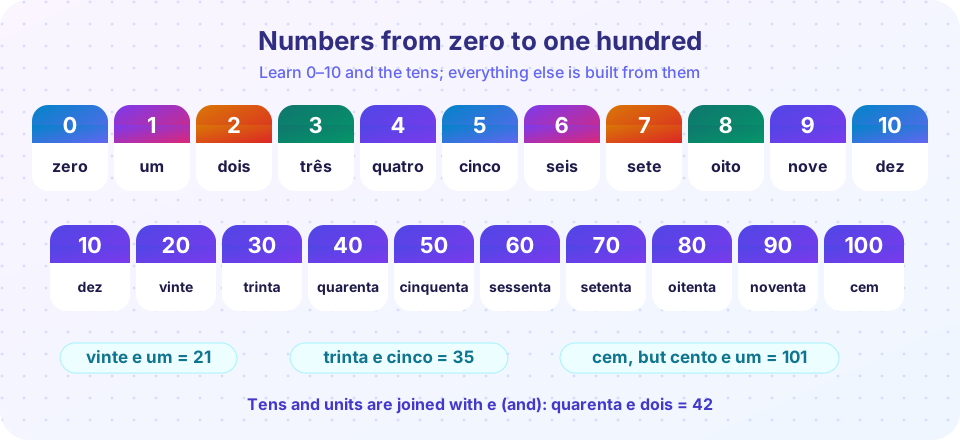
Numbers are the most practical vocabulary there is. You need them for prices, phone numbers, addresses, dates, ages, and the time. Fortunately, Portuguese numbers follow neat patterns: learn zero to twenty, then the tens, and you can build everything up to a hundred by joining pieces with the word e ("and").
This lesson also teaches the days of the week, the months, how to say a date, and how to ask and tell the time. Almost all of it can be used in your first conversation at a bus stop or a bakery. Say every number aloud; the best way to know a number is to say it before you read it.
What you will learn
- Numbers 0 to 100, and how to build numbers such as 21 and 68.
- Which numbers change for feminine nouns (um/uma, dois/duas).
- The days of the week and the months.
- How to say today's date and a year.
- How to ask and tell the time.
Key terms
Cardinal number: a counting number: one, two, three.
Feminine / masculine: Portuguese nouns have gender, and um/uma and dois/duas agree with it.
Lowercase days and months: unlike English, Portuguese writes days and months without a capital letter: segunda-feira, março.
24-hour clock: a system from 00:00 to 23:59, common in schedules.
Zero to twenty
| Number | Portuguese | Respelling |
|---|---|---|
| 0 | zero | "ZEH-roo" |
| 1 | um / uma | "oong / OO-mah" |
| 2 | dois / duas | "doys / DOO-ahs" |
| 3 | três | "trehs" |
| 4 | quatro | "KWAH-troo" |
| 5 | cinco | "SEENG-koo" |
| 6 | seis | "says" |
| 7 | sete | "SEH-chee" |
| 8 | oito | "OY-too" |
| 9 | nove | "NOH-vee" |
| 10 | dez | "dehs" |
| 11 | onze | "OHN-zee" |
| 12 | doze | "DOH-zee" |
| 13 | treze | "TREH-zee" |
| 14 | catorze (also quatorze) | "kah-TOHR-zee" |
| 15 | quinze | "KEEN-zee" |
| 16 | dezesseis (Portugal: dezasseis) | "deh-zeh-SAYS" |
| 17 | dezessete (Portugal: dezassete) | "deh-zeh-SEH-chee" |
| 18 | dezoito | "deh-ZOY-too" |
| 19 | dezenove (Portugal: dezanove) | "deh-zeh-NOH-vee" |
| 20 | vinte | "VEEN-chee" |
Notice that um and dois have feminine forms: um livro (one book, masculine) and uma casa (one house, feminine); dois livros and duas casas. The other numbers do not change. Many people say meia ("half") instead of seis when reading out phone numbers, because seis is easy to mishear.
The tens, and everything between
| Number | Portuguese | Respelling |
|---|---|---|
| 20 | vinte | "VEEN-chee" |
| 30 | trinta | "TREEN-tah" |
| 40 | quarenta | "kwah-REHN-tah" |
| 50 | cinquenta | "seeng-KWEHN-tah" |
| 60 | sessenta | "seh-SEHN-tah" |
| 70 | setenta | "seh-TEHN-tah" |
| 80 | oitenta | "oy-TEHN-tah" |
| 90 | noventa | "noh-VEHN-tah" |
| 100 | cem | "sayng" |
To make the numbers in between, join the tens and the unit with e: vinte e um (21), trinta e cinco (35), quarenta e dois (42), sessenta e oito (68), noventa e nove (99). With a feminine noun, the final um or dois becomes feminine: vinte e uma casas (21 houses), vinte e duas casas (22 houses). When you simply count, without a noun, say vinte e um.
The number 100 is cem when it stands alone or before a noun (cem pessoas, 100 people), and cento when more follows: cento e um (101), cento e vinte (120). Larger numbers continue the pattern: duzentos (200), trezentos (300), mil (1,000). A year is read as a full number: 2026 is dois mil e vinte e seis.
Days of the week
| Day | Portuguese | Short form |
|---|---|---|
| Monday | segunda-feira | segunda |
| Tuesday | terça-feira | terça |
| Wednesday | quarta-feira | quarta |
| Thursday | quinta-feira | quinta |
| Friday | sexta-feira | sexta |
| Saturday | sábado | sábado |
| Sunday | domingo | domingo |
The word feira originally meant "market day" or "feast day", and it follows the number words segunda (second), terça (third), and so on. Only Saturday and Sunday lack it. In everyday speech, people drop -feira: na segunda ("on Monday"), na sexta ("on Friday"). Use no sábado and no domingo for the others, because those two are masculine words.
To ask: Que dia é hoje? ("What day is it today?") Answer: Hoje é quarta-feira. ("Today is Wednesday.") Amanhã é quinta. ("Tomorrow is Thursday.")
Months and dates
The months are janeiro, fevereiro, março, abril, maio, junho, julho, agosto, setembro, outubro, novembro, dezembro. They are written in lowercase.
A date is built with de: Hoje é 3 de março. ("Today is March 3rd"), Meu aniversário é em maio. ("My birthday is in May."), Nasci em 12 de outubro de 1998. ("I was born on October 12, 1998.") The first of the month is primeiro: 1º de maio is primeiro de maio. Other days use the normal number: dois de maio.
Brazilians write the date as day/month/year, like most of the world: 04/03/2026 means 4 March, not April 3 as in the American order.
Telling the time
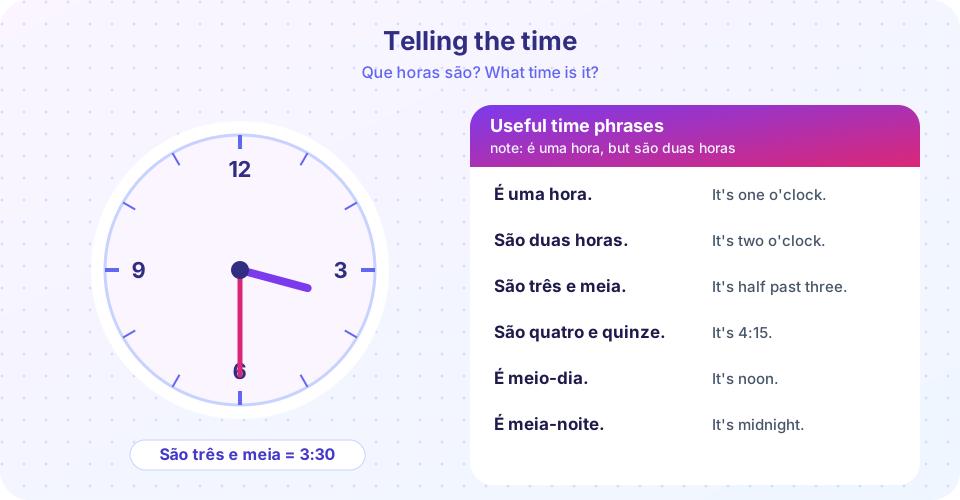
To ask the time: Que horas são? ("What time is it?") The answer uses são (plural) for everything except one o'clock, noon, and midnight, which use é.
| Time | Portuguese |
|---|---|
| 1:00 | É uma hora. |
| 2:00 | São duas horas. |
| 3:30 | São três e meia. |
| 4:15 | São quatro e quinze. (Portugal also: quatro e um quarto.) |
| 6:20 | São seis e vinte. |
| 7:50 | São dez para as oito. (ten to eight) |
| 12:00 | É meio-dia. |
| 0:00 | É meia-noite. |
Add the part of the day with da: São duas da tarde (2 p.m.), São dez da noite (10 p.m.), São sete da manhã (7 a.m.), and São três da madrugada (3 a.m., "early hours"). To say "at": A que horas? ("At what time?") Às oito horas ("at eight"), ao meio-dia ("at noon"), and à uma hora ("at one"). The às and à forms are the crase, which chapter 3 explains.
Numbers in daily life
Numbers appear in many forms, so here are the ones you will meet most. Prices in Brazil are in reais: cinco reais (5 reais), dez reais e cinquenta centavos (10 reais and 50 cents), written R$ 10,50. Notice that Portuguese uses a comma for decimals and a dot for thousands: R$ 1.250,00 is one thousand two hundred and fifty reais. For decimals in speech, say vírgula: 3,5 is três vírgula cinco.
Phone numbers are usually read in pairs or digits, and many Brazilians say meia for six. Addresses use the number after the street name: Rua das Flores, número 25. For floors and positions, you need ordinals: primeiro (first), segundo (second), terceiro (third), as in no segundo andar ("on the second floor").
Percentages use por cento: dez por cento (10%). Thousands use mil, which never takes a plural: dois mil (2,000), cinco mil (5,000). And remember ages: Brazilians say Eu tenho vinte anos ("I have twenty years"), using the verb ter, which you will learn in chapter 4.
Practice reading numbers on signs, bus numbers, and prices around you. The more often you convert a digit to a word, the faster it becomes automatic.
Practice ideas for numbers and time
Numbers become automatic only through repetition in context. Try three small habits this week. First, count aloud whenever you climb stairs, wait for a kettle, or walk to the bus stop: um, dois, três... up to twenty, then by tens. Second, read prices and times in Portuguese in your head: a price tag of 35 becomes trinta e cinco, and a clock showing 4:15 becomes quatro e quinze. Third, say the date each morning: Hoje é terça-feira, quatro de março.
When you meet a Portuguese speaker, be ready for the question every beginner hears first: Quantos anos você tem? ("How old are you?"). You can answer with Tenho vinte e cinco anos once you know the verb ter, and in the meantime you can simply say the number.
Common misconceptions
"Days and months need a capital letter." In Portuguese they are written in lowercase: segunda-feira, março.
"All the numbers have a feminine form." Only um/uma and dois/duas (and the hundreds from 200 up: duzentas, trezentas) change.
"100 is always cem." Alone it is cem, but before another number it is cento: cento e dois.
"It is um horas." It is uma hora (feminine hora), and the verb is é: É uma hora, but São duas horas.
Try it
The first tool is a number quiz. Pick the Portuguese word for each number.
The second tool turns any number from 0 to 100 into Portuguese words, following the rules above.
Press Run (or Ctrl + Enter) to see the result here.
Program input · what you'd type while the program runs
Type the answers before you press Run, one per line. Each time the program reads a line (with input()), it gets the next line from this box.
The third tool says the time out loud in Portuguese for any hour and minute, including the part of the day.
Press Run (or Ctrl + Enter) to see the console output here.
No output.
Check your understanding
Quick check · 6 questions
of 6 answered You scored / 6 · perfect!
-
1. How do you say 35?
Tens and units are joined with e: trinta e cinco. -
2. What is 'two houses'?
Casa is feminine, so dois becomes duas: duas casas. -
3. How do you say 'It is one o'clock'?
One o'clock uses é (singular) and uma hora (feminine): É uma hora. -
4. Which day of the week does not end in -feira?
Sábado and domingo are the two days without -feira. -
5. How do you write 'March' correctly?
Months and days are written in lowercase in Portuguese: março. -
6. What is 100 when it stands alone?
100 alone is cem; with more following it is cento (cento e um).
Summary
- Learn 0-20 and the tens; build the rest with e: vinte e um, sessenta e oito.
- um/uma and dois/duas agree with gender; 100 is cem, but cento e um for 101.
- Days and months are lowercase; the days Monday to Friday end in -feira.
- A date is 3 de março; the first is primeiro.
- Ask Que horas são?; answer with São... (plural) except É uma hora, É meio-dia, É meia-noite.
- Add da manhã / da tarde / da noite / da madrugada for the part of the day.
Next: Chapter 2 review
Track your progress
Create a free account to tick off lessons and pick up where you left off on any device.
of Portuguese for Beginners lessons completed