


















Lesson 8 of 48 · Sounds, Greetings and Basics
Consonants, Stress and Accent Marks
Master the Portuguese consonants that surprise English speakers (ç, ch, lh, nh, rr, x), the four stress rules, and every accent mark, with Brazilian pronunciation.
Most Portuguese consonants look and sound like their English cousins, so you already know b, f, m, n, p, v, and z. A small group of letters behaves differently, and a few of them change sound depending on the letters around them. Learn the group once and you will be able to read any word aloud.
The second half of the lesson deals with stress and accent marks. Portuguese words are stressed in a predictable way, and an accent mark appears only when a word breaks the rules. That means the spelling tells you exactly where to put the emphasis.
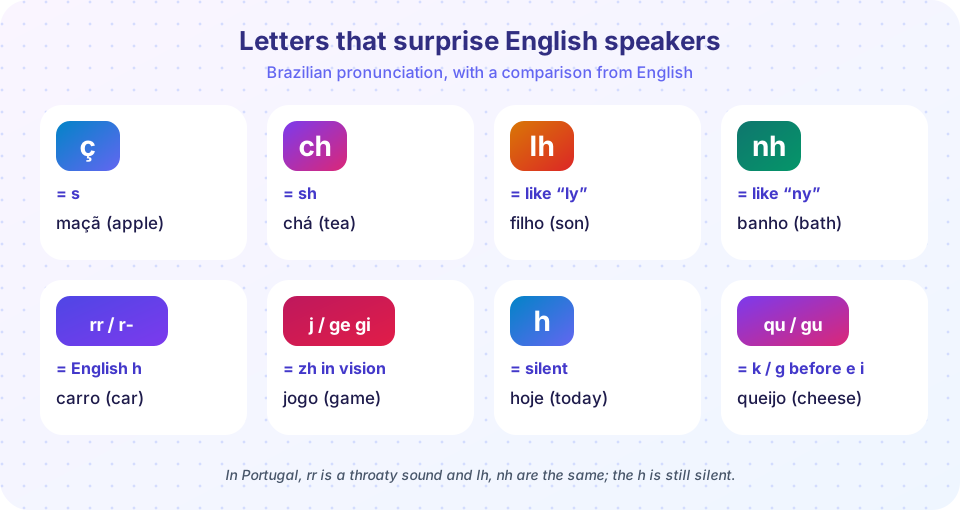
What you will learn
- How c, g, s, r, and x change sound depending on their neighbors.
- The sounds of ç, ch, lh, nh, rr, j, and the silent h.
- The four rules that tell you which syllable is stressed.
- What the acute, circumflex, tilde, grave, and cedilla do.
Key terms
Digraph: two letters that make one sound, like ch, lh, nh, rr, qu.
Stressed syllable: the syllable with the main emphasis, in capitals in respellings: ca-FÉ.
Diacritic: a mark above or below a letter that modifies it.
Crase: the contraction of the preposition a and the article a, written à (chapter 3).
Letters that match English
These behave as you expect: b, f, k, m, n, p, v, w, y, z. The letters k, w, and y appear mainly in foreign words and names (kiwi, Wilson, Yara).
Letters that change by context
C and Ç
- c before a, o, u is a hard k: casa (house), copo (glass), cuidado (care).
- c before e or i is s: cena (dinner), cinco (five).
- ç (c with a cedilla) is always s and appears only before a, o, u: maçã (apple), coração (heart), açúcar (sugar).
G and J
- g before a, o, u is a hard g: gato (cat), gosto (I like).
- g before e or i is like the s in "vision" (written zh here): gente (people), girafa (giraffe).
- gu before e or i gives a hard g, and the u is silent: guerra (war), guitarra (guitar).
- j is always zh: jogo (game), hoje (today).
Q
- qu before e or i sounds like k, and the u is silent: queijo (cheese), quilo (kilo).
- qu before a or o is usually kw: quando (when), quatro (four).
H, CH, LH, NH
- h alone is always silent: hoje is "OH-zhee", and hotel is "oh-TEHL".
- ch is sh: chá (tea), chave (key).
- lh is a sound like "ly" in "million": filho (son), mulher (woman). In much of Brazil it sounds close to "FEE-lyoo".
- nh is like "ny" in "canyon": banho (bath), amanhã (tomorrow).
R and RR
This letter changes with its position, and the pronunciation also varies by region, so treat the following as the common Brazilian pattern.
- r between vowels is a quick tap, like the tt in American "butter": caro (expensive), hora (hour).
- r at the start of a word and rr make a strong sound, in much of Brazil like an English h: rato (mouse) sounds like "HAH-too" and carro (car) like "KAH-hoo". Elsewhere in Brazil, and in Portugal, it can be rolled or a throaty sound.
- r at the end of a syllable varies: a tap, an h, or nearly silent. In casual speech, the r in infinitives like falar is often very light.
S and SS
- s at the start of a word is s: sapo (frog).
- s between two vowels is z: casa is "KAH-zah" and mesa (table) is "MEH-zah".
- ss is always s: passo (step).
- s at the end of a word is s in São Paulo and many other regions, but sh in Rio de Janeiro and in Portugal: os amigos can be "oos ah-MEE-goos" or "oosh ah-MEE-goosh". Both are correct.
X
The letter x is the least predictable. Learn the common words:
| Sound | Examples |
|---|---|
| sh | xícara (cup), caixa (box) |
| ks | táxi, tórax |
| z | exemplo (example), exame (exam) |
| s | próximo (next) |
T and D before an "ee" sound
In most of Brazil, t and d before the vowel sound "ee" are pronounced "ch" and "j". This includes the unstressed final -e, which sounds like "ee". So tia (aunt) sounds like "CHEE-ah", dia (day) like "JEE-ah", noite (night) like "NOY-chee", cidade (city) like "see-DAH-jee", and de (of) like "jee". In some regions of Brazil, and in Portugal, the t and d stay as in English.
L at the end of a syllable
In Brazil, l at the end of a syllable sounds like an English w: Brasil is "brah-ZEEW", sal is "sow", and animal is "ah-nee-MOW". Elsewhere an l is a normal l: lua (moon), bola (ball).
Stress: four rules
Every Portuguese word with two or more syllables has one stressed syllable. These rules tell you which one, when there is no accent mark:
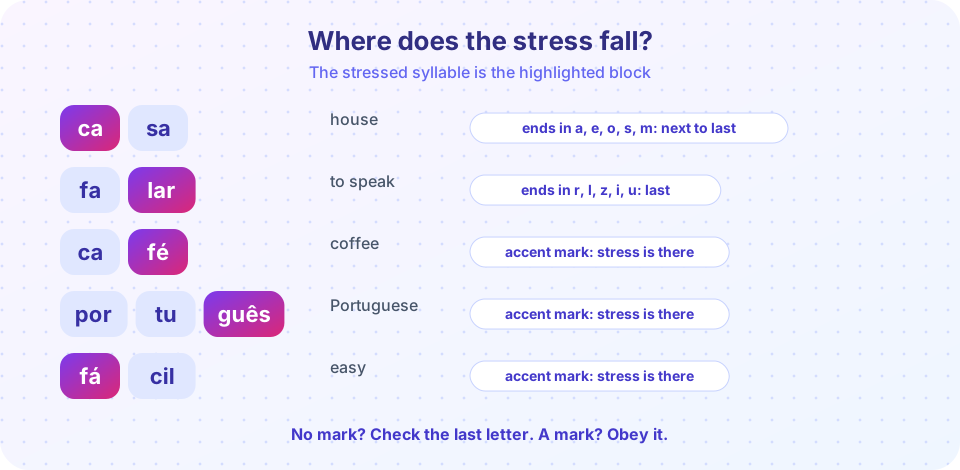
- Words ending in -a, -e, -o, -as, -es, -os, -am, -em, -ens are stressed on the second-to-last syllable: CA-sa, FA-lam, JO-vem, HO-mens.
- Words ending in any other letter are stressed on the last syllable: fa-LAR (to speak), a-QUI (here), a-ni-MAL, a-MOR (love). This includes the infinitives in -ar, -er, -ir, and the endings -i, -u, -l, -r, -z.
- A word that breaks these rules gets an accent mark over the stressed vowel: ca-FÉ (ends in é, stressed on the last), FÁ-cil (ends in l, but stressed on the first), por-tu-GUÊS.
- Words stressed on the third-to-last syllable always have an accent: MÚ-si-ca, MÉ-di-co, SÁ-ba-do.
A tilde (ã, õ) also marks the stress in most words: co-ra-ÇÃO, ir-MÃ.
So reading a word becomes a quick decision: look for a mark; if there is none, check the last letter.
The accent marks
| Mark | Name | Function | Examples |
|---|---|---|---|
| ´ | acute (agudo) | stress, open vowel | café, avó, rápido |
| ^ | circumflex (circunflexo) | stress, closed vowel | você, avô, ônibus |
| ~ | tilde (til) | nasal vowel (and usually stress) | mãe, pão, limões |
| ` | grave (grave) | a + a (crase) | à noite, vou à praia |
| ¸ | cedilla (cedilha) | c sounds like s | maçã, açúcar |
Accents can also tell similar words apart: pôr (to put) and por (by, through); pode (can, now) and pôde (was able to); é (is) and e (and); há (there is) and a (the, to).
A note on the spelling reform: an agreement signed in 1990 made Brazilian and Portuguese spelling more alike. It came into force in the 2000s and removed a few marks, for example the diaeresis in linguiça and the circumflex in voo (flight). If you find an older book with vôo, it is the old spelling.
Common misconceptions
"The letter h is aspirated, like English." A lone h is silent. The digraphs ch, lh, and nh are different sounds.
"rr is rolled like Spanish rr." In much of Brazil, it sounds like an English h. A rolled or throaty r is also heard in some regions and in Portugal. Either is understood.
"c before e is a k." Before e and i, c is s. The k sound needs qu (que) or a different vowel (ca, co, cu).
"Accent marks tell you how to stress every word." Most words have no mark, because the rules above already predict the stress.
Try it
The first tool is a stress game. Click the syllable that carries the stress, then read the rule in the feedback.
The second tool is a simplified sound-out helper. It applies only the letter rules from this lesson, so it covers the consonants but ignores vowels and regional variation.
Press Run (or Ctrl + Enter) to see the console output here.
No output.
Check your understanding
Quick check · 6 questions
of 6 answered You scored / 6 · perfect!
-
1. How is 'c' pronounced in 'cinco'?
Before e or i, c is pronounced s: cinco starts with s. -
2. Where is the stress in 'falar'?
Words ending in r (and other letters not in the -a, -e, -o, -s, -m group) are stressed on the last syllable. -
3. What does 'ç' do?
The cedilla makes c sound like s, as in maçã and açúcar. -
4. Which word needs an accent because it is stressed on the third-to-last syllable?
Words stressed on the third-to-last syllable always carry an accent: MÚ-si-ca. -
5. How is 'dia' usually pronounced in most of Brazil?
In most of Brazil d before an 'ee' sound becomes j, so dia is JEE-ah. -
6. What is the sound of 'nh' in 'banho'?
Nh is one sound, like the ny in canyon.
Summary
- c and g are hard before a, o, u and soft before e, i; ç is always s; j is always zh; h is silent.
- ch = sh, lh = ly, nh = ny, rr and initial r are strong (often an English h in Brazil).
- s between vowels is z; x varies, so learn the common words.
- In most of Brazil, t and d before "ee" become "ch" and "j", and final l sounds like w.
- Stress: -a, -e, -o, -as, -es, -os, -am, -em, -ens use the second-to-last syllable; other endings use the last; accents mark exceptions.
Track your progress
Create a free account to tick off lessons and pick up where you left off on any device.
of Portuguese for Beginners lessons completed