


















Lesson 2 of 48 · Getting Started
Portuguese Around the World
See where Portuguese is spoken, how it spread from Iberia to four continents, and how Brazilian and European Portuguese differ for learners.
Portuguese is not the language of one small country in Europe. It is the language of Brazil, a nation of more than 200 million people, and of Angola, Mozambique, and several smaller countries and territories on three more continents. More than 250 million people use it, which makes it one of the world's biggest languages and one of the most widely spoken languages in the Southern Hemisphere.
In this lesson you will see where Portuguese is spoken and why, meet the two main standard varieties, and learn the first everyday words that differ between Brazil and Portugal. You will also see why this course uses Brazilian Portuguese as its base. Knowing the map makes the language feel real: every word you learn can be heard in one of many places.
What you will learn
- Which countries use Portuguese as an official language, and roughly how large they are.
- How the language spread from the Iberian Peninsula across the world.
- The main differences between Brazilian and European Portuguese.
- A handful of Portuguese words that English already uses.
Key terms
Official language: the language a country uses for government, schools, and laws.
Lusophone: describing people, places, or cultures that use Portuguese. It comes from Lusitania, the Roman name for a region of western Iberia.
CPLP: the Community of Portuguese Language Countries (Comunidade dos Países de Língua Portuguesa), founded in 1996, which links the Portuguese-speaking nations.
Standard variety: the form of a language taught in schools and used in news and books.
From Latin to a global language
Portuguese is a Romance language, a child of the Latin that Roman soldiers and settlers brought to Iberia more than two thousand years ago. Spoken Latin in the northwest of the peninsula slowly changed into a local language, often called Galician-Portuguese. By the twelfth century the kingdom of Portugal existed, and by the thirteenth the court was writing in Portuguese rather than Latin. Poets wrote songs in it, and it became a literary language long before many European languages did.
The language spread over the seas. In the fifteenth and sixteenth centuries, Portuguese sailors explored the coast of Africa, reached India, and later arrived in Brazil in 1500. Trading posts and colonies carried the language to West and East Africa, the Atlantic islands, India, Southeast Asia, and China. Colonial history was often cruel: it included conquest, the transatlantic slave trade, and forced labor, and it is part of why Portuguese is spoken where it is today. Brazil became independent in 1822. Most of Portugal's African colonies, among them Angola, Mozambique, Guinea-Bissau, Cabo Verde, and São Tomé and Príncipe, gained independence in the mid-1970s. Timor-Leste became fully independent in 2002.
When these nations became independent, most kept Portuguese as a common official language, because it joined many different local languages. Today they sit alongside Portugal in the CPLP.
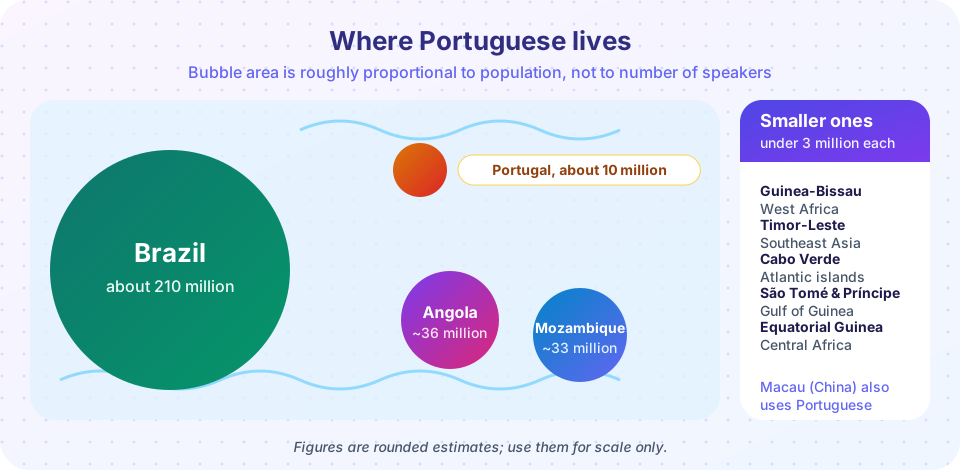
The map of Portuguese
| Country or place | Notes |
|---|---|
| Brazil | The largest by far; capital Brasília; around 210 million people |
| Portugal | Home of the standard European variety; capital Lisbon (Lisboa) |
| Angola | Large and growing Portuguese-speaking population; capital Luanda |
| Mozambique | Portuguese is the official language and a lingua franca; capital Maputo |
| Guinea-Bissau, Cabo Verde, São Tomé and Príncipe | Small African nations; local creoles live beside Portuguese |
| Timor-Leste | Official language together with Tetum |
| Equatorial Guinea | Added Portuguese as an official language in 2007 |
| Macau | A special region of China where Portuguese is co-official |
Two cautions help you read the table. First, "official language" does not mean everyone speaks it at home. In parts of Africa, many people speak local languages first and learn Portuguese at school, which means millions use it as a second language. Second, the figures are rounded. Population counts change every year, and counting speakers is harder than counting people.
Portuguese is also an official or working language in several international groups, including the CPLP and the African Union, and has a strong presence in South American trade bodies.
Brazilian and European Portuguese
Brazilians and Portuguese people read the same written grammar, but they do not speak identically. The differences fall into four groups.
Sound. Brazilian vowels are generally clearer. European Portuguese drops or whispers many unstressed vowels, so a word like obrigado can sound clipped, almost like "brigad". In most of Brazil, the letters t and d before an i sound are pronounced like English "ch" and "j": tia sounds like "CHEE-ah" and dia like "JEE-ah". In Portugal, tia is closer to "TEE-ah". Chapter 2 gives the full story.
Vocabulary. Many everyday words differ, as the table shows.
| English | Brazil | Portugal |
|---|---|---|
| bus | ônibus | autocarro |
| train | trem | comboio |
| cell phone | celular | telemóvel |
| breakfast | café da manhã | pequeno-almoço |
| juice | suco | sumo |
| refrigerator | geladeira | frigorífico |
| screen | tela | ecrã |
| team | time | equipa |
Grammar. Brazilians say Estou falando (I am speaking), while Portuguese people say Estou a falar. Brazilians use você for "you" in most situations, and a few regions also use tu. In Portugal, tu is the normal informal "you" and você is more formal or even cold. The position of short pronouns also differs: a Brazilian says Eu te amo ("I love you") and a Portuguese speaker says Amo-te.
Spelling. A spelling agreement signed in 1990 and put into practice in the 2000s and 2010s brought the two spellings much closer, but small differences remain, for instance Brazilian fato against Portuguese facto for "fact", and Brazilian equipe against Portuguese equipa.
Why this course teaches Brazilian Portuguese
Brazil has about four in five of the language's speakers. Its music (samba, bossa nova), television, and films are watched around the world, and tourism and business in Brazil continue to grow. A learner who studies Brazilian Portuguese will find it easy to find teaching material, partners, and media. You will still be understood in Lisbon or Luanda, and the notes in this course show the main European alternatives so that a Portuguese menu or street sign will not surprise you.
If your goal is Portugal, work through the course and then pay attention to the European notes. Chapter 2's pronunciation notes tell you what changes. The grammar you learn is the same.
Portuguese words you already know
English borrowed words from Portuguese, often through trade. Marmalade comes from marmelada, quince jam. Cobra is a Portuguese word, as is caste. Molasses comes from melaço. Piranha reached English through Portuguese, and banana travelled with Portuguese traders. Modern borrowings include samba, bossa nova, favela, capoeira, and caipirinha. These words are a good place to practice sounds: say samba as "SAHM-bah" and capoeira as "kah-poh-AY-rah".
Common misconceptions
"Brazilians do not speak real Portuguese." Both varieties are fully real. Language moves with its speakers, and the larger group is not a copy of the smaller one.
"They speak Brazilian in Brazil." The language is called Portuguese (português), and the country's official language is Portuguese, not a separate "Brazilian" language.
"All Portuguese-speaking places sound the same." There is wide variation: Rio, São Paulo, Lisbon, Luanda, and Maputo each have their own accents, and there are more differences inside Brazil than most beginners expect.
Try it
The first tool tests a few vocabulary differences. Pick the word a Brazilian would use.
The second tool draws the population chart. It shows population, not the number of speakers, and every number is a rounded estimate.
Press Run (or Ctrl + Enter) to see the result here.
Program input · what you'd type while the program runs
Type the answers before you press Run, one per line. Each time the program reads a line (with input()), it gets the next line from this box.
Check your understanding
Quick check · 5 questions
of 5 answered You scored / 5 · perfect!
-
1. Which country has the most Portuguese speakers?
Brazil has more than 200 million people, about four in five of all Portuguese speakers. -
2. Which is the Brazilian word for a bus?
Brazilians say ônibus. Autocarro is the European Portuguese word, and comboio means train in Portugal. -
3. What does CPLP stand for in English?
The CPLP, founded in 1996, links the Portuguese-speaking nations. -
4. In which way do Brazilian and Portuguese speakers say 'I am speaking'?
Brazilians use the gerund (estou falando); Portuguese speakers use a + infinitive (estou a falar). -
5. Why do many African countries use Portuguese as an official language?
After independence, Portuguese served as a shared official language across many local languages.
Summary
- Portuguese is an official language on four continents, with Brazil holding about four in five speakers.
- It grew from Latin through Galician-Portuguese, and spread through exploration, trade, and colonial history.
- Brazilian and European Portuguese differ in sound, vocabulary, grammar, and a few spellings, but remain mutually understandable.
- This course teaches Brazilian Portuguese and notes European forms.
- English already uses Portuguese words such as marmalade, cobra, and piranha.
Track your progress
Create a free account to tick off lessons and pick up where you left off on any device.
of Portuguese for Beginners lessons completed