


















Lesson 31 of 48 · Past Tenses
Perfeito or Imperfeito? Choosing the Right Past
Learn when to use the Portuguese pretérito perfeito and imperfeito together: interrupted actions, time markers and verbs like sabia and soube.
You now know two past tenses and how to build them. The hard part, and the part that makes your Portuguese sound natural, is choosing between them. English hides the choice: "I walked", "I was walking" and "I used to walk" are different English forms, but "I lived in Recife" could be either Portuguese tense depending on what you mean.
This lesson gives you a simple decision rule, shows how the two tenses work together in a story, and teaches the handful of verbs whose meaning changes with the tense. By the end you will be able to tell a short anecdote with a proper background and a proper sequence of events.
What you will learn
- A decision rule for choosing the perfeito or the imperfeito.
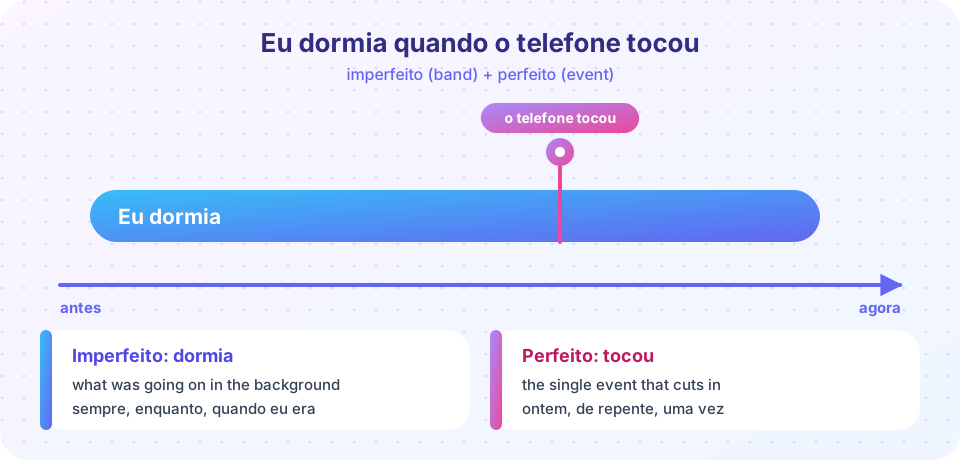
- The "interrupted action" pattern: dormia quando tocou.
- Which time words point to each tense.
- How sabia/soube, conhecia/conheci, queria/quis and podia/pôde change meaning.
- How to tell a short story using both tenses.
Key terms
Evento (event): something that happened and had a beginning and an end.
Cenário (background): the situation, description or habit in which events happen.
Ação interrompida (interrupted action): an action in progress cut off by another.
Mais-que-perfeito (past perfect): "tinha falado", an action before another past action.
The decision rule
Ask yourself two questions about the verb you want to put in the past.
- Can I count it, or give it a clear end? ("I arrived", "she called twice", "the party ended at midnight") → perfeito.
- Am I describing how things were, how often, or what was going on? ("it was raining", "we used to go", "I was working") → imperfeito.
A few signals help:
| Points to the perfeito | Points to the imperfeito |
|---|---|
| ontem, anteontem | sempre, todo dia, toda semana |
| na semana passada, no ano passado | às vezes, normalmente, geralmente |
| de repente (suddenly) | antigamente, naquela época |
| uma vez, duas vezes | quando eu era criança |
| então, depois, em seguida (then) | enquanto (while) |
| há três dias (three days ago) | (no time word: a description) |
Time words are hints, not laws. The decision is about the meaning: do you report an event, or describe a scene?
The interrupted action
The most common way both tenses meet is when something happens while something else is going on. The ongoing activity goes in the imperfeito; the interruption goes in the perfeito.
- Eu dormia quando o telefone tocou. (I was sleeping when the phone rang.)
- Ela cozinhava quando a luz apagou. (She was cooking when the lights went out.)
- Nós jantávamos quando a campainha tocou. (We were having dinner when the doorbell rang.)
When two actions go on at the same time, both are imperfeito:
- Ela lia enquanto ele cozinhava. (She read while he cooked.)
When actions happen one after another, they are all perfeito:
- Ele entrou, sentou e pediu um café. (He came in, sat down and ordered a coffee.)
A short story with both tenses
Read this story and notice the labels. The background verbs are in the imperfeito, the events in the perfeito.
| Portuguese | Role | English |
|---|---|---|
| Era uma noite fria. | background | It was a cold night. |
| Chovia muito e não havia ninguém na rua. | background | It was raining a lot and there was nobody in the street. |
| Eu voltava para casa quando vi um gato. | background + event | I was going home when I saw a cat. |
| Ele estava molhado e tremia. | background | He was wet and shaking. |
| Então eu peguei o gato, levei para casa e dei leite a ele. | events in sequence | Then I picked up the cat, took him home and gave him milk. |
| No dia seguinte, ele ficou comigo. | event | The next day he stayed with me. |
Verbs that change meaning
A few verbs about knowing, wanting and being able mean something different in each tense. This is a classic test of a learner's Portuguese.
| Verb | Imperfeito (state) | Perfeito (event) |
|---|---|---|
| saber | Eu sabia a resposta. (I knew the answer.) | Eu soube da notícia ontem. (I found out about the news yesterday.) |
| conhecer | Eu conhecia a Marta. (I knew Marta.) | Eu conheci a Marta em 2020. (I met Marta in 2020.) |
| querer | Eu queria sair. (I wanted to leave.) | Eu quis sair, mas não consegui. (I tried to leave, but could not.) / Não quis (I refused.) |
| poder | Eu podia nadar. (I was able to swim, in general.) | Eu pude nadar. (I managed to swim, once.) |
| ter | Eu tinha uma ideia. (I had an idea in mind.) | Eu tive uma ideia. (I had an idea: it came to me.) |
Another useful contrast is era versus foi. "Era um dia lindo" sets the scene (it was a lovely day), while "Foi um dia lindo" sums up a finished day (it was a lovely day, looking back).
One step further back: tinha + participle
If you need to talk about something that happened before another past event, Brazilian Portuguese uses tinha (imperfeito of ter) plus the participle: "Quando cheguei, ele já tinha saído" (When I arrived, he had already left). Participles end in -ado (-ar verbs) and -ido (-er/-ir verbs): falado, comido, partido. In casual speech many people just use the perfeito.
Worked examples: choose and explain
Try to decide first, then read the reasoning.
- Eu (morar) em São Paulo por cinco anos. → morei. The period is closed and counted ("por cinco anos"), so it is a bounded event. "Eu morava em São Paulo" would describe the situation without saying that it ended.
- Enquanto eu (cozinhar), ele (ler) o jornal. → cozinhava ... lia. Two actions going on at the same time, both background.
- De repente, o cachorro (latir). → latiu. "De repente" announces a sudden event.
- Naquele dia, (fazer) sol e (haver) muita gente na praia. → fazia ... havia (or tinha). Weather and crowd are the scene.
- Ela (abrir) a porta e (ver) um gato. → abriu ... viu. A sequence of events.
- Eu (ter) fome, então (comer) um sanduíche. → tinha ... comi. A state, then an event.
A three-step method for telling a story
- Write the scene: time, place, weather, who is there. Use the imperfeito (era, estava, havia, chovia).
- List the events in order, one verb each, in the perfeito (cheguei, vi, liguei).
- Test each verb: if you could put "suddenly" or "then" in front of it, it is probably perfeito. If you could put "at that time" or "always" in front of it, it is probably imperfeito. This is a rule of thumb, not a law, but it works in most sentences.
Practice by retelling your last holiday in six sentences: two for the scene, four for the events.
Common misconceptions
"Perfeito is for short actions and imperfeito for long ones." Length does not decide. "Eu morei em Recife por dez anos" uses the perfeito because the period is closed and counted; "Eu morava em Recife" describes the situation.
"I choose the tense by the English translation." The same English sentence can need either tense. Choose by meaning: event or background.
"Sabia and soube both mean knew." Sabia = knew; soube = found out.
"Quando always takes the perfeito." In "Quando eu era criança" it takes the imperfeito because it describes an extended time.
Try it
Choose the right tense in each sentence. The explanation tells you why.
The second TryIt is a small Python "hint machine". It looks for time words in a sentence and suggests a tense. It is a toy: real decisions depend on meaning, as the lesson shows.
Press Run (or Ctrl + Enter) to see the result here.
Program input · what you'd type while the program runs
Type the answers before you press Run, one per line. Each time the program reads a line (with input()), it gets the next line from this box.
Finally, match the verbs whose meaning changes.
Check your understanding
Quick check · 6 questions
of 6 answered You scored / 6 · perfect!
-
1. Which sentence correctly says 'I was sleeping when the phone rang'?
The ongoing action (dormia) is imperfeito, and the interruption (tocou) is perfeito. -
2. What does 'Eu soube da notícia ontem' mean?
'Saber' in the perfeito means to find out (a new piece of information). -
3. Which tense for 'Era uma noite fria'?
Setting the scene is the job of the imperfeito, even for a single night. -
4. Which is correct for 'We arrived, ate and went to sleep'?
A series of events in order uses the perfeito for all of them. -
5. What does 'Não quis' mean in the perfeito?
'Não quis' in the perfeito means refused; 'não queria' would mean did not want. -
6. What does 'Quando cheguei, ele já tinha saído' say?
'Tinha saído' (tinha + participle) places his leaving before the other past event.
Summary
- Event with an end or a count → perfeito; background, habit, description or ongoing → imperfeito.
- Interrupted action: imperfeito for the one in progress, perfeito for the interruption.
- Simultaneous actions: both imperfeito. Sequential actions: all perfeito.
- Time words (ontem, de repente versus sempre, antigamente) are hints, not rules.
- Meaning changes: sabia/soube, conhecia/conheci, queria/quis, podia/pude.
- Before another past event: tinha + participle (já tinha saído).
Next: Chapter review
Track your progress
Create a free account to tick off lessons and pick up where you left off on any device.
of Portuguese for Beginners lessons completed