


















Lesson 9 of 48 · Sounds, Greetings and Basics
Greetings and Introductions in Portuguese
Learn how to say hello, ask how someone is, introduce yourself, be polite and say goodbye in Brazilian Portuguese, with pronunciation and European notes.
You can now read Portuguese aloud, so it is time to use it. Greetings are the best first phrases to learn because you can use them in your very first conversation, and because they carry politeness, which Brazilians and Portuguese people value highly. A warm Bom dia! opens doors.
This lesson teaches you how to say hello at different times of day, ask and answer "How are you?", introduce yourself, say where you are from, be polite, and say goodbye. You will also learn the first survival phrases for when you do not understand. Say every phrase aloud as you go; short phrases are easiest to remember when your mouth has practiced them.
What you will learn
- Greetings for different times of day.
- How to ask and answer "How are you?".
- How to say your name, where you are from, and where you live.
- Polite words: please, thank you, excuse me, you're welcome.
- Goodbyes and the first survival phrases.
Key terms
Greeting (cumprimento): words said when meeting someone.
Formal / informal: formal speech shows respect for strangers, elders, or officials; informal speech is for friends and family.
Você: the usual word for "you" in Brazil. O senhor / a senhora: a more formal, respectful "you" for an older or unfamiliar person.
Tu: the informal "you" in Portugal and in some regions of Brazil.
Saying hello
| Portuguese | Respelling | Meaning and use |
|---|---|---|
| Oi! | "oy" | Hi. The most common informal greeting in Brazil. |
| Olá! | "oh-LAH" | Hello. Neutral, works anywhere, and is the usual form in Portugal. |
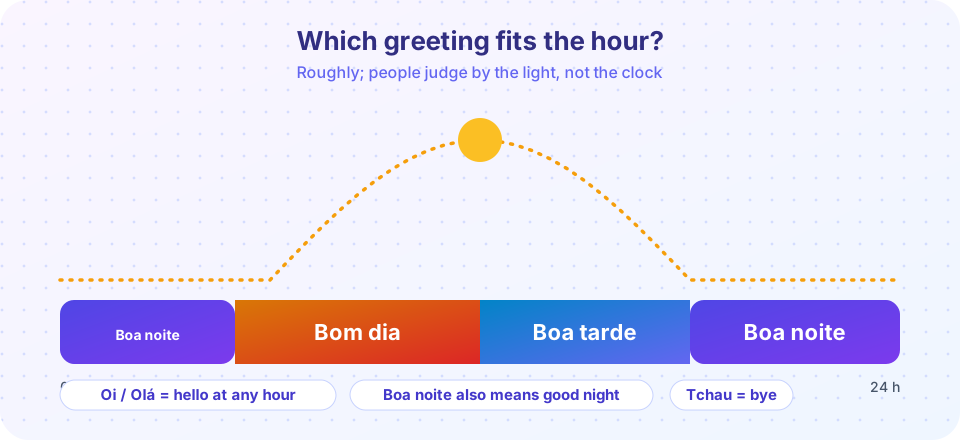
| Bom dia! | "bohng JEE-ah" | Good morning, from waking until about noon. |
| Boa tarde! | "BOH-ah TAR-jee" | Good afternoon, from noon until it gets dark. |
| Boa noite! | "BOH-ah NOY-chee" | Good evening, and also good night. |
| E aí? | "ee ah-EE" | What's up? Very informal, between friends. |
In Brazil, Oi is perfectly fine with almost everyone, but in a shop, a bank, or an office, Bom dia and Boa tarde sound more polite. Notice that boa noite is both "good evening" when you arrive and "good night" when you leave or go to bed. In Portugal, Olá is the standard hello, and Oi is also heard, mainly among younger people.
How are you?
| Portuguese | Respelling | Meaning |
|---|---|---|
| Tudo bem? | "TOO-doo bayng" | Everything well? The most common "how are you?" in Brazil. |
| Tudo bom? | "TOO-doo bohng" | Everything good? Equally common. |
| Como vai? | "KOH-moo vy" | How are you going? Slightly more formal. |
| Como você está? | "KOH-moo voh-SAY ehs-TAH" | How are you? |
| Tudo bem, e você? | "TOO-doo bayng, ee voh-SAY" | Fine, and you? |
You can answer with the same question: Tudo bem? "Tudo bem!" is a normal reply. You can also say Tudo ótimo ("everything great"), Tudo certo ("all right"), Mais ou menos ("so-so"), or Não muito bem ("not very well"). In Portugal, Como está? (formal) and Como estás? (informal, with tu) are the usual questions, and the answer is Estou bem, obrigado or Estou bem, obrigada.
Introducing yourself
There are three common ways to say your name:
- Meu nome é Ana. My name is Ana.
- Eu me chamo Ana. I call myself Ana. (The verb chamar-se is "to be called".)
- Sou a Ana. I am Ana.
To ask someone's name: Qual é o seu nome? ("What is your name?") or Como você se chama? ("What are you called?"). After hearing it, say Prazer ("Pleasure", "Nice to meet you"), Muito prazer ("Very nice to meet you"), or Prazer em te conhecer ("Pleasure to meet you", informal Brazilian).
Where are you from?
- De onde você é? (Where are you from?)
- Sou do Brasil. (I am from Brazil.)
- Sou dos Estados Unidos. (I am from the United States.)
- Sou da Inglaterra. (I am from England.)
- Sou de Portugal. (I am from Portugal.)
- Sou de Londres. (I am from London.)
For cities and for Portugal, we use de. For most countries, the word joins with the article: de + o = do, de + a = da, de + os = dos. Chapter 3 explains the articles and these contractions; for now, memorize the sentences you need.
To say where you live: Eu moro em São Paulo ("I live in São Paulo"), Eu moro no Canadá ("I live in Canada"). Again, em + o becomes no.
Being polite
| Portuguese | Respelling | Meaning |
|---|---|---|
| Por favor | "poor fah-VOHR" | Please |
| Obrigado / Obrigada | "oh-bree-GAH-doo / -dah" | Thank you (a man says obrigado, a woman says obrigada) |
| De nada | "jee NAH-dah" | You're welcome |
| Com licença | "kohng lee-SEHN-sah" | Excuse me (to pass, or to enter) |
| Desculpe | "dees-KOOL-pee" | Sorry; excuse me (to get attention) |
| Imagina | "ee-mah-ZHEE-nah" | No problem (informal, Brazil) |
The rule for obrigado surprises many learners. It does not agree with the person you thank; it agrees with you, the speaker. A woman who thanks a man says obrigada. A man who thanks anybody says obrigado. It literally means "obliged", and the ending follows your gender.
Saying goodbye
| Portuguese | Meaning |
|---|---|
| Tchau! | Bye! (from Italian ciao; very common in Brazil) |
| Até logo. | See you later. |
| Até amanhã. | See you tomorrow. |
| Até mais. | See you later. (Brazil, informal) |
| Boa noite. | Good night. |
| Adeus. | Goodbye. (final, formal; in Portugal it is common) |
Até means "until", so every até phrase is "until...": até amanhã is "until tomorrow".
Survival phrases
When you do not understand, say so. These five phrases are worth more than a hundred isolated words.
- Não entendo. I do not understand.
- Pode repetir, por favor? Can you repeat, please?
- Mais devagar, por favor. More slowly, please.
- Como se diz "water" em português? How do you say "water" in Portuguese?
- Você fala inglês? Do you speak English?
A dialogue
Two people meet at a party. The dialogue is in Brazilian Portuguese; a European version is noted below.
| Portuguese | English |
|---|---|
| Lia: Oi! Tudo bem? | Hi! How are you? |
| Sam: Tudo bem, e você? | Fine, and you? |
| Lia: Tudo ótimo! Qual é o seu nome? | Great! What is your name? |
| Sam: Meu nome é Sam. E o seu? | My name is Sam. And yours? |
| Lia: Eu me chamo Lia. Muito prazer! | I am called Lia. Nice to meet you! |
| Sam: Prazer! De onde você é? | Pleasure! Where are you from? |
| Lia: Sou do Rio de Janeiro. E você? | I am from Rio de Janeiro. And you? |
| Sam: Sou dos Estados Unidos. Eu moro em Chicago. | I am from the United States. I live in Chicago. |
| Lia: Que legal! Até mais! | How cool! See you later! |
In Portugal, a similar exchange would go: Olá! Como estás? / Estou bem, e tu? / Chamo-me Lia. Muito prazer! The ideas are the same; the words estás and tu are the informal European forms.
Formal and informal
In Brazil, você is the usual "you", even with strangers, and o senhor / a senhora show respect to elders, officials, and people you want to treat with care: O senhor quer um café? ("Would you like a coffee, sir?"). In Portugal, using você can sound distant, so people use the person's name, a title (a Dona Maria), or o senhor / a senhora. With friends, Portuguese speakers say tu. In some Brazilian regions, such as parts of the South and the Northeast, you will also hear tu.
Tone, body language and culture
Greetings in Portuguese-speaking countries are warm and physical. In Brazil, friends and relatives often greet with a hug and one or more kisses on the cheek between women and between a man and a woman, while men usually shake hands or hug. The number of cheek kisses varies by region and by family, so it is fine to follow the other person's lead. In Portugal, two kisses are common between a woman and a man or two women. In business settings and with new acquaintances, a handshake is always safe.
Small talk matters. Tudo bem? is not a request for a detailed answer: it is a polite greeting, and the expected reply is a short Tudo bem, e você? People often start with a friendly question about family or the day before they come to the point, and rushing straight to business can feel cold.
First names are normal even in many workplaces, but respect for elders is shown with titles: Seu João and Dona Maria (the Seu and Dona before a first name) are common in Brazil for older people, and Doutor/Doutora is used for professionals such as doctors and lawyers. When in doubt, begin with o senhor or a senhora and let the other person invite you to relax.
Common misconceptions
"Obrigado changes depending on who I thank." It changes depending on who is speaking: a man says obrigado, a woman says obrigada.
"Tchau is rude." It is a normal, friendly goodbye.
"Boa noite only means good night." It is also a greeting in the evening.
"Tudo bem? needs a long answer." It is a greeting; Tudo bem, e você? is enough.
Try it
The first tool tests which greeting fits which situation.
The second tool is a small program that chooses a greeting by the hour and builds an introduction. It follows the rules from this lesson, with the usual Brazilian cut-offs; real people are more flexible.
Press Run (or Ctrl + Enter) to see the result here.
Program input · what you'd type while the program runs
Type the answers before you press Run, one per line. Each time the program reads a line (with input()), it gets the next line from this box.
Check your understanding
Quick check · 6 questions
of 6 answered You scored / 6 · perfect!
-
1. Which greeting do you use at 3 p.m.?
Boa tarde covers the time from noon until it gets dark. -
2. A woman wants to thank someone. What does she say?
Obrigado/obrigada agrees with the speaker, so a woman says obrigada. -
3. What does 'Até amanhã' mean?
Até means until and amanhã means tomorrow. -
4. How do you say 'My name is Ana'?
Meu nome é Ana is the standard way; Eu me chamo Ana is another. -
5. Which sentence means 'I am from Brazil'?
Sou do Brasil: do is de + o. Eu moro no Brasil means I live in Brazil. -
6. What is the informal word for 'you' in Portugal?
Portuguese people use tu with friends and family; você can sound distant.
Summary
- Use Oi or Olá any time, and Bom dia, Boa tarde, Boa noite by the hour.
- Tudo bem? is the everyday "how are you?"; answer Tudo bem, e você?.
- Introduce yourself with Meu nome é..., Eu me chamo..., and say Muito prazer.
- Sou do/da/de... tells where you are from; Eu moro em... tells where you live.
- Obrigado (man speaking) and obrigada (woman speaking); say goodbye with Tchau or Até logo.
- Learn survival phrases: Não entendo, Pode repetir, por favor?, Mais devagar, por favor.
Next: Numbers, days and time
Track your progress
Create a free account to tick off lessons and pick up where you left off on any device.
of Portuguese for Beginners lessons completed