


















Lesson 41 of 48 · Conversation and Culture
Culture and Etiquette in Brazil and Portugal
Learn the customs behind Portuguese: greetings, forms of address, meals and tipping, punctuality, gestures, holidays like Carnaval, music, football and saudade.
Language and culture cannot be separated. The same sentence ("Passa lá em casa!") can be a firm invitation or a friendly way of saying goodbye, and a gesture that is friendly at home can be rude abroad. In this lesson you will learn the customs that surround Portuguese in Brazil and Portugal: how people greet each other, address each other, eat and celebrate, and the cultural ideas behind famous words like saudade.
A warning before we start: Brazil and Portugal are large and diverse. What follows describes common patterns and should be read as a guide, not as a set of rules. Individuals and regions differ, and locals will always forgive a sincere learner.
What you will learn
- How people greet and address each other in Brazil and Portugal.
- Basic manners at meals and in social situations, including tipping.
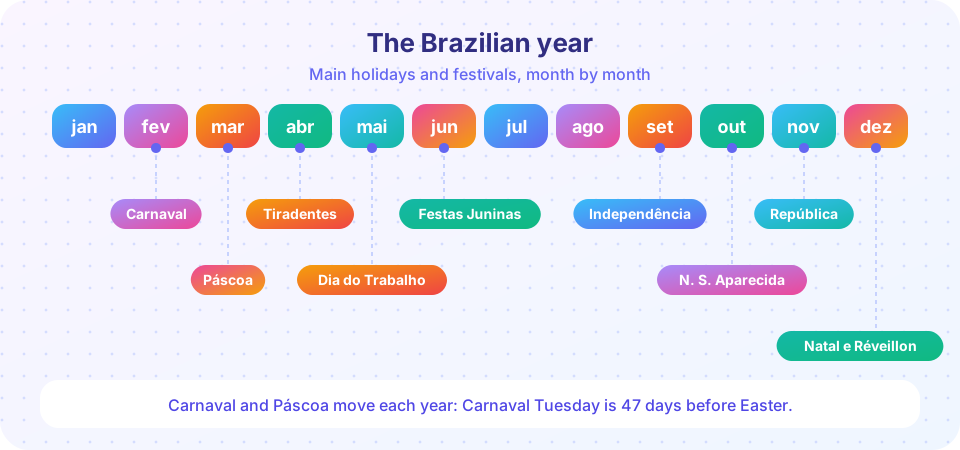
- The main holidays and festivals, and how to compute Carnaval.
- Gestures to avoid, and polite phrases for every situation.
- The cultural ideas behind saudade, cafuné and jeitinho.
Key terms
Saudade: a deep longing or nostalgia for a person, place or time that is absent. It is famously hard to translate.
Dona and Seu: respectful titles with first names in Brazil (Dona Maria, Seu João).
Churrasco: a Brazilian barbecue, a major social event.
Festa junina: June festivals with food, dance and bonfires, strongest in the Northeast.
Greetings
- Brazil. Friends and relatives greet with a kiss on the cheek (a beijo) between women and between a woman and a man. The number varies by region (one in São Paulo, two in many places, three in some areas of Minas Gerais), so follow the other person. Men usually shake hands or hug. In business, a firm handshake is standard. Brazilians are warm and often touch an arm during conversation, and they stand closer than many English speakers expect.
- Portugal. Two kisses (right cheek first) between women and between a woman and a man when people know each other; handshakes between men and in formal contexts.
Standard greetings by time of day: bom dia (until lunch), boa tarde (until evening) and boa noite (after dark, also for goodbye at night). Informally: oi, olá, e aí?.
Forms of address
| Situation | Brazil | Portugal |
|---|---|---|
| Friends and family | você (in some regions tu) | tu |
| Older person, respect | o senhor / a senhora | o senhor / a senhora |
| Elderly neighbor, a woman | Dona Maria | a Dona Maria |
| Elderly man | Seu João | o Senhor João |
| Professional | Doutor/Doutora (doctor, lawyer, any professional) | Doutor/Doutora, Engenheiro/a, Professor/a |
People use first names much more than surnames, even with bosses and teachers. Titles like doutor/doutora are often given to professionals, including lawyers and engineers, not only to physicians. When in doubt, use the formal form until the other person invites you to use the informal one.
Meals and hospitality
- Invitations. Brazilians are hospitable, and an invitation to someone's house is a big compliment. The phrase "Passa lá em casa" (drop by) can be sincere or polite, so ask "Quando?" to see.
- Bringing something. At a churrasco (barbecue) it is polite to ask "Posso levar alguma coisa?" (Can I bring something?) and bring a drink or dessert.
- Table manners. Even sandwiches and pizza are often eaten with a knife and fork. Hands are for bread, fruit and certain street foods. Say bom apetite before eating.
- Bill and tip. A service charge of around 10 percent is often already included on a Brazilian bill; check before you add a tip. In Portugal tipping is smaller and optional, often rounding up.
- Coffee. A cafezinho is offered everywhere in Brazil and refusing it is slightly awkward; accept a sip.
A short dialogue about a barbecue:
| Portuguese | English |
|---|---|
| Vamos fazer um churrasco no sábado. Você vem? | We are having a barbecue on Saturday. Are you coming? |
| Claro! Posso levar alguma coisa? | Of course! Can I bring something? |
| Leva uma sobremesa, se quiser. | Bring a dessert if you like. |
| Pode deixar. A que horas? | Leave it to me. What time? |
| A gente começa por volta das duas. | We start around two. |
| Perfeito. Até sábado! | Perfect. See you Saturday! |
Time and punctuality
For business meetings and appointments, be on time. For social events such as parties and barbecues, arriving 15 to 30 minutes after the stated time is often normal in Brazil, and arriving exactly on time may mean the host is not ready. When in doubt, ask: "A que horas devo chegar?" (What time should I arrive?). Plans are often flexible, and "vamos ver" (we will see) can mean "probably not".
Gestures
- The thumbs up is friendly and widely used for "OK" or "thanks".
- The "OK" sign (thumb and index finger in a circle) is considered rude or vulgar in Brazil; use the thumbs up instead.
- The figa (a fist with the thumb between the first two fingers) is a lucky charm, often on jewelry, but can look rude if used the wrong way.
- Pointing with a finger at someone is rude; Brazilians may point with their lips or a nod of the head.
Holidays and festivals
| Date | Holiday | Notes |
|---|---|---|
| Jan 1 | Confraternização Universal / Ano Novo | Réveillon on Dec 31: white clothes, fireworks, jumping seven waves at the beach in many places |
| Feb or Mar | Carnaval | Four days before Ash Wednesday; samba schools in Rio and São Paulo, trio elétrico in Salvador, frevo in Recife and Olinda |
| Mar or Apr | Páscoa (Easter) | Good Friday (Sexta-feira Santa) is a national holiday |
| Apr 21 | Tiradentes | Commemorates a leader of an 18th-century independence conspiracy |
| May 1 | Dia do Trabalho | Labor Day |
| June | Festas juninas | Saints Anthony, John and Peter; bonfires, quadrilha dances, corn dishes, strongest in the Northeast |
| Sep 7 | Independência | Brazil's independence from Portugal, 1822 |
| Oct 12 | Nossa Senhora Aparecida | Patron saint of Brazil |
| Nov 2 | Finados | All Souls' Day |
| Nov 15 | Proclamação da República | Republic proclaimed in 1889 |
| Nov 20 | Consciência Negra | National holiday since 2024 |
| Dec 25 | Natal | The main meal and gifts are on the night of Dec 24 |
In Portugal the key dates include 25 de Abril (the 1974 Carnation Revolution, which ended the dictatorship), 10 de Junho (Portugal Day), the Santos Populares in June (Lisbon celebrates Saint Anthony around June 12-13; Porto celebrates Saint John on June 23-24, with sardines and basil pots), 1 de Dezembro (Restoration of independence in 1640) and Christmas with salt cod.
Music, books and football
- Music. Brazil: samba, bossa nova (late 1950s, associated with João Gilberto and Tom Jobim), MPB, forró, sertanejo and funk carioca. Portugal: fado, recognized by UNESCO as intangible heritage in 2011, plus a strong pop and rock scene.
- Writers. Machado de Assis, Clarice Lispector and Jorge Amado (Brazil); Luís de Camões, Fernando Pessoa and José Saramago, who won the Nobel Prize in Literature in 1998 (Portugal).
- Football. Brazil has won the men's World Cup five times (1958, 1962, 1970, 1994, 2002). Football is a way of making friends; knowing someone's team is a great conversation starter.
- Food. Feijoada on Saturdays, pão de queijo, açaí, brigadeiro and caipirinha (cachaça, lime, sugar, ice) in Brazil; bacalhau, pastel de nata and caldo verde in Portugal.
Words with culture inside
- Saudade: longing for someone or something you miss. "Que saudade de você!" (I miss you so much!)
- Cafuné: running your fingers gently through someone's hair, a Brazilian word without a one-word translation.
- Jeitinho brasileiro: a flexible, creative way of solving problems, sometimes admired as resourcefulness and sometimes criticized as bending rules. Brazilians debate it.
- Desenrascanço (Portugal): the ability to improvise a solution.
Polite phrases
| Portuguese | When |
|---|---|
| Com licença | excuse me (passing, entering) |
| Desculpe / Desculpa | sorry |
| Por favor | please |
| Obrigado / obrigada | thank you |
| De nada / Imagina | you are welcome / do not mention it |
| Disponha | at your service (formal) |
| Bom apetite | enjoy your meal |
| Saúde! | cheers (also after a sneeze) |
| Parabéns! | congratulations |
| Boa viagem! | have a good trip |
Common misconceptions
"Brazilians speak Spanish." They speak Portuguese. The two languages are related but different.
"Rio is the capital of Brazil." It is Brasília, which became the capital in 1960.
"Everyone in Brazil dances samba and lives for Carnaval." Many Brazilians enjoy it, but others travel, rest or ignore it. It varies by region.
"Portugal and Brazil have the same customs." They share many words, but their manners, meal times and humor differ.
Try it
The first TryIt is a Python calendar for Brazilian holidays. It computes Easter with a standard algorithm, then derives Carnaval, Good Friday and Corpus Christi, and prints the fixed national holidays in order. Change YEAR to see the movable dates shift.
Press Run (or Ctrl + Enter) to see the result here.
Program input · what you'd type while the program runs
Type the answers before you press Run, one per line. Each time the program reads a line (with input()), it gets the next line from this box.
Next, a matching game on festivals and customs.
And flashcards with polite phrases to say aloud.
Check your understanding
Quick check · 6 questions
of 6 answered You scored / 6 · perfect!
-
1. Which gesture is considered rude in Brazil?
The 'OK' circle is vulgar in Brazil; use the thumbs up instead. -
2. What is 'Dona Maria'?
'Dona' + first name is a respectful form of address in Brazil. The male equivalent is 'Seu João'. -
3. How many times has Brazil won the men's football World Cup?
Brazil won in 1958, 1962, 1970, 1994 and 2002. -
4. What is 'saudade'?
Saudade is a feeling of nostalgic longing. -
5. What does the 25 de Abril commemorate in Portugal?
The 1974 revolution ended the dictatorship. -
6. What should you do when invited to a Brazilian churrasco?
Asking 'Posso levar alguma coisa?' is polite; arriving a little after the stated time is normal.
Summary
- Greet with a cheek kiss among friends in Brazil (the number varies) and a handshake in business; use first names and titles like Dona and Seu.
- Be on time for business, flexible for social events; check whether the bill already includes the service charge.
- The "OK" gesture is rude in Brazil; the thumbs up is friendly.
- Key holidays: Carnaval, Páscoa, Festas Juninas, 7 de Setembro, Natal; in Portugal 25 de Abril and Santos Populares.
- Cultural ideas: saudade, cafuné, jeitinho brasileiro, desenrascanço.
Next: Chapter review
Track your progress
Create a free account to tick off lessons and pick up where you left off on any device.
of Portuguese for Beginners lessons completed