


















Lesson 3 of 48 · Getting Started
Cognates and False Friends
Use thousands of look-alike words to learn Portuguese fast, with spelling patterns like -tion to -ção, and learn the false friends that can trip you up.
You already know a surprising amount of Portuguese. When you see animal, hotel, família, música, or restaurante, you can guess the meaning at once. English and Portuguese both borrowed heavily from Latin and Greek, and English also took thousands of words from French, which is Portuguese's cousin. The result is a large shared vocabulary of cognates: words in two languages that share an origin and look and mean almost the same.
Cognates give you a head start of hundreds of words in your first week. But the same history creates false friends (falsos amigos): words that look alike and mean something different. In this lesson you learn the spelling patterns that turn English words into Portuguese ones, the traps to avoid, and a way of guessing that is both fast and safe.
What you will learn
- How to recognize identical and near-identical cognates.
- Seven ending patterns that convert English words to Portuguese.
- Spelling changes that appear again and again, such as ph becoming f.
- The most common false friends, and how to avoid them.
- A safe strategy: guess, then check.
Key terms
Cognate (cognato): a word related in origin to a word in another language, with similar spelling and meaning.
False friend (falso amigo): a word that looks like an English word but means something different.
Suffix: an ending added to a word stem, such as -tion in English or -ção in Portuguese.
Gender: every Portuguese noun is masculine or feminine; chapter 3 covers it fully.
Identical and near-identical words
Some words are spelled the same in both languages, although they are pronounced differently: hospital, animal, hotel, normal, natural, final, terror, and motor. Others differ by an accent mark: música, família, médico, fácil, difícil, café, táxi. Many more are only a letter or two apart: banco (bank), teatro (theater), telefone (telephone), chocolate, computador (computer), restaurante.
The accent marks matter, because they tell you where to stress the word. Música is stressed on the first syllable, "MOO-zee-kah". Chapter 2 shows the rules.
Seven patterns that work
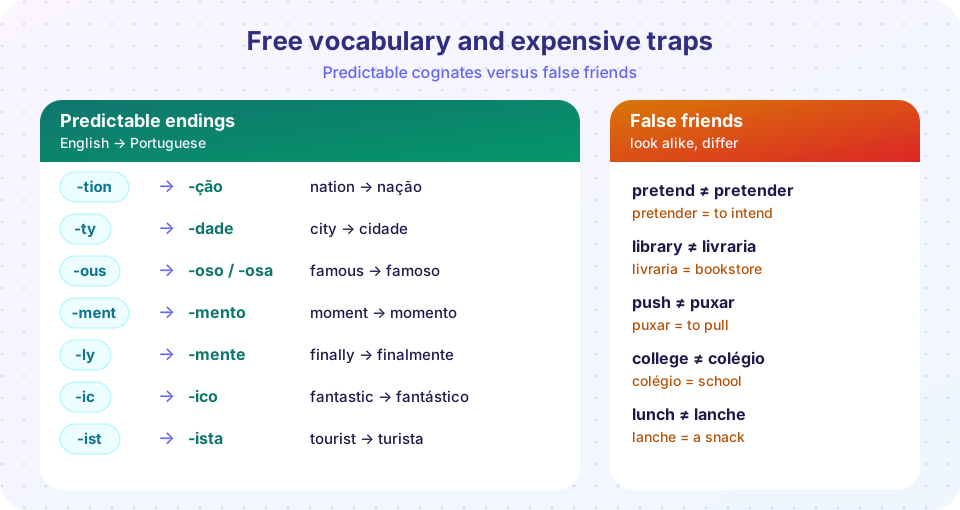
English words made of Latin or Greek parts usually follow the same rules in Portuguese. Learn these endings and you can build hundreds of words.
| English ending | Portuguese ending | Example |
|---|---|---|
| -tion | -ção | nation → nação, information → informação |
| -ty | -dade | city → cidade, university → universidade |
| -ous | -oso / -osa | famous → famoso, nervous → nervoso |
| -ment | -mento | moment → momento, document → documento |
| -ly | -mente | finally → finalmente, really → realmente |
| -ic | -ico / -ica | fantastic → fantástico, magic → mágico |
| -ist | -ista | artist → artista, dentist → dentista |
You can also add -ant → -ante (important → importante) and -ence → -ência (patience → paciência). When the English word ends in -ent or -ant, the Portuguese one often ends in -ente or -ante: inteligente, elegante.
Spelling changes that repeat
A few small changes appear in many words:
- Double letters shrink. Portuguese rarely doubles consonants except rr and ss. Different becomes diferente, occasion becomes ocasião, and tradition becomes tradição.
- ph → f, th → t, y → i. Photo becomes foto, theory becomes teoria, and physical becomes físico.
- ct → t in Brazil. Action is ação, contact is contato in Brazil, and in Portugal contacto keeps the c.
- s + consonant at the start gets e-. Student is estudante, station is estação, special is especial, school is escola. Portuguese speakers cannot start a word with st, sp, or sc without a helping vowel.
- Gender comes with the ending. Words in -ção and -dade are feminine (a nação, a cidade), while words in -mento are masculine (o momento). You can learn gender and vocabulary together.
Pronunciation is different
A cognate is not a free pronunciation. Hospital is pronounced roughly "oh-spee-TOW" in Brazil, with a silent h and a final l that sounds like English w. Animal is "ah-nee-MOW". You will practice these rules in chapter 2, so for now notice them as a curiosity.
False friends
False friends form a small group, but they cause some of the biggest mistakes. Here are the most important, with a note on how to remember each.
| Portuguese word | Looks like | Really means |
|---|---|---|
| pretender | pretend | to intend, to plan: Pretendo viajar = "I intend to travel" |
| livraria | library | a bookstore. A library is a biblioteca. |
| puxar | push | to pull. To push is empurrar. |
| colégio | college | a school (often a private school). College is faculdade. |
| lanche | lunch | a snack. Lunch is almoço. |
| parentes | parents | relatives. Parents are pais. |
| costume | costume | a custom or habit. A costume is a fantasia. |
| atual | actual | current. Actual is real or de fato. |
| esquisito | exquisite | strange or odd |
| assistir | to assist | to watch (a film), as in assistir a um filme; to help is ajudar |
| sensível | sensible | sensitive. Sensible is sensato. |
| eventualmente | eventually | possibly, occasionally. Eventually is por fim or finalmente. |
Notice that a few mistakes are only embarrassing (saying you are looking for a library when you want a bookstore). Others can change your meaning completely, such as telling someone you pretend to visit them when you mean that you intend to.
Why false friends exist
Words drift. Two languages can inherit the same ancestor word and then shift its meaning in different ways, like two siblings who grow up in different cities. English library and Portuguese livraria both come from Latin liber, "book", but English kept the idea of "a place to read books" while Portuguese kept "a place that sells them".
A safe strategy: guess, then check
- Guess from the shape of the word and the situation. Cognates are right most of the time.
- Check the first time you use a word: look it up or ask a tutor. Pay special attention to words you suspect might be false friends, such as anything meaning "to push", "to pretend", or "lunch".
- Collect surprises in a list. Every false friend you meet becomes a memorable story, and stories stick.
Reading a real sentence with cognates
Try decoding this sentence before you look at the answer: O restaurante é fantástico e o chef é muito famoso. You can probably read restaurante, fantástico, chef, and famoso. The only new words are small grammar words: é (is), e (and), o (the), and muito (very). The meaning is "The restaurant is fantastic and the chef is very famous."
Here is a second example: A informação é importante para a universidade. ("The information is important for the university.") Notice that each noun carries an article that shows its gender. A informação and a universidade are feminine, which you could have predicted from the endings -ção and -dade. Cognates therefore teach you vocabulary and gender at the same time.
Building your own cognate list
Keep a two-column list in a notebook or an app. Each week, choose ten English words of Latin origin, apply the patterns from this lesson, and check your guesses in a dictionary. Mark each one as correct, close, or a false friend. After a month you will see which patterns are most reliable for you, and the false friends will become a small, memorable collection.
A quick extra exercise is to open a Portuguese menu, a street sign photo, or a news headline and count the words you can already read. Beginners are often surprised: a typical short headline contains several words they understand on the first day.
Common misconceptions
"Every similar word means the same thing." About one in a few dozen look-alikes is a false friend. Always confirm important words.
"Cognates sound the same." They look similar, but the sounds differ: hotel is "oh-TEHL", with a silent h.
"If the English word ends in -tion, the Portuguese word is the same as Spanish -ción." The Portuguese spelling is -ção, with a cedilla (ç), and it is pronounced roughly "sowng", with a nasal sound. The Spanish spelling does not exist in Portuguese.
Try it
The first tool applies the seven endings automatically to see how well the rules work. Some words will be wrong, and that is part of the lesson: the program guesses, then compares the guess with the real word.
Press Run (or Ctrl + Enter) to see the console output here.
No output.
The second tool tests false friends. Choose what the Portuguese word really means.
Check your understanding
Quick check · 5 questions
of 5 answered You scored / 5 · perfect!
-
1. What is the Portuguese form of the English word 'nation'?
English -tion becomes -ção in Portuguese, and the word is feminine: a nação. -
2. What does the word 'puxar' mean?
Puxar means to pull. To push is empurrar, which makes puxar a classic false friend. -
3. Where would you go to buy a book?
A livraria is a bookstore; a biblioteca is a library. -
4. How do Portuguese words beginning with s + consonant often change from English?
Portuguese adds a helping e- before sp, st, sc: student → estudante, special → especial. -
5. Which sentence means 'I intend to travel'?
Pretender means to intend. Fingir is the verb for to pretend.
Summary
- Cognates give you hundreds of free words: identical, near-identical, or pattern-based.
- Seven useful endings: -tion → -ção, -ty → -dade, -ous → -oso, -ment → -mento, -ly → -mente, -ic → -ico, -ist → -ista.
- Common spelling shifts: double letters shrink, ph → f, th → t, ct → t, and s + consonant gains e-.
- False friends such as pretender, livraria, puxar, lanche, and parentes have different meanings from their English twins.
- Guess from the pattern, check the first time you use the word, and keep a list of surprises.
Next: Study plan and habits
Track your progress
Create a free account to tick off lessons and pick up where you left off on any device.
of Portuguese for Beginners lessons completed