


















Lesson 41 of 50 · Analysis and Composition
Secondary dominants and modulation
Learn how secondary dominants such as V7/V create temporary tonics, how to tell tonicization from modulation, and how pivot chords move music into a new key.
A key is not a locked room. Within a single piece, music often steps out of it for a moment, leans on another chord as if it were home, and then comes back. Sometimes it leaves for good and settles in a new key. These two actions, the brief and the lasting, are the subject of this lesson. The tool for the first is the secondary dominant: a dominant chord that points at a chord other than the tonic. The tool for the second is modulation, which relies on the same dominant pull plus a smooth connecting chord. Both turn one accidental into a doorway.
What you will learn
- What a secondary dominant is and how to spell and label one
- How to tell a tonicization from a modulation
- Which keys are closely related to a given key
- How a pivot chord modulation works, step by step
- How to label a modulation in an analysis
Key terms
Secondary (applied) dominant: a dominant or dominant seventh chord whose target is a diatonic chord other than the tonic. V7/V means "the dominant seventh of V".
Tonicization: briefly treating a chord other than I as if it were the tonic.
Modulation: a change of key that is confirmed by a cadence in the new key and lasts for a phrase or more.
Pivot chord: a chord that belongs to both the old and the new key and so connects them.
Closely related keys: keys whose key signatures differ by at most one accidental.
The secondary dominant
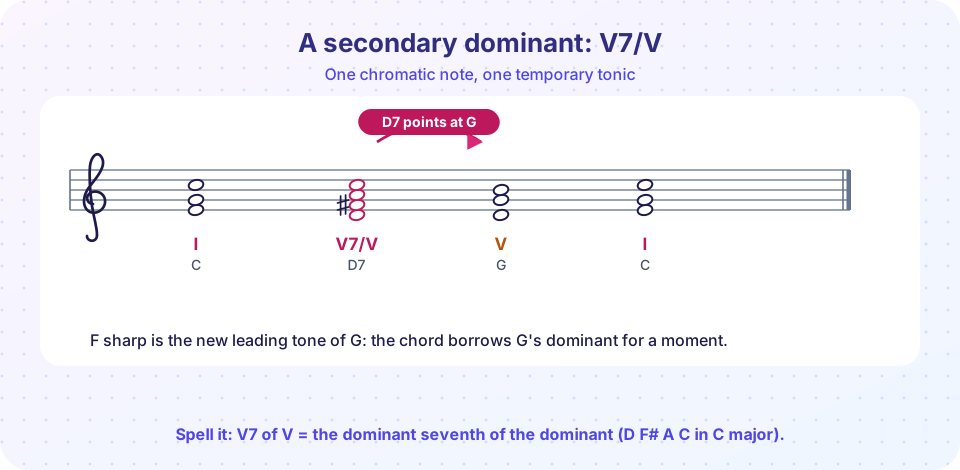
Every key has one dominant chord, built on the fifth degree. The pull of that chord comes from two facts: its root is a fifth above the tonic, and it contains the leading tone, which sits a half step below the tonic. Now notice that the same relationship can be built above any chord. For any target chord, find the note a perfect fifth above its root and build a major triad or dominant seventh there. That chord has the same pull toward its target that V has toward I. It is called a secondary dominant, or applied dominant, and is labeled V/x or V7/x where x is the target.
In C major the common ones are:
| Label | Chord | Spelling | Accidental outside C major | Resolves to |
|---|---|---|---|---|
| V7/V | D7 | D F♯ A C | F♯ | G (V) |
| V7/ii | A7 | A C♯ E G | C♯ | Dm (ii) |
| V7/iii | B7 | B D♯ F♯ A | D♯ and F♯ | Em (iii) |
| V7/vi | E7 | E G♯ B D | G♯ | Am (vi) |
| V7/IV | C7 | C E G B♭ | B♭ | F (IV) |
You will meet V7/V most often, because the dominant is the most important target. The characteristic sound is the raised fourth degree (F♯ in C major) sliding up to G. It feels like a small jolt of brightness, and it makes V feel more like a goal.
The labeling works as a fraction: top is the chord's function relative to the target, bottom is the target chord. Read "V7/V" as "five-seven of five". The target does not have to be reached; the chord can resolve elsewhere, as in a deceptive cadence, but the label stays.
Spotting them in a score
Look for an accidental that is not in the key signature, then check the next chord. If the accidental note is a half step below a note in the next chord (it acts as a leading tone), and the chord with the accidental is major or a dominant seventh whose root lies a fifth above the next chord's root, you have a secondary dominant. In the Roman numeral analyzer from the previous lesson, a chord such as D7 in C major is labeled V7/V, and A7 is labeled V7/ii.
Leading-tone chords as secondary dominants
A diminished seventh or diminished triad on the leading tone of the target can also tonicize it: vii°/V in C major is F♯ diminished. It sounds like V7/V without its root and is used in the same places.
Tonicization versus modulation
Both involve an accidental and a dominant. The difference is how long the new key lasts and whether it is confirmed.
- A tonicization is brief: one or two chords. The target chord is not yet felt as a new tonic. In the analysis, the label V7/V is enough, and the key stays C.
- A modulation is a change of key. It needs three things: a phrase (or more) in the new key; a cadence in the new key (V7 to I, in the new key); and consistent use of the new key's accidentals. Once the music cadences in G major and stays there, you should label the key change, for example "C: ... | G: ...".
A useful test is to ask what the music would feel like if it stopped. If a phrase ended after the secondary dominant resolved to V, you would hear "the music went to the dominant", a half cadence in the old key. If it ended after a perfect authentic cadence in G, you would hear a piece in G major. The difference is where the ear places home.
Closely related keys
Modulation is easiest between keys that share almost all their notes. The closely related keys of a major key are its dominant (one more sharp or one fewer flat), its subdominant (one more flat or one fewer sharp) and the relative minors of these and of the key itself. For C major they are G major, F major, A minor, E minor and D minor. For a minor key they are the relative major, the dominant and subdominant minor and their relative majors.
The most common modulations in classical music follow the same two routes: from a major key to its dominant (the exposition of a sonata) or its relative minor, and from a minor key to its relative major. Because those keys share so many chords, a smooth connection is easy to find.
Pivot chord modulation
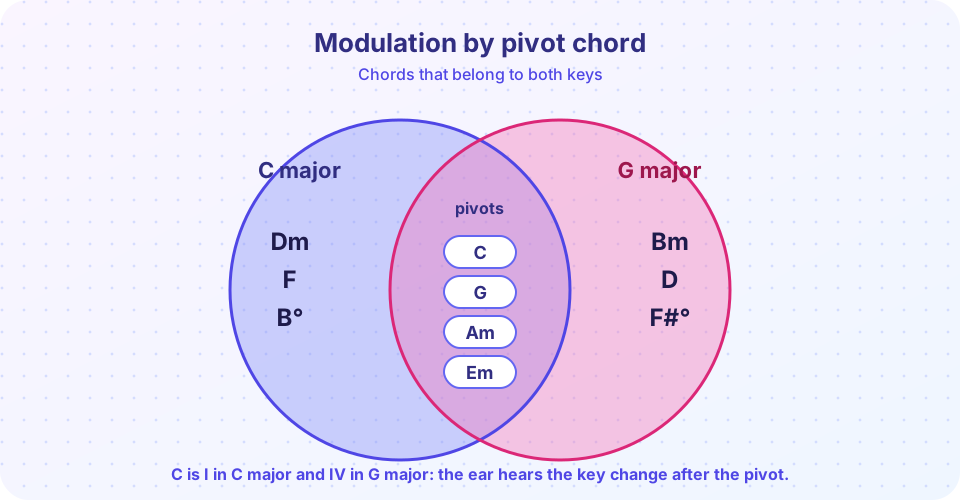
The standard smooth method is the pivot chord modulation (also called common-chord modulation). The recipe has five steps:
- Establish the old key. Play a progression and cadence that make it clear.
- Choose a pivot chord that belongs to both keys. In C major and G major the shared chords are C, G, Am and Em, as the picture below shows.
- Reinterpret the pivot. Hear the pivot as a different Roman numeral in the new key. Am is vi in C and ii in G.
- Add a new-key dominant. Follow the pivot with V7 of the new key, which supplies the new accidental. In G major, D7 with F♯.
- Confirm with a cadence. Resolve to the new tonic: G.
The full progression is C, F, C, Am, D7, G. As Roman numerals: C: I, IV, I, vi; G: ii, V7, I. In an analysis you mark the key labels and use a bracket or an equals sign for the pivot: C: vi = G: ii. The ear hears Am as part of C major until the D7 arrives with its F♯, and then in hindsight Am becomes the beginning of a ii–V–I in G.
Other ways to modulate
- Direct (phrase) modulation. The music simply stops in the old key and starts in the new one, with no connecting chord. The old key's final chord is followed by the new key's first chord. Popular songs use this to raise the final chorus by a half or whole step (the so-called "gear change").
- Chromatic modulation. A chord with an accidental connects two keys that are not closely related, as in a chromatic alteration that slides up by a half step in one voice.
- Enharmonic modulation. A chord is respelled so that it belongs to a distant key. The diminished seventh chord is the favorite pivot: it can resolve in four different ways.
Common misconceptions
"Every accidental means modulation." Most accidentals are tonicizations, chromatic passing notes or borrowed chords. Check for a cadence in the new key.
"The secondary dominant has to resolve to its target." It usually does. Sometimes the music deceives the listener: V7/V can resolve to a different chord, such as a vii° or a cadential six-four. The label tells you where it points, not where it ends.
"Modulation requires a pivot chord." Pivot chords make it smooth; direct modulations show that a connecting chord is optional.
Try it
Hear a tonicization. Each button plays the progression I, then the secondary dominant of the chosen target, then the target, then V7 and I. Compare with the plain version that leaves the secondary dominant out.
Now hear three modulations. The colored blocks show which key each chord belongs to; the pivot chord is marked in violet. Listen for the moment the new key takes over.
Check your understanding
Quick check · 5 questions
of 5 answered You scored / 5 · perfect!
-
1. In C major, which chord is V7/V?
The dominant seventh of G is D7 (D F# A C). Its F# is the leading tone of G. -
2. What distinguishes a modulation from a tonicization?
A tonicization is a brief emphasis; a modulation establishes a new tonic with a cadence. -
3. Which key is NOT closely related to C major?
F-sharp major has six sharps, so its signature differs from C major by six accidentals. -
4. In the modulation C, F, C, Am, D7, G, what is the pivot chord?
Am is vi in C major and ii in G major, so it belongs to both keys. -
5. What is a direct modulation?
The music simply starts the new key, as in a pop song's final-chorus key change.
Summary
- A secondary dominant is the dominant of a chord other than I, labeled V/x or V7/x; it introduces one accidental.
- A tonicization is brief; a modulation is confirmed by a cadence in the new key.
- Closely related keys differ by at most one accidental; the dominant and relative minor are the most common targets.
- Pivot chord modulation: establish the key, reinterpret a shared chord, add the new V7, confirm with a cadence.
- Direct, chromatic and enharmonic modulations are alternatives to the pivot chord.
Track your progress
Create a free account to tick off lessons and pick up where you left off on any device.
of Music Theory lessons completed