


















Lesson 30 of 50 · Melody and Form
Melodic contour and motifs
Describe the shape of a melody, understand steps, leaps, range and climax, and learn how composers grow a whole theme from a motif by sequence, inversion and more.
Two melodies can use exactly the same notes and sound completely different, because melody is more than a list of pitches. It has a shape, a rhythm and a set of relationships between its parts. A tune you can whistle after one hearing usually has two qualities: a clear contour that your memory can trace, and a small idea that repeats so that you recognize it. This lesson takes both apart: first the outline of a melody, then the seed it grows from.
What you will learn
- The common contour shapes and what they feel like
- How steps, leaps and range affect character
- Why melodies usually have one climax
- What a motif is and how to recognize one
- The standard transformations: repetition, sequence, inversion, retrograde, augmentation, diminution and fragmentation
Key terms
Contour: the overall shape a melody traces, ignoring exact interval sizes.
Conjunct motion: moving mostly by step. Disjunct motion: moving with leaps.
Range: the distance from the lowest to the highest note.
Climax: the highest or most intense point of a melody.
Sequence: repeating a motif at a different pitch level.
Inversion: flipping a motif upside down: each rise becomes a fall of the same size.
The shape of a line
If you draw a melody as a line on a graph, with time across and pitch up, you get its contour. A few shapes occur again and again.
| Shape | Description | Typical feel |
|---|---|---|
| Arch | rises to a peak, then falls | the most common; a natural breath |
| Inverted arch | falls to a low point, then rises | introspection, then recovery |
| Ascending | rises overall | growing energy, aspiration |
| Descending | falls overall | relaxation, closure |
| Wave | rises and falls repeatedly | gentle, flowing |
| Static | stays around one pitch | tension, chant, speech |
The opening phrase of "Ode to Joy" is a wave that settles: it rises a little, falls, rises again and settles on a long note. The theme from the Beethoven fifth symphony is an example of a descending contour built from a motif and its sequence.
Contour is also what your memory holds on to. In experiments about melody recognition researchers have found that listeners recognize a transposed melody reliably, and that contour tends to be more robust in memory than the exact interval sizes, especially for unfamiliar tunes. Practically, that means you can change an interval a little and keep the tune recognizable, but if you flip the contour the tune is gone.
Steps, leaps and range
Moving by step (a second) sounds smooth and singable. A leap (a third or more) sounds dramatic or energetic. A melody made mostly of steps is called conjunct; one with many leaps is disjunct. Most memorable tunes mix both, with steps doing most of the work and leaps providing highlights.
Three practical tendencies are worth knowing, though they are tendencies, not laws:
- Recover from a leap. After a big leap, melodies often turn back in the opposite direction, usually by step. The line "fills the gap" it just opened. The octave leap at the start of "Somewhere over the Rainbow" is followed by a step back down in the melody line.
- Notes near the top of the range feel tense. The higher and farther from the tonic you go, the more effort the line seems to carry.
- A narrow range feels intimate; a wide range feels grand. "Ode to Joy" spans only a fifth. The "Star-Spangled Banner" is famous for covering an octave and a fifth, which is why many people find it hard to sing.
One climax
A good melody usually has a single high point, and a skillful composer places it carefully, often about two-thirds of the way through a phrase, and avoids reaching it too early. If the highest note appeared at the beginning and again in the middle, neither would feel special. When you write a melody, plan the climax first, then approach it with a rising line and leave it with a descent.
The motif
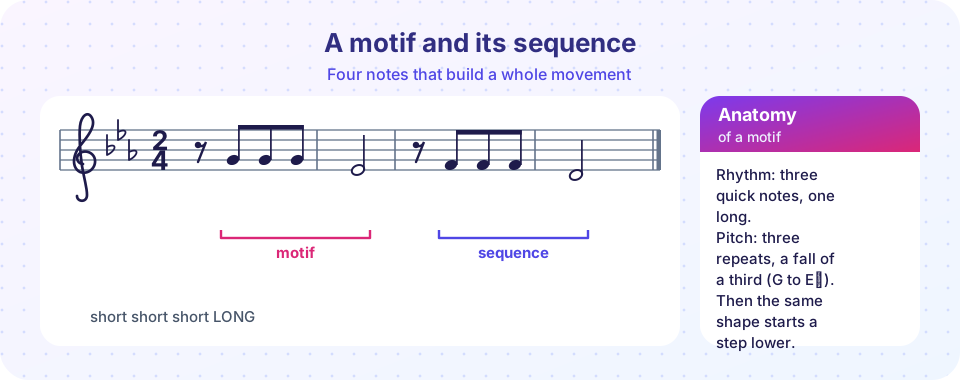
A motif is the smallest recognizable musical idea: usually two to five notes that have a distinctive rhythm, a distinctive interval pattern, or both. The best-known example in all of classical music is the four-note figure that opens Beethoven's fifth symphony: three short notes on the same pitch followed by a long note a third lower. Its power comes from the contrast of short and long and from the fact that it is so simple that it can be used in thousands of ways.
A motif is not the same as a theme. A theme is a complete melody; a motif is a fragment of one. A phrase is a unit of musical sentence length. Theme, phrase and motif nest inside each other like words in a sentence.
Motif transformations
Composers get mileage from a motif by changing it in controlled ways. Below, the base motif is G G G E♭ (three short notes, one long).
| Technique | What changes | Result |
|---|---|---|
| Repetition | nothing | exact restatement; reinforces |
| Sequence | pitch level (by step) | F F F D: same shape, lower |
| Inversion | direction of intervals | G G G then a rising third: G G G B♭ |
| Retrograde | order of notes | E♭ G G G: the motif backwards |
| Augmentation | durations multiplied | the rhythm slows down |
| Diminution | durations shortened | the rhythm speeds up |
| Fragmentation | only part is used | G G G alone, building tension |
In Beethoven's fifth the opening motif is followed at once by its sequence. Later in the movement he uses it fragmented, in the horn call and in the long build-up. Almost the entire first movement grows from those four notes. A good rule of thumb for composing: when you have a good motif, resist the temptation to invent new material. Transform what you have.
Sequences are a composer's best friend
A sequence is a motif repeated at higher or lower pitch levels. A tonal (or diatonic) sequence stays within the key, so the intervals change slightly to fit the scale; a real sequence repeats the exact intervals and so leaves the key. Sequences are popular in Baroque music because they are easy to follow and provide forward momentum, and they work in popular songs for the same reason.
Common misconceptions
"A melody is just the high notes." Melody includes rhythm. Strip the rhythm from a famous tune and it often becomes hard to identify, while the rhythm alone can sometimes reveal the song.
"Leaps are bad." Leaps are essential to give a melody character. The guideline is to compensate for them, not to avoid them.
"Variation means changing everything." The motif works because it stays recognizable. Change one thing at a time (pitch level, direction or rhythm) and the ear follows.
Try it
Choose a contour. The program writes a random eight-note melody in C major that follows the shape, plots it and plays it. Generate several and see which ones sound like real tunes.
Now work with a motif. The base motif is G G G E♭ from the picture. Choose a transformation and listen to what changes and what stays.
Check your understanding
Quick check · 5 questions
of 5 answered You scored / 5 · perfect!
-
1. Which contour rises to a peak and then falls?
An arch climbs to a high point, then descends. It is the most common contour. -
2. What is a sequence?
In a sequence the same shape reappears higher or lower, as in G G G E-flat followed by F F F D. -
3. What does inversion do to a motif?
Inversion flips the direction of every interval; a rising third becomes a falling third. -
4. A melody makes a large leap upward. What usually happens next?
Melodies tend to fill in the gap opened by a leap by moving back the other way. -
5. Why do composers often keep a motif's rhythm the same when varying it?
A distinctive rhythm is one of the most recognizable parts of a motif.
Summary
- Contour is the shape of a melody; arches are the most common, and contour is what memory holds.
- Steps give smoothness, leaps give character, and a leap is usually followed by a turn back.
- A melody typically has one climax, placed with care.
- A motif is a small recognizable idea; sequence, inversion, retrograde, augmentation, diminution and fragmentation let a composer grow a whole piece from it.
Track your progress
Create a free account to tick off lessons and pick up where you left off on any device.
of Music Theory lessons completed