


















Lesson 20 of 50 · Intervals and Chords
Triads: major, minor, diminished and augmented
Build the four triad qualities from stacked thirds, spell them correctly, find the triads of any major or minor key with Roman numerals and train your ear to tell them apart.
A single note is a point. Two notes form an interval. Three notes are the smallest group that can feel like a real chord: a block of sound with a color, a center and a direction. The simplest and most common chord is the triad, built from three notes stacked in thirds. Nearly all the pop songs, hymns, folk songs and classical themes you know are accompanied, at least much of the time, by triads.
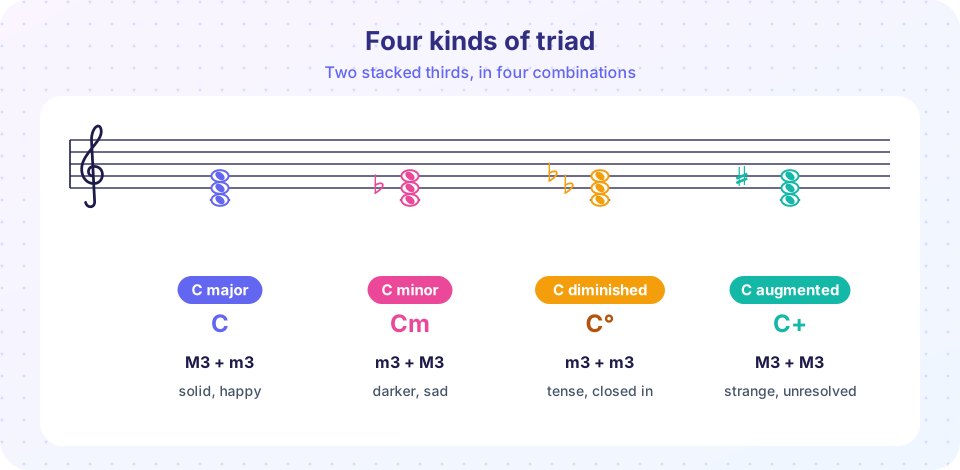
A triad's character depends entirely on the sizes of its two thirds. Make them major then minor and you get the bright sound of a major chord. Reverse the order and the chord becomes minor. Make both minor and the chord is tense and diminished, and make both major and it is strange and floating and augmented. In this lesson you will build all four, learn their symbols and find every triad in a key.
What you will learn
- The three parts of a triad: root, third and fifth
- How to build major, minor, diminished and augmented triads from interval sizes
- How to spell a triad correctly by skipping letters
- The triads that occur in a major or minor key, and how Roman numerals label them
- How to hear the difference between the four qualities
Key terms
Triad: a three-note chord made of a root, a third above it and a fifth above it.
Root: the note the chord is built on and named after.
Chord quality: the type of triad: major, minor, diminished or augmented.
Roman numeral: a label such as I, ii or V that gives a chord's scale degree in a key; capitals mean major, lowercase means minor.
Chord symbol: shorthand for a chord, such as C, Am or B° (or Bdim).
Anatomy of a triad
Start with any note, the root. Add the note a third above it (the third of the chord) and the note a fifth above the root (the fifth of the chord). On C the notes are C, E and G. Each note is named by its interval above the root, and the picture shows that the notes sit on adjacent lines or adjacent spaces on the staff: stacking thirds means skipping a letter name each time. Seeing a chord as "line, line, line" or "space, space, space" on the staff is a quick way to recognize a triad in root position.
The two thirds, the one from root to third and the one from third to fifth, can each be major (4 half steps) or minor (3 half steps). That gives four possible combinations, and each one is a different triad:
| Triad | Root to third | Third to fifth | Root to fifth | Symbol | Example on C |
|---|---|---|---|---|---|
| Major | major third (4) | minor third (3) | perfect fifth (7) | C | C E G |
| Minor | minor third (3) | major third (4) | perfect fifth (7) | Cm or C− | C E♭ G |
| Diminished | minor third (3) | minor third (3) | diminished fifth (6) | C° or Cdim | C E♭ G♭ |
| Augmented | major third (4) | major third (4) | augmented fifth (8) | C+ or Caug | C E G♯ |
The easiest way to remember them: the major triad has the major third on the bottom, the minor triad has the minor third on the bottom, the diminished triad is minor thirds all the way, and the augmented triad is major thirds all the way. Another way to see it is by changing one note of the major triad: lower the third, and you get a minor triad; lower the fifth as well, and you get a diminished triad; raise the fifth of the major triad, and you get an augmented one.
Spelling a triad correctly
Triads must be spelled with the correct letter names, and this is easy if you follow the skip-a-letter rule. Start on the root, skip a letter for the third and skip another for the fifth. For a triad on E♭ the letters are E, G, B. Then add the accidentals that give the right sizes:
- E♭ major: E♭ G B♭ (G is a major third above E♭, and B♭ a perfect fifth)
- E♭ minor: E♭ G♭ B♭ (lower the third)
- E♭ diminished: E♭ G♭ B♭♭ (lower the third and the fifth)
For a triad on F♯, the letters are F, A, C: F♯ major is F♯ A♯ C♯, F♯ minor is F♯ A C♯, and F♯ diminished is F♯ A C. Never write a third as a different letter just because it sounds the same. D♯ is not a valid third for B♭, even though D♯ and E♭ share a key. If you spell a chord with wrong letters, the notation is harder to read and obscures how the chord functions.
Triads in a key
Take the C major scale and build a triad on each degree using only notes of the scale (every other note). You get seven triads: three major, three minor and one diminished.
| Degree | Triad | Notes | Quality | Roman numeral |
|---|---|---|---|---|
| 1 | C | C E G | major | I |
| 2 | Dm | D F A | minor | ii |
| 3 | Em | E G B | minor | iii |
| 4 | F | F A C | major | IV |
| 5 | G | G B D | major | V |
| 6 | Am | A C E | minor | vi |
| 7 | B° | B D F | diminished | vii° |
Roman numerals label the chords independently of the key: I-IV-V means the chords built on the first, fourth and fifth degrees, whether the key is C (C F G) or D (D G A). Capitals are major, lowercase minor and a small circle diminished. The pattern major, minor, minor, major, major, minor, diminished is the same in every major key. The three major chords, I, IV and V, are the primary chords, and the three minor chords, ii, iii and vi, are the secondary ones. The diminished chord on the leading tone has a tense, unstable sound, and acts as a link to the tonic.
In a minor key (natural minor) the pattern differs: i, ii°, III, iv, v, VI, VII (minor, diminished, major, minor, minor, major, major). But the dominant chord v is minor, and the leading tone is missing, so in practice the seventh degree is raised (harmonic minor) to make a major V and a diminished vii° that leads to the tonic. That is the reason for the harmonic minor scale that you learned in chapter 3. In A minor, the harmonic-minor triads are Am, B°, C+ (augmented, rare in practice), Dm, E, F and G♯°. The augmented triad only appears naturally on the third degree of the harmonic minor, which is why it is the rarest of the four.
How triads sound
- Major: bright, stable, happy or triumphant in many styles.
- Minor: darker, softer, melancholy or serious (but not always).
- Diminished: tense and unsettled, wanting to resolve. It was used often in horror and suspense music.
- Augmented: dreamy, ambiguous and floating, because its three notes divide the octave into equal parts of four half steps, so it has no clear root. It was often used in the music of the Romantic era and by Impressionist composers such as Debussy and Ravel.
All four are built from the same two ingredients, the major and minor third. This is a good example of how a few simple building blocks give rise to a wide variety of sounds.
Common misconceptions
"Minor chords are sad and major chords are happy." It is a tendency, not a law. Tempo, rhythm, register and context color the effect a great deal.
"The notes of a chord must be adjacent." Notes in a chord are stacked in thirds, with a letter skipped. Notes next to each other form a cluster, not a triad.
"C+ means C major." A plus sign means augmented. A plain letter (C) means major; a lowercase m or a minus means minor.
"A chord can only be played in root position." The root can be on top or in the middle, and the notes can be spread over several octaves, but the chord remains the same chord. See the next lesson on inversions.
Try it
Choose a root and a quality. The page spells the triad, shows the interval pattern and plays it as a block chord followed by an arpeggio (one note after another).
Now find all the triads of a key with code. The program spells each scale, stacks thirds on every degree, works out the quality from the half steps and prints chord names and Roman numerals. Compare the three scales: in harmonic minor the dominant becomes major, and an augmented chord appears on degree 3.
Press Run (or Ctrl + Enter) to see the result here.
Program input · what you'd type while the program runs
Type the answers before you press Run, one per line. Each time the program reads a line (with input()), it gets the next line from this box.
Last, train your ear. The game plays a triad from a random root. Decide whether it is major, minor, diminished or augmented. Start with the first two options only.
Check your understanding
Quick check · 6 questions
of 6 answered You scored / 6 · perfect!
-
1. Which interval stack makes a major triad?
A major triad has the major third at the bottom and the minor third on top: C E G is 4 + 3 half steps. -
2. Which notes make a C diminished triad?
Diminished triads stack two minor thirds: C E♭ G♭. -
3. What are the Roman numerals for the triad qualities of a major scale, in order?
In a major key the chords on degrees 1 to 7 are major, minor, minor, major, major, minor, diminished: I ii iii IV V vi vii°. -
4. Which triad quality is found only on the third degree of the harmonic minor?
In harmonic minor the third degree builds an augmented triad (C E G♯ in A minor). -
5. How do you spell the third of a triad on F-sharp?
Skip one letter above F to get A. F♯ major uses A♯ and F♯ minor uses A natural. -
6. In a minor key, why is the seventh degree often raised?
Raising the seventh creates a leading tone and a major V chord, which pulls strongly to the tonic.
Summary
- A triad stacks two thirds on a root: root, third, fifth. Its quality depends on the sizes of the thirds.
- Major = M3 + m3, minor = m3 + M3, diminished = m3 + m3, augmented = M3 + M3.
- Spell triads by skipping letters, then adding the right sharps or flats.
- A major key has triads I ii iii IV V vi vii°; natural minor has i ii° III iv v VI VII, and harmonic minor makes the dominant major.
- Roman numerals label chords by degree; capitals are major, lowercase minor.
Track your progress
Create a free account to tick off lessons and pick up where you left off on any device.
of Music Theory lessons completed