


















Lesson 25 of 50 · Harmony and Progressions
Chord function and common progressions
Learn why chords fall into tonic, predominant and dominant families, how they form a cycle, and how famous progressions such as I-V-vi-IV and ii-V-I work.
Seven diatonic chords are not seven equal choices. Play C, then Am, then F, then G, and your ear hears an order, even if you cannot yet say why. Certain chords feel like places to rest. Others feel like they are on their way somewhere. Theorists call this feeling harmonic function: a chord's job in the key, as opposed to its name. Understanding function is the difference between memorizing progressions and knowing why they work, and it is the single most useful idea in harmony.
What you will learn
- The three harmonic functions and which diatonic chords belong to each
- Why those chords behave as they do, in terms of scale-degree tendencies
- How the cycle tonic, predominant, dominant, tonic organizes progressions
- How to read and play progressions such as I-IV-V-I, I-vi-IV-V, I-V-vi-IV and ii-V-I
- How to spot a backstep and when composers use one on purpose
Key terms
Tonic (T): the home chord; stable, at rest. Usually I, sometimes vi or iii as substitutes.
Predominant (PD): a chord that leaves home and prepares the dominant. Usually IV or ii.
Dominant (D): a chord that creates tension and demands resolution to the tonic. Usually V or vii°.
Tendency tone: a scale degree that wants to move, such as the leading tone, which pulls up to the tonic.
Root motion: the interval between the roots of two successive chords.
The three families
Here are the seven chords of C major sorted by function.
| Function | Chords | Notes they contain | Feeling |
|---|---|---|---|
| Tonic | I (C), vi (Am), iii (Em) | share notes with I (C and E, or E and G) | rest, arrival |
| Predominant | IV (F), ii (Dm) | include scale degrees 4 and 6 | departure, openness |
| Dominant | V (G), vii° (B°) | include 7 and 2 (and 5) | tension, expectation |
The reasoning behind the groups is about shared notes and tendencies. The most important tendency tone is the leading tone, scale degree 7, which sits a half step below the tonic and strongly wants to rise to it. Both V (G B D) and vii° (B D F) contain the leading tone B. They also contain degree 2 (D), which falls to 1. So these chords carry the notes that most urgently want to resolve to C. That is what makes a chord "dominant".
Predominant chords, IV (F A C) and ii (D F A), contain scale degree 4 (F). Degree 4 tends to fall to 3, and in the dominant chord it becomes the seventh of V7 (F is the seventh of G7), which also falls to E. So a predominant sets up the dominant by introducing the notes that the dominant will push around.
Tonic chords share many notes with I. The chord vi (A C E) has two notes in common with I (C and E), and iii (E G B) has two as well (E and G). That is why vi and iii can stand in for the tonic, softening the arrival: this is the idea behind a deceptive cadence, which you will meet in the next lesson.
The cycle
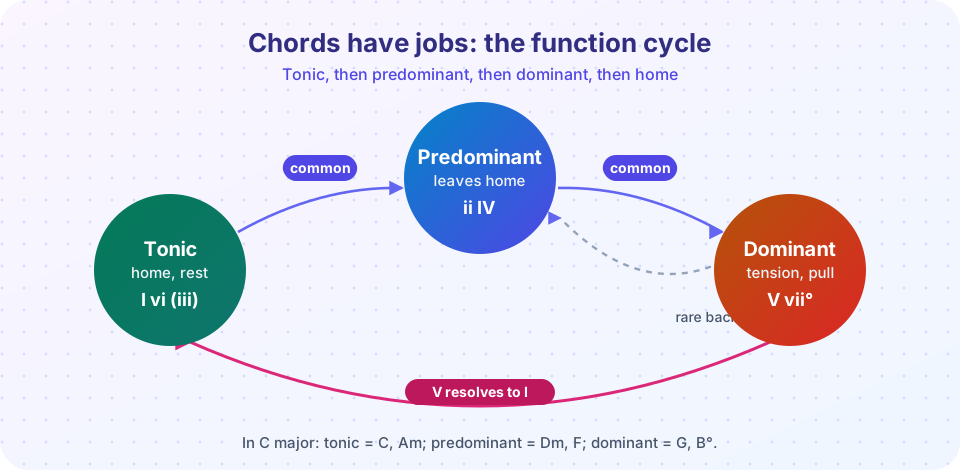
If you plot the three functions in order you get a circle: tonic leads to predominant, predominant leads to dominant, and dominant leads back to tonic. This is the standard flow, and the vast majority of tonal progressions follow it.
- T to PD: leaving home. Very common (I to IV, I to ii).
- PD to D: building tension. Very common (IV to V, ii to V).
- D to T: resolving. The strongest motion in tonal music (V to I).
- T to D: skipping the predominant. Also common (I to V).
- PD to T: a gentler return, as in the plagal "amen" (IV to I).
- D to PD: a backstep (or retrogression), such as V to IV. It sounds less goal-directed and is used mostly in folk, rock and blues, where the loosening is the point.
Since the strongest motion is by descending fifth (root moves down a fifth, or up a fourth), V to I is stronger than I to V. The same logic explains ii to V: D to G is a descending fifth. And vi to ii, iii to vi, IV to vii° are all descending fifths too, which is why the longest standard chain, I-IV-vii°-iii-vi-ii-V-I, sounds so smooth.
Progressions worth knowing
Roman numerals let you keep the pattern and change the key. Here are the most common ones in C major.
| Name | Numerals | Chords in C | Function path |
|---|---|---|---|
| The basics | I-IV-V-I | C F G C | T PD D T |
| Fifties progression | I-vi-IV-V | C Am F G | T T PD D |
| Pop loop | I-V-vi-IV | C G Am F | T D T PD |
| Jazz cadence | ii-V-I | Dm G C | PD D T |
| Pachelbel loop | I-V-vi-iii-IV-I-IV-V | C G Am Em F C F G | T D T T PD T PD D |
| Circle of fifths | I-IV-vii°-iii-vi-ii-V-I | C F B° Em Am Dm G C | all fifths down |
The I-V-vi-IV loop, used in countless pop songs, is interesting because it breaks the cycle. It goes T to D, but then D to vi (a deceptive resolution) and vi to IV, which then falls back to I at the loop point. The loop works not because it follows the textbook path but because each chord shares notes with its neighbor and the whole thing circles around the tonic.
The 12-bar blues uses only I, IV and V, usually as dominant-seventh chords. In C it is C C C C, F F C C, G F C C (often with a turnaround on G at the end). It is the cycle stretched out: a long tonic, a visit to the predominant, a return, and a dominant-led close.
Harmonic rhythm
Harmonic rhythm is how often the chords change. A hymn might change chords every beat, a pop song every bar or two. Slow harmonic rhythm lets one chord feel like a place; fast harmonic rhythm creates a sense of motion. Many composers change chords at a rate that matches the phrase length: the cadence at the end of a phrase usually comes on a strong beat.
Common misconceptions
"A chord's function is fixed by its name." Function depends on the key. G major is dominant in C major, tonic in G major and predominant in D major.
"V must always go to I." It usually does, but composers sometimes send V to vi (deceptive) or to IV (backstep). The strong expectation is what makes these moves interesting.
"vi and iii are always tonic." They are tonic substitutes in some contexts, but iii often behaves as a connector between I and IV, and vi often functions as the start of a chain heading toward ii or IV.
Try it
First, hear the standard progressions. The player chooses smooth voicings automatically (each chord moves as little as possible from the last) and adds a bass note. Watch the function labels light up as the music plays.
Now build your own. Click chords to add them, then ask for a check. The checker names the function of each chord and tells you whether the path follows the cycle.
Check your understanding
Quick check · 4 questions
of 4 answered You scored / 4 · perfect!
-
1. Which pair of chords has the dominant function in a major key?
V and vii° both contain the leading tone and scale degree 2, the notes that most strongly pull to the tonic. -
2. What is the standard order of the function cycle?
Tonic leaves home, a predominant prepares the dominant, the dominant creates tension, and the tonic resolves it. -
3. In the progression I-V-vi-IV, what is unusual compared with the textbook cycle?
V goes to vi, a deceptive motion, and the loop only returns to I when it repeats. -
4. What is a backstep?
Backsteps go against the cycle and sound more relaxed, which is why folk and rock use them freely.
Summary
- Chords have functions: tonic (rest), predominant (departure), dominant (tension).
- The standard cycle is T, PD, D, T; shortcuts and backsteps exist but are used for effect.
- Function comes from tendency tones: the leading tone rises, degree 4 falls to 3.
- Descending-fifth root motion is the strongest, which is why ii-V-I and V-I work so well.
- Roman numerals let you keep the pattern and change the key.
Next: Cadences
Track your progress
Create a free account to tick off lessons and pick up where you left off on any device.
of Music Theory lessons completed