


















Lesson 2 of 50 · Getting Started
The staff, clefs and note names
Learn the seven note letters, the five-line staff, the treble and bass clefs and how to read the lines and spaces, with pictures and a clickable staff.
Written music is a graph. Height on the page means height in pitch: the higher a note sits, the higher it sounds. The grid that makes this graph readable is the staff, five horizontal lines with four spaces between them. A symbol at the start of the staff, the clef, tells you which pitches the lines and spaces stand for. Once you know the seven letter names and the two main clefs, you can read the notes of almost any piece for piano, voice, guitar or orchestra.
This lesson builds that foundation slowly. You will meet the letters first, then the staff, then each clef, and then you will try a clickable staff that names and plays the notes you choose.
What you will learn
- The seven note letters and how they repeat
- How the staff is built and how its lines and spaces are counted
- What the treble clef and bass clef each mean, and why there are two
- Memory tricks for the line and space notes, and where they stop being useful
- How to name a note from its position on either staff
Key terms
Staff (plural staves): five parallel lines and four spaces on which notes are written.
Clef: the sign at the start of a staff that fixes the pitch of one line, and so of all the rest.
Treble clef (G clef): its curl circles the second line from the bottom, which is the G above middle C.
Bass clef (F clef): its two dots straddle the second line from the top, which is the F below middle C.
Grand staff: a treble staff above a bass staff, joined by a brace, as used for piano.
Seven letters, over and over
Western music names its notes with the first seven letters of the alphabet: A B C D E F G. After G the letters start again at A, but higher. If you walk up the white keys of a piano from any A, you will hear the same pattern of seven names repeat in every register. The note that comes eight names after another, for example from one A to the next A, sounds like the "same" note in a higher or lower voice. That distance is the octave, from the Latin word for eight, and the lesson on the keyboard will explain why the notes sound so alike.
The letters rise in alphabetical order going up and fall in reverse order going down. Many beginners stumble because they remember that the alphabet runs A to Z but forget that on the staff it wraps around at G. Say it aloud: "F, G, A, B" going up, and "B, A, G, F" going down. If you can recite these both ways, you are most of the way to note reading.
Building the staff
The staff has five lines. Count them from the bottom: the lowest line is line 1 and the top line is line 5. The spaces between the lines are numbered the same way, from the bottom: space 1 is between lines 1 and 2, and space 4 is between lines 4 and 5. Notes can sit on a line, with the line passing through the middle of the note head, or in a space.
Every step up (line to space, space to line) raises the note by one letter name. A note on line 1 followed by a note in space 1 above it are neighbors in the alphabet, such as E then F in the treble clef. This is a regular pattern, and it is why a staff makes melodies easy to see: a melody that climbs by steps looks like a staircase, and a leap looks like a jump.
A note has a head (the oval), usually a stem (a thin vertical line) and sometimes a flag or beam. For now, only the head's position matters, because that gives the pitch. The stem and flags will tell you the length of the note in chapter 2. A stem points up when the head is below the middle line and down when it is on or above the middle line. This is only a convention to keep the staff tidy, and it never changes the note.
Treble clef: the G clef
The treble clef is the tall curly symbol found at the start of most melodies for the voice, violin, flute, trumpet, guitar and the right hand of the piano. It is also called the G clef because the spiral at its center wraps around the second line from the bottom, and that line is G (the G above middle C). Once one line is fixed, every other note follows.
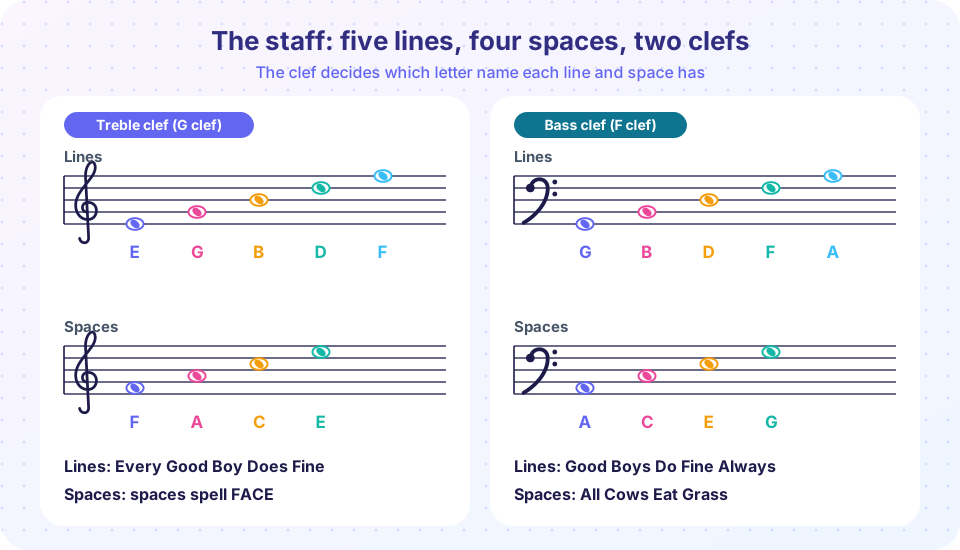
Here are the names in the treble clef:
- Lines from bottom to top: E G B D F. A common sentence: Every Good Boy Does Fine.
- Spaces from bottom to top: F A C E. They spell the word FACE.
If you need a note that is not on the staff, you can count up or down by letters from one you know. For example, the space above the top line (F) is G, and the space below the bottom line (E) is D.
Bass clef: the F clef
The bass clef serves lower sounds: the left hand of the piano, the cello, bassoon, trombone, tuba and the bass guitar. Its two dots straddle the fourth line from the bottom, which is the second line from the top, and that line is F (the F below middle C). It is called the F clef, and its curved form descends from a handwritten F.
- Lines from bottom to top: G B D F A. A sentence: Good Boys Do Fine Always.
- Spaces from bottom to top: A C E G. A sentence: All Cows Eat Grass.
Compare the two clefs position by position. The bottom line is E in the treble clef but G in the bass clef, so the same position carries a letter two names higher in the bass clef (and sounds more than an octave lower). The names are shifted by two, which tempts many learners to translate between the clefs by counting. Resist that: memorize each clef's names on their own, the way you would learn two alphabets.
Why two clefs?
A single five-line staff covers only about an octave and a half. The human ear can hear a range of more than nine octaves, and a piano plays seven and a quarter. Rather than write everything on a very tall staff, music uses a movable reference: the clef. Placing the treble clef on one staff and the bass clef on another puts the high and low notes where each staff can show them without many extra lines. Together they form the grand staff, and the two staves meet at middle C, the note you will study in depth in the lesson on ledger lines.
There are other clefs too. The C clef (alto and tenor clefs) points at middle C. The viola reads the alto clef, and the trombone sometimes reads the tenor clef. You do not need them yet, but it is helpful to know that "a clef" is a general idea: a sign that tells you which line has which name.
Common misconceptions
"The treble clef is for the right hand and the bass clef for the left hand, always." Often, but not always. Pianists play the notes written on each staff with whichever hand is convenient, and hands may cross.
"A note on a line is higher than a note in the space above." No. Pitch goes up as you go up the page, line or space. A note in a space above a line is higher than that line's note.
"The mnemonic sentences are the goal." They are a ladder. Recite them for a week, then drop them: aim to recognize notes by sight, like words in a language you read.
Try it
This staff is clickable. Choose a clef, then click on any line or space (and the ledger positions above and below) to place a note and hear it. The text tells you the note name, the octave number and whether the note is on a line or in a space.
The next example is a small program that does what you just did by hand: it turns a position on the staff into a note name. Position 0 is the bottom line, position 1 is the first space, and so on. Notice that the only difference between the two clefs is the starting note.
Press Run (or Ctrl + Enter) to see the console output here.
No output.
Check your understanding
Quick check · 5 questions
of 5 answered You scored / 5 · perfect!
-
1. Which letters name the spaces of the treble clef from bottom to top?
The treble spaces are F A C E, which spell FACE. E G B D F are the treble lines; A C E G are the bass spaces. -
2. Which line does the curl of the treble clef circle?
The treble clef is the G clef: its spiral wraps around the second line, which is the G above middle C. -
3. The two dots of the bass clef straddle which line?
The dots surround the F line, which is the fourth line from the bottom. That is why the bass clef is also called the F clef. -
4. After the letter G, the next note name going up is:
Only seven letters are used. After G the cycle starts again at A in the next octave. -
5. Why are there two clefs on the grand staff?
A five-line staff spans only about an octave and a half. Two staves with different clefs cover the whole range.
Summary
- Notes use seven letters, A to G, which repeat in each octave.
- The staff has five lines and four spaces, counted from the bottom; pitch rises as you go up the page.
- The treble clef is the G clef: lines E G B D F, spaces F A C E.
- The bass clef is the F clef: lines G B D F A, spaces A C E G.
- The grand staff joins treble and bass for instruments with a wide range, and the two meet at middle C.
- Mnemonics are temporary aids; aim to read notes at sight.
Track your progress
Create a free account to tick off lessons and pick up where you left off on any device.
of Music Theory lessons completed