


















Lesson 6 of 50 · Sound, Notes and Rhythm
Chapter 2 overview: sound, notes and rhythm
See the big picture of chapter 2: the four properties of musical sound, how pitch and duration are written, and what each lesson in the chapter covers.
Chapter 1 taught you where pitches live on the staff and the keyboard. Chapter 2 asks two more questions: what is a pitch, physically? and how long does it last? Together the answers give you the two things you need to write down any melody: which notes, and for how long.
Music is organized sound, and sound is vibration. When a guitar string, a column of air in a flute or a singer's vocal folds vibrate, they push the air around them back and forth. Those pressure changes travel to your ear and your brain turns them into the experience of a note. Everything music theory talks about, from pitch to rhythm to harmony, can be traced to patterns in that vibration.
What you will learn
- The four properties of a musical sound and how theory writes each one
- Why chapter 2 focuses on pitch and duration
- What each of the four lessons in this chapter covers and why they come in this order
Key terms
Frequency: the number of vibrations per second, measured in hertz (Hz); it determines pitch.
Amplitude: the size of a vibration; it determines loudness.
Timbre: the quality that distinguishes a flute from a violin playing the same note at the same loudness.
Duration: how long a sound lasts.
Dynamics: the loud and soft levels of music, written with symbols such as p (soft) and f (loud).
The four properties of sound
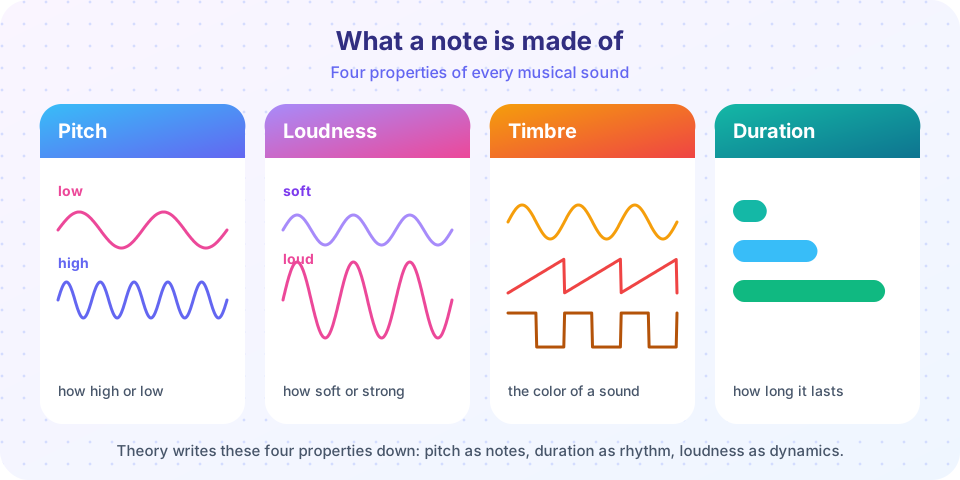
Pick up any note you have ever heard and you can describe it with four properties.
- Pitch is how high or low the note is. It depends on the frequency: faster vibration gives a higher pitch. The A above middle C vibrates 440 times per second. A healthy young listener hears frequencies from roughly 20 Hz to 20,000 Hz; a piano covers about 27.5 Hz to 4,186 Hz.
- Loudness is how strong the sound feels. It depends on the amplitude of the wave: a bigger vibration pushes the air harder. Notation writes loudness with dynamics such as pianissimo (pp, very soft), piano (p, soft), mezzo forte (mf, medium loud), forte (f, loud) and fortissimo (ff, very loud).
- Timbre (pronounced "TAM-ber") is the color or character of a sound. A clarinet and an oboe can play the same pitch at the same loudness and still sound unmistakably different. The reason lies in the shape of the wave, which is built from a mix of overtones. Notation records timbre only indirectly, by naming the instrument or a technique such as pizzicato (plucked).
- Duration is how long the sound lasts. Notation writes duration with note values and rests, and it groups them into measures with a time signature. This is rhythm, and it is the subject of two of the four lessons.
Notice how unevenly theory treats these properties. Pitch and duration are written precisely with symbols that every musician reads the same way. Loudness is written more loosely: forte does not name an exact decibel level. Timbre is mostly left to the performer and the instrument. That is why chapter 2 spends most of its time on pitch and duration.
Why this chapter comes now
You could read a score without knowing how sound works, but you would not understand why certain notes sound consonant or why octaves seem to be the "same note". Chapter 2 supplies the missing physical reasons in a gentle way: you will see harmonics on a staff, hear them in the browser and compute them in a few lines of code. It also prepares the ground for chapters 3 and 4: every scale and chord is a set of frequency relationships, and these relationships are simple ratios, which we will discover in lesson 2.
Rhythm is the other half of the chapter. Pitch tells you what to play, and rhythm tells you when to play it. Without rhythm, a melody is a list of pitches. With rhythm, it becomes a tune you can clap and recognize.
What is in this chapter
Four properties of sound
Your lessons
Your goals
Then a review quiz checks it all.
The four lessons in this chapter:
- Pitch, frequency and timbre explains why 440 Hz is an A, why an octave doubles frequency, what overtones are and why a violin does not sound like a flute. You will see the harmonic series written on a staff and play with different waveforms.
- Note values, dots and ties teaches the whole, half, quarter, eighth and sixteenth notes and rests, how a dot lengthens a note by half, and how a tie joins two notes into one.
- Time signatures and tempo shows how beats are grouped into measures (4/4, 3/4, 6/8 and more) and how tempo in beats per minute sets the speed.
- Chapter 2 review pulls the threads together with a one-page picture and a ten-question quiz.
Common misconceptions
"Higher pitch means louder." Pitch and loudness are independent. A tiny piccolo playing very softly is still much higher than a loud tuba.
"Notes in the same octave are the same note." Notes with the same letter in different octaves share a name, but each has its own pitch and frequency.
"Timbre is just the instrument." Timbre also changes with how a note is played, such as plucking or bowing, and with how loud it is.
Try it
Explore pitch, loudness and waveform together. Drag the sliders while the tone is playing and watch the wave change on the screen. The picture shows 20 milliseconds of the wave: higher frequency packs more cycles into the window, and a higher volume gives taller waves.
The same ideas can be drawn with a few lines of Python. This plot shows a low and a high pitch (frequency) and a soft and loud wave (amplitude) over the same 20 milliseconds.
Press Run (or Ctrl + Enter) to see the result here.
Program input · what you'd type while the program runs
Type the answers before you press Run, one per line. Each time the program reads a line (with input()), it gets the next line from this box.
Check your understanding
Quick check · 5 questions
of 5 answered You scored / 5 · perfect!
-
1. Which property of a wave determines the pitch of a note?
Frequency, the number of vibrations per second, determines pitch. Amplitude determines loudness. -
2. What does f mean as a dynamic marking?
Forte is Italian for strong or loud. Piano (p) means soft. -
3. A clarinet and an oboe play the same note at the same loudness but sound different. This difference is called:
Timbre is the tone color, which comes from the mix of overtones and the way the sound starts and ends. -
4. Which of the four properties is written with note values and rests?
Note values and rests record how long each sound or silence lasts. Pitch is written by position on the staff. -
5. What is the approximate range of human hearing for a healthy young person?
About 20 Hz to 20 kHz. The upper limit declines with age.
Summary
- Sound is vibration; music organizes it using four properties: pitch, loudness, timbre and duration.
- Frequency (in Hz) gives pitch and amplitude gives loudness; timbre depends on the wave's overtone mix.
- Theory writes pitch and duration precisely; loudness and timbre are indicated more loosely.
- Chapter 2 covers pitch and timbre, note values, time signatures and tempo, then reviews them.
Track your progress
Create a free account to tick off lessons and pick up where you left off on any device.
of Music Theory lessons completed