


















Lesson 1 of 50 · Getting Started
Course map: how this music theory course works
Start here: who this music theory course is for, what you need, how the nine chapters fit together and how to practice so the ideas stick.
Music theory is the vocabulary and grammar of music. It gives names to the things your ears already notice: why a melody feels finished, why two notes clash, why a song in a minor key sounds sad to some listeners and tense to others. Theory does not tell you what music must sound like. It describes what composers, players and singers around the world have actually done, so you can understand it, borrow from it and break its patterns on purpose.
This course starts at the very beginning. You will not need to read a note or play an instrument before lesson 1. By the end of the full course you will be able to read standard notation, build every scale and chord, follow a chord progression, analyze a short piece and write a small composition of your own. Every lesson has pictures drawn on real staves and short interactive examples that make sound in your browser.
What you will learn
- Who this course is for and what you need before you start
- How the nine chapters build on one another
- How each lesson is organized, and how to use the sound examples
- A simple weekly routine for turning reading into skill
Key terms
Music theory: the study of how music is put together: notes, rhythm, scales, chords and form.
Notation: the written system (staff, clefs, notes, rests) that records pitch and rhythm on paper.
Pitch: how high or low a sound is.
Rhythm: the pattern of long and short sounds and silences in time.
Harmony: notes that sound at the same time, and how chords follow one another.
Who this course is for
The course is written for three kinds of learner. The first is the complete beginner, perhaps a teenager picking up a guitar or a keyboard for the first time, who keeps hearing words like "key", "chord" and "bar" and wants them to mean something. The second is the self-taught player who can play by ear or from tablature but gets lost when someone says "go to the relative minor" or "that is a tritone substitution". The third is the student preparing for a school exam. The first nine chapters cover the same ground as the grade 1 to 5 theory syllabuses used in many countries, in a way that applies to every instrument and every style.
You do not need to be able to sing. You do not need perfect pitch, a gift that a small fraction of people have and that no theory exam requires. You do need curiosity and a pair of speakers or headphones for the interactive examples. If you have a piano, keyboard, guitar or even a free keyboard app, keep it nearby: it lets you check every idea against real sound.
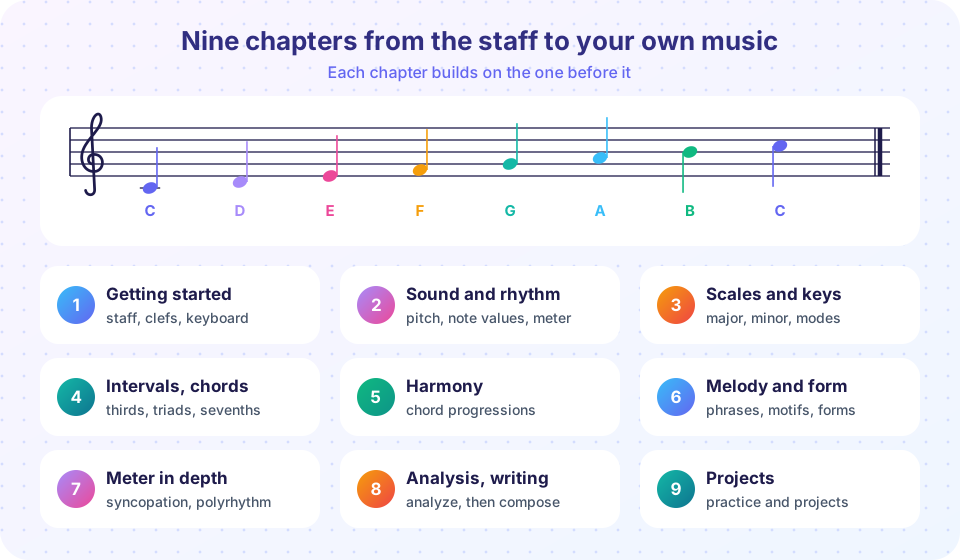
What the nine chapters cover
Each chapter ends with a review lesson and a quiz, so you always know whether to move on or revisit.
Read and hear
- Getting started
- Sound and rhythm
Build the materials
- Scales and keys
- Intervals and chords
Put them in motion
- Harmony
- Melody and form
Go deeper
- Rhythm in depth
- Analysis, composition
Make music
- Projects
Everything leads to your own music.
Chapters 1 and 2 give you the alphabet: how pitch is written, how time is divided. Chapters 3 and 4 give you the building blocks, scales and chords. Chapters 5 and 6 show how those blocks move through time as progressions, melodies and forms. Chapter 7 returns to rhythm with more advanced tools. Chapter 8 trains your analytical eye and then your pen as you analyze pieces and write your own. Chapter 9 collects projects and practice sets.
How each lesson is organized
Every content lesson follows the same skeleton, so you can always find what you need:
- What you will learn lists three to five outcomes. Read it first, and read it again at the end to check yourself.
- Key terms gives short definitions of the new words. Music theory has many names for things; learning them gradually is part of the job.
- The body teaches the idea with worked examples and an illustration, usually of a real staff or keyboard.
- Common misconceptions names mistakes that learners tend to make and corrects them.
- Try it gives short examples you can run. Many of them play sound.
- Check your understanding is a short quiz with explanations, and Summary lists the takeaways.
Overview lessons open each chapter with the big picture, and review lessons close it with a one-page picture and a longer quiz.
Hearing before reading
Theory is about sound, so the interactive examples matter as much as the text. They use the Web Audio API built into your browser: a small program creates an oscillator, a simple electronic generator of a pure tone, and shapes it into a note. No audio files are downloaded. Browsers only allow sound after you press a button, which is why every example has a Play button. If you hear nothing, check that the page is not muted and that your system volume is up.
A simple habit helps more than anything else: say what you expect before you press Play. If a lesson says an interval is "tense", predict how it will feel, then listen. Your ear learns fastest when it has been asked a question.
A routine that works
Ten to fifteen minutes a day beats a two-hour burst once a week, because recognizing notes and rhythms is a skill like reading a language. A good weekly pattern is three short sessions. In the first, read the lesson and run the examples. In the second, do the quiz without looking back, then check the explanations. In the third, apply the idea to a piece you already know: find the key signature of a song, count the beats of a melody, name the chords in a chorus. Applying a concept to real music is what turns a definition into understanding.
Common misconceptions
"Theory kills creativity." Most great composers studied theory, but theory describes music; it does not set rules for it. The aim is to give you more choices, including the choice to break a pattern with purpose.
"You must read notation before you can learn theory." Notation is just one way to write music down. You will learn it step by step in chapter 1, and every written example also has sound.
"You need perfect pitch." Perfect pitch (naming a note with no reference) is rare and not required. What you need is relative pitch, hearing how notes relate to each other, and that can be trained.
Try it
First, make a sound. This example plays the note A above middle C, the standard tuning note of 440 vibrations per second.
Now try a keyboard. Click the keys (or press the letters on your computer keyboard, A to K) to play the white keys from middle C up to the C above it. The note names are printed on the keys: you will learn what they mean in this chapter.
Check your understanding
Quick check · 4 questions
of 4 answered You scored / 4 · perfect!
-
1. Which statement best describes music theory?
Theory describes what musicians actually do, so you can understand, borrow and deliberately break patterns. It is not a rulebook and it does not require perfect pitch. -
2. Why does every sound example in this course have a Play button?
Browsers block automatic sound for the user's benefit. The tones are generated live by oscillators, not downloaded files. -
3. Which chapter introduces the idea of chords?
Chapters 3 and 4 supply the building blocks. Scales come first, then intervals and chords are built from them. -
4. Which study habit does the lesson recommend?
Regular short practice plus application to real songs turns definitions into skills.
Summary
- Music theory describes the vocabulary and grammar of music; it does not limit what you may write.
- The course has nine chapters: reading and rhythm, scales and chords, harmony and melody, deeper rhythm, analysis and composition, and projects.
- Every lesson follows the same skeleton: outcomes, key terms, body, misconceptions, examples, quiz, summary.
- The sound examples are generated by your browser and start only when you press a button.
- Short regular practice, applied to real songs, works best.
Track your progress
Create a free account to tick off lessons and pick up where you left off on any device.
of Music Theory lessons completed