


















Lesson 11 of 50 · Scales and Keys
Chapter 3 overview: scales and keys
See how scales are built from whole and half steps, why the first note feels like home, and what you will learn about major, minor, modes and keys in chapter 3.
Sing "Do, re, mi, fa, sol, la, ti, do" and you have sung a scale. Most people have done it, and almost everyone knows the feeling of the last note: it sounds like a destination, and stopping on "ti" instead is deeply unsatisfying. That feeling of tension and arrival is one of the most powerful ideas in Western music, and it comes from the way a scale is organized.
A scale is an ordered set of notes within an octave, climbing from a starting note to the same note an octave higher. Melodies are made mostly of scale notes, and chords are built by stacking them, so scales are the raw material of both. A key is the scale a piece is based on, together with the sense of "home" that goes with it. This chapter shows how to build scales, name their notes, find the key of a song and understand why the scales sound the way they do.
What you will learn
- What a scale is and what scale degrees are
- The idea of a tonic, the note that feels like home
- How scales differ in size: pentatonic, diatonic, chromatic
- What each of the six lessons in this chapter covers
Key terms
Scale: an ordered series of pitches within an octave, defined by a pattern of steps.
Tonic: the first note of a scale, the note that feels like home.
Scale degree: the position of a note in a scale, numbered from the tonic (1 to 7).
Diatonic scale: a seven-note scale with five whole steps and two half steps, such as the major scale.
Key: the tonic and scale that a piece of music is organized around.
What makes a scale
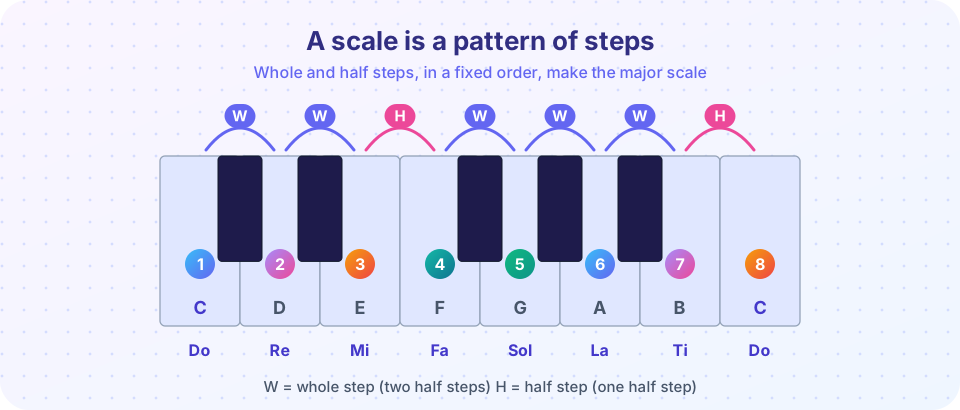
A scale is defined by two things: its starting note (the tonic) and its pattern of steps. The pattern is the identity. The pattern whole, whole, half, whole, whole, whole, half (written W W H W W W H) always gives a major scale, whatever the starting note. On the white keys, starting from C, you get the C major scale: C D E F G A B C. Starting on G with the same pattern, you need F sharp to keep the pattern, giving G major. The notes change, but the shape stays the same, like a melody transposed to another register.
Each note of the scale is called a scale degree, numbered 1 to 7 from the tonic (and 8 for the octave, which repeats degree 1). Degrees also have names: tonic (1), supertonic (2), mediant (3), subdominant (4), dominant (5), submediant (6) and leading tone (7). The names describe their roles, and you will meet them again in harmony: the dominant pulls toward the tonic, and the leading tone, a half step below the tonic, practically begs to resolve upward.
Notes in a scale differ in how stable they feel. The tonic is the most stable, the dominant (5) nearly as much, and the leading tone (7) is the least stable. A melody is like a journey: it leaves home, wanders through unstable notes and returns. Understanding this gives scales their emotional power. Singers know the effect: the syllables do re mi fa sol la ti do (solfège) attach a sound to each degree.
Scales of different sizes
Not every scale has seven notes. Three of the most useful kinds are:
- Pentatonic scales have five notes per octave. The major pentatonic (C D E G A) leaves out the two notes that create half steps in the major scale, so it avoids clashes. It appears in folk music across the world, from Scotland to China to West Africa.
- Diatonic scales have seven notes, and the major and the natural minor scales are the most important. "Diatonic" means the notes use five whole steps and two half steps, with the half steps spread apart.
- Chromatic scales use all twelve half steps in an octave. It is not "in a key": it includes every key on the piano.
Other scales exist too: the whole-tone scale has six notes, each a whole step apart, which gives a dreamy, floating sound that composers like Debussy used. Musical traditions in other parts of the world use scale systems with different steps, including the maqam of Arabic music and the raga system of India, both of which include intervals smaller than a half step. Scales are not natural laws; they are human choices that sound meaningful within a tradition.
What is in this chapter
The building blocks
More colors
By the end you can
Everything in chapter 4 is built from these notes.
The lessons, in order:
- The major scale teaches the W W H W W W H pattern, scale degrees and how to build a major scale on any note.
- Key signatures and the circle of fifths shows how the sharps and flats of a key are collected at the start of the staff, and how all twelve keys are related.
- Minor scales covers natural, harmonic and melodic minor, and relative and parallel minors.
- Modes, pentatonic and blues scales explores the seven modes, the five-note pentatonic scales and the blues scale.
- Chapter 3 review summarizes everything with a cheat-sheet picture and a quiz.
Common misconceptions
"A major scale is just the white keys." Only C major uses only white keys. Every other major scale uses black keys, because the pattern, not the white-key layout, defines it.
"Scales are things you only practice." Scales are the vocabulary of melodies. A tune is not a scale, but its notes come from one.
"Major is happy and minor is sad." The tendency is real in much Western music, but it is a cultural association, not a law. Many fast minor-key pieces are exhilarating, and some major-key songs are sad.
Try it
Choose a scale and a starting note and listen to it ascend. The notes light up as they sound. The step pattern is shown under the notes: W is a whole step and H is a half step. Compare how major, natural minor and pentatonic scales feel.
The same idea in code: a scale is a starting note plus a list of step sizes. Add up the steps and you have the notes. Try adding your own pattern.
Press Run (or Ctrl + Enter) to see the console output here.
No output.
Check your understanding
Quick check · 5 questions
of 5 answered You scored / 5 · perfect!
-
1. What is the first note of a scale called?
The tonic is degree 1, the home note of the scale. -
2. How many notes are in a pentatonic scale (per octave, not counting the repeated octave note)?
Penta means five. Pentatonic scales have five notes per octave. -
3. Which scale uses all twelve half steps in an octave?
The chromatic scale moves by half steps and includes every key on the piano. -
4. What defines a major scale regardless of its starting note?
The step pattern defines the scale. Only C major happens to use white keys alone. -
5. Which degree is the leading tone?
The leading tone is the seventh degree, one half step below the tonic, and it leads upward to it.
Summary
- A scale is a tonic plus a pattern of steps; the pattern gives it its identity and sound.
- Scale degrees are numbered 1 to 7 and have names such as tonic, dominant and leading tone.
- Pentatonic scales have five notes, diatonic scales seven and the chromatic scale twelve.
- Major and minor are the two main diatonic scales of Western music; other cultures use other scale systems.
- Chapter 3 covers major, keys, minor, modes, pentatonic and blues scales.
Next: The major scale
Track your progress
Create a free account to tick off lessons and pick up where you left off on any device.
of Music Theory lessons completed