


















Lesson 35 of 50 · Rhythm and Meter in Depth
Syncopation and polyrhythm
Learn how syncopation puts accents off the beat, how clave patterns organize Latin music, and how polyrhythms such as 3 against 2 work, with playable grids.
A marching band stamps on every beat and the result is solid, square and predictable. Now imagine the cornets entering half a beat late, right between the stamps. The music suddenly leans, lilts and pushes forward. That is syncopation, and it is one of the most powerful tools in rhythm. A step further, imagine two groups of players, one dividing the bar into three equal parts and another into two. Their notes line up only at the start and then drift apart and meet again. That is polyrhythm. Syncopation plays with the beat; polyrhythm plays two beats against each other. Between them they explain much of what makes jazz swing, Latin music dance, funk groove and a good deal of classical music surprising.
What you will learn
- What syncopation is and the three main ways to create it
- How to count and write syncopated rhythms
- How clave patterns such as the son clave organize a whole style of music
- What a polyrhythm is, and how 3:2 and 4:3 work
- The difference between polyrhythm and polymeter
Key terms
Syncopation: a rhythmic effect in which accents or long notes fall on weak beats or between beats.
Backbeat: an accent on beats 2 and 4 of a 4/4 bar, as in rock and pop.
Anticipation: arriving on a beat early, usually half a beat before.
Clave: a repeating five-hit rhythm that acts as the organizing pattern of Afro-Cuban music.
Polyrhythm: two or more different groupings of the same span of time sounding together, such as 3 against 2.
Syncopation: accents in unexpected places
In 4/4 the natural accents fall on beat 1 (strongest) and beat 3 (medium), then 2 and 4 (weaker). Between the beats lie the "and" positions, the weakest of all. Syncopation puts weight where the meter does not expect it. There are three common ways.
- An accent on a weak position. A short note at the "and" gets a strong accent, as in the backbeat of rock, where the snare hits beats 2 and 4 instead of 1 and 3.
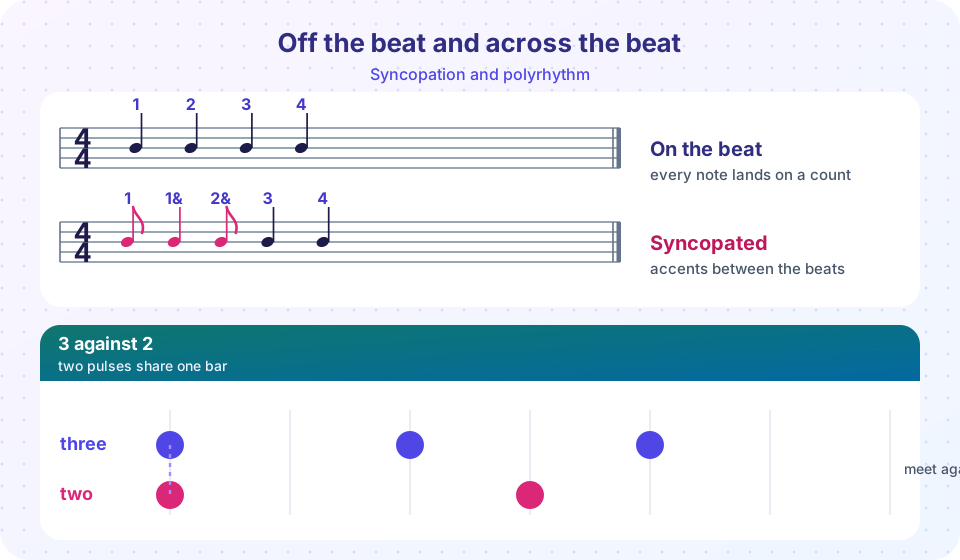
- A note held across a strong beat. A note starts on a weak position and is tied or held through the next strong beat, so the strong beat arrives without a new attack. In the picture above, the middle quarter note of the syncopated rhythm starts on the "and" of 1 and is still sounding when beat 2 passes.
- A rest on a strong beat. If the downbeat is silent and the music begins just after it, the beat is implied but not heard; the listener feels it only because it is missing.
The picture's syncopated bar is: eighth, quarter, eighth, quarter, quarter, which counts "1, 1-and (long), 2-and, 3, 4". Listeners usually describe the effect as "off-beat" or "pushing". Ragtime composers such as Scott Joplin built entire pieces on a syncopated right-hand melody over a steady left-hand beat. In reggae the chords land on the "and" of every beat (the skank), leaving the beats themselves for bass and drums. In funk the first beat (the "one") is emphasized, while sixteenth-note syncopations fill the space around it.
Anticipation and the tied note
Pop and jazz arrangers love anticipation: a chord that is due on beat 1 of the next bar arrives half a beat early, on the "and" of 4. In notation the anticipated note is often tied over the bar line. The harmony hurries, the melody stays, and the music leans forward.
A related trick is an accent regrouping, where accents recur every three eighths in a bar of 4/4 (3 + 3 + 2). That pattern, called the tresillo, is the rhythmic building block behind countless Latin, rock and pop rhythms.
The clave
In Afro-Cuban music (son, rumba, salsa) a repeating pattern called the clave (Spanish for "key") acts as the timeline that every other part must fit. The best-known version is the son clave, five hits spread over two bars of 4/4. Counting eighth notes across the two bars (steps 1 to 16), the hits fall on steps 1, 4, 7, 11 and 13.
- The first bar, with three hits, is the "three side".
- The second bar, with two hits, is the "two side".
- Played in that order it is a "3-2" clave; reverse the bars and you get a "2-3" clave.
Variants include the rumba clave (the third hit of the three side is moved one step later) and the bossa nova clave used in Brazilian-influenced jazz. Whether a melody is "3-2" or "2-3" decides how bass lines and horns are phrased, so musicians in the style are acutely aware of which side they are on. Try the grid at the end of this lesson to hear the differences.
Polyrhythm: two pulses at once
A polyrhythm (or cross-rhythm) occurs when two groups divide the same stretch of time in different ways. The simplest is 3 against 2: in one bar, one part plays three equally spaced notes and another plays two. To find where the notes fall, use the least common multiple: divide the bar into six equal units. The three-part plays on units 1, 3 and 5; the two-part plays on units 1 and 4. They coincide only on unit 1. Because the groupings share no other points, the sound has a rolling, interlocking feel that is both stable and surprising.
| Ratio | Grid size | Part A hits at units | Part B hits at units |
|---|---|---|---|
| 3 : 2 | 6 | 1, 3, 5 | 1, 4 |
| 4 : 3 | 12 | 1, 4, 7, 10 | 1, 5, 9 |
| 5 : 4 | 20 | 1, 5, 9, 13, 17 | 1, 6, 11, 16 |
Pianists meet polyrhythm in works such as Chopin's Fantaisie-Impromptu, where the right hand plays four notes against three in the left, and in many pieces by Brahms and Schumann with three against two. In West African drum ensembles several drummers play interlocking patterns that sound like polyrhythms, and these traditions deeply influenced jazz and Latin music.
To play 3 against 2 yourself, count the six units out loud, "1 2 3 4 5 6". Tap one hand on 1, 3 and 5 and the other on 1 and 4. Do it slowly until it locks; the body figures it out faster than the head.
Polyrhythm versus polymeter
A polymeter uses two different time signatures at the same time with a shared pulse: for example a bass line in 3/4 and a melody in 4/4 so that the bar lines drift apart and realign after twelve beats. In a polyrhythm the pulse itself is divided differently (3 against 2 within one bar). The difference is whether the underlying beat is shared (polymeter) or reinterpreted (polyrhythm). The two terms are often confused, even by musicians.
Common misconceptions
"Syncopation means playing off the beat." It means emphasizing a weak position. If the music never confirms the beat anywhere (in the bass or drums), it is simply a different pulse, not a syncopation.
"Polyrhythm is advanced and only for drummers." You hear it every time a waltz melody floats against a steady accompaniment, and you play it whenever you tap three against two. Treat it as a skill to practice slowly.
"The clave is just a metronome pattern." It is closer to a hidden rule for how the bass, piano and horns place their accents. Musicians describe a part as "in clave" when it fits.
Try it
First experiment with polyrhythm. Choose a ratio and listen to the two layers together. The high bell plays the first number of notes per cycle and the low drum plays the second. Watch the dots and the sweeping line.
Second, shape a syncopated groove. There are three lanes (kick, snare and chord) over eight eighth-note steps. Presets show a straight beat, the rock backbeat, the reggae off-beat chord and a syncopated pattern.
Check your understanding
Quick check · 5 questions
of 5 answered You scored / 5 · perfect!
-
1. What defines syncopation?
Syncopation emphasizes positions the meter treats as weak. -
2. How many units are needed to place 3 against 2 on one grid?
The least common multiple of 3 and 2 is 6: one part plays on units 1, 3, 5 and the other on 1 and 4. -
3. How many hits are in a son clave pattern?
The son clave has five hits across two bars: three in one bar and two in the other. -
4. What is the difference between polyrhythm and polymeter?
Polymeter keeps the pulse and changes the bar length; polyrhythm changes how a span of time is divided. -
5. In the rock backbeat, which beats does the snare usually hit?
The snare accent on 2 and 4 is the backbeat, a built-in syncopation against the strong beats 1 and 3.
Summary
- Syncopation moves accents to weak positions through off-beat accents, held notes across the beat or silent downbeats.
- The clave is a five-hit timeline that organizes Afro-Cuban music; 3-2 and 2-3 are the same pattern with the bars swapped.
- A polyrhythm places two different divisions of one span on top of each other; the grid size is the least common multiple.
- Polymeter shares a pulse but uses different bar lengths.
Next: Odd and additive meters
Track your progress
Create a free account to tick off lessons and pick up where you left off on any device.
of Music Theory lessons completed