


















Lesson 31 of 50 · Melody and Form
Phrases, periods and sentences
Learn how melodies are built from phrases, how a period pairs a question with an answer, how a sentence builds momentum, and how to find phrase boundaries.
Say a sentence aloud and notice how your voice behaves. It starts, it carries some momentum, it reaches a high point, and it comes to rest. The rise and fall is the phrase of speech. Music has the same unit. A musical phrase is a stretch of music that expresses a complete thought and ends with a point of rest, short or long. When you sing "Happy Birthday" you naturally breathe at the ends of the phrases, and when you listen to a symphony you feel the music pause and move on without being told where the pauses are. This lesson teaches you to see those sentences on the page, and to build bigger structures from them: the two most important being the period and the sentence.
What you will learn
- What a phrase is, how long it usually is and how to find where it ends
- How a period pairs an antecedent and a consequent
- The difference between a parallel and a contrasting period
- How a sentence builds momentum: presentation, then continuation
- Why composers stretch, trim and overlap phrases
Key terms
Phrase: a musical thought that ends at a cadence or a point of rest, often four bars long in simple music.
Antecedent: the first phrase of a period; it ends unresolved, usually on a half cadence.
Consequent: the second phrase of a period; it answers the antecedent and ends with an authentic cadence.
Sentence: a phrase structure with a presentation (an idea and its repeat) followed by a continuation that speeds up toward a cadence.
Elision: two phrases overlapping so that the last note of one is the first of the next.
What makes a phrase
Look for four signs that a phrase has ended.
- A cadence. The harmony arrives at a resting point (see cadences).
- A long note or a rest. The melody pauses or slows, like a breath.
- A return of the opening idea. When the first motif reappears, a new phrase has usually started.
- A change in direction or energy. After a peak, the line falls and settles.
In simple music, phrases are very often four bars long in 4/4 or 2/4 (sixteen beats in 4/4), partly because that is a comfortable length to breathe and partly because dance and song fall naturally into groups of two and four. This is a tendency, not a rule. Phrases of three, five, six or seven bars occur wherever a composer wants to surprise you, and the "extra" bars often make the music memorable.
Phrases are made of smaller units. A four-bar phrase is typically two two-bar ideas: the first sets something out, the second reacts. If bars 1-2 are the question, bars 3-4 are the answer, and the whole can again be the question to which the next four bars reply.
The period
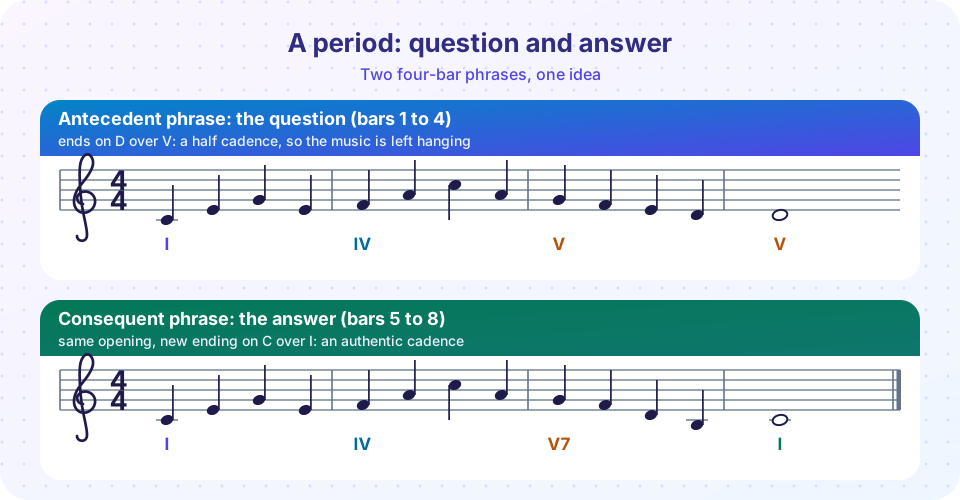
A period is a pair of phrases, antecedent and consequent, that work as question and answer. The image above shows the pattern: the antecedent (bars 1-4) ends on D over a dominant chord. That is a half cadence, a pause that sounds incomplete. The consequent (bars 5-8) starts the same way but ends on C over the tonic, a perfect authentic cadence, the full stop.
The words come from logic: the antecedent is what comes first and prepares the consequent, which follows from it.
- In a parallel period the two phrases begin the same way and differ only near the end, as in the picture. This is the clearest type and appears all the time in folk tunes and Classical themes.
- In a contrasting period the consequent begins with new material but still ends with a stronger cadence.
- In a double period four phrases are grouped: two antecedent-like phrases and two consequent-like ones, forming sixteen bars. The cadences get stronger in steps: for instance half cadence, weak authentic, half, then strong authentic.
The tune "Ode to Joy", which you met in the chapter overview, is a parallel period: its two four-bar phrases begin identically, the first ending on D and the second on C.
The sentence
A sentence is a different way of building eight bars (or four, or sixteen), and it has more drive. It splits into a presentation and a continuation in the proportion 1 : 1 : 2.
- Presentation (bars 1-4 in an eight-bar sentence): a basic idea (two bars), then its repetition (two bars), often changed slightly, for instance over a different chord or at a different pitch. The repetition says "this is important".
- Continuation (bars 5-8): the idea is fragmented into shorter units, the rhythm tends to speed up and the harmony changes faster, until a cadence ends the sentence.
The sentence is the most common structure for themes in Classical sonatas (Haydn, Mozart, Beethoven), and you can hear its logic in the opening of Beethoven's fifth symphony: a four-note motif, its repetition one step lower, then fragments of the motif piling up with growing intensity. The energy comes from repeat-then-accelerate, so a sentence feels propulsive in a way that a period does not.
| Feature | Period | Sentence |
|---|---|---|
| Layout | 4 + 4 bars | 2 + 2 + 4 bars (or 1 + 1 + 2) |
| Feel | question and answer | statement, restatement, drive |
| Cadence | half, then authentic | one strong cadence at the end |
| Opening material | antecedent and consequent begin alike or similar | idea, repeat, then fragments |
Stretching and overlapping phrases
Composers rarely write the same four bars over and over. They use several techniques.
- Extension: adding bars to a phrase, perhaps by repeating the cadence or inserting a sequence.
- Elision: the last note of one phrase is also the first note of the next, so the join disappears and the music sounds seamless.
- Phrase repetition with change: the same phrase heard again with a new ending, as in the consequent.
- Hypermeter: if you count bars as beats, a four-bar phrase has a strong first bar, a weak second, a medium third and a weak fourth. A composer can shift this accent, adding an extra bar to trick your expectations.
Common misconceptions
"A phrase is always four bars." Four bars is the usual length in simple music, but phrases of three, five or seven bars are common in expressive music. Count what the music does, not what a textbook says.
"The consequent just repeats the antecedent." It repeats the opening but must arrive somewhere different: a stronger cadence is what makes it an answer.
"A sentence is a kind of period." They are separate structures. A period is two phrases; a sentence is one phrase built as idea, repeat, continuation.
Try it
Here is the tune from the picture, in C major with simple chords. Compare the three versions: the real period, two questions in a row, and two answers in a row.
Now hear a short sentence. The basic idea (bar 1) is repeated on a new chord (bar 2), then bar 3 fragments it into faster notes, and bar 4 cadences.
Check your understanding
Quick check · 5 questions
of 5 answered You scored / 5 · perfect!
-
1. What does an antecedent phrase usually end with?
The antecedent asks a question, so it ends unresolved, normally on V. -
2. Which proportion describes a standard sentence?
A basic idea, its repetition, then a continuation twice as long: 1 : 1 : 2. -
3. What happens in the continuation of a sentence?
Fragmentation and faster harmonic rhythm give a sentence its drive. -
4. What is an elision?
In an elision the end of one phrase is also the beginning of the next. -
5. In a parallel period, what is the main difference between the antecedent and the consequent?
The two phrases start alike, but the consequent finishes with a stronger cadence.
Summary
- A phrase is a musical sentence ending at a cadence or point of rest; four bars is typical.
- A period joins an antecedent (ending on a half cadence) with a consequent (ending on an authentic cadence).
- A sentence presents an idea, repeats it, then fragments it and accelerates to a cadence in a 1 : 1 : 2 proportion.
- Extension and elision let composers stretch or join phrases for surprise.
Track your progress
Create a free account to tick off lessons and pick up where you left off on any device.
of Music Theory lessons completed