


















Lesson 49 of 50 · Projects and Practice
One-page cheat sheet: harmony, form, rhythm and analysis
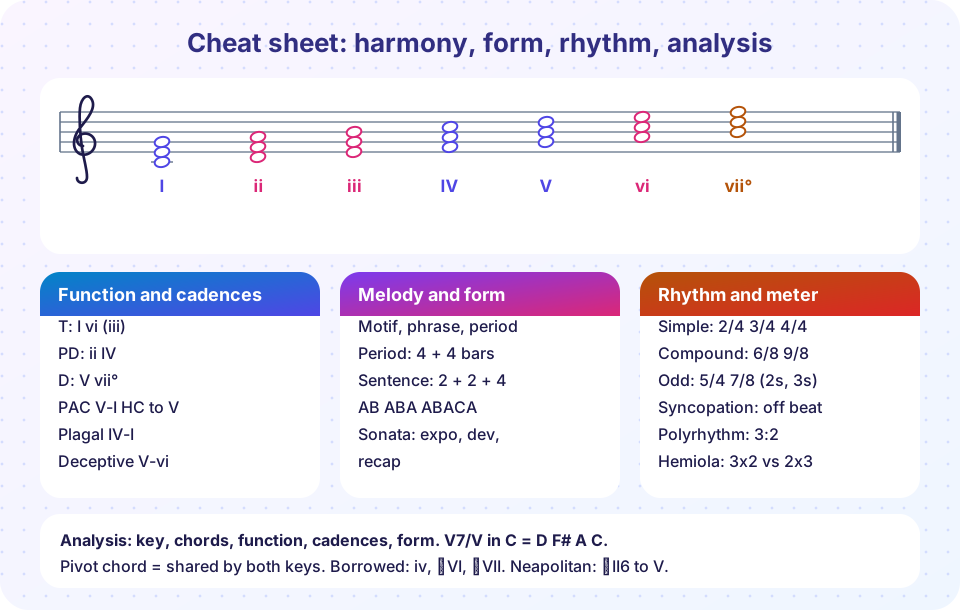
A one-page recap of chapters 5 to 8: the seven triads, functions, cadences, voice-leading rules, forms, odd meters, formulas and the analysis routine, with a lookup tool.
This page is the part of the course you will return to most. It condenses chapters 5 to 8 into one big picture and a set of quick-reference tables: what to check, what to remember and which formula to use. Print it, pin it above the piano or keep it open while you analyze or compose. Every item links back to a full lesson if you need the reasoning.
What you will learn
- Where to find each key fact of chapters 5 to 8 at a glance
- Which formulas to use for tempo, polyrhythm and meter
- How to check an analysis quickly
Key terms
Cheat sheet: a short reference of the most useful facts.
Quick test: a one-line question that checks whether you know a fact.
Routine: a fixed order of steps that you follow every time.
Harmony
| Item | Rule |
|---|---|
| Triad qualities in a major key | I M, ii m, iii m, IV M, V M, vi m, vii° dim |
| Triads in minor (with raised 7th) | i, ii°, III, iv, V, VI, vii° |
| Roman numerals | uppercase major, lowercase minor, ° diminished, + augmented |
| Functions | tonic: I vi (iii); predominant: ii IV; dominant: V vii° |
| Standard cycle | T, PD, D, T |
| Strongest root motion | down a fifth (V to I, ii to V) |
| Inversions | 6 (third in bass), 6/4 (fifth in bass); sevenths 6/5, 4/3, 4/2 |
Common progressions in C: I-IV-V-I (C F G C), I-vi-IV-V (C Am F G), I-V-vi-IV (C G Am F), ii-V-I (Dm G C), Pachelbel loop I-V-vi-iii-IV-I-IV-V.
Cadences
| Cadence | Chords | Feel |
|---|---|---|
| Perfect authentic | V(7) to I, root position, melody on 1 | full stop |
| Imperfect authentic | V to I with an inversion or melody on 3 or 5 | semicolon |
| Half | any chord to V | comma |
| Plagal | IV to I | amen |
| Deceptive | V to vi | surprise |
Voice leading
Keep common tones. Move by step. Use contrary motion between outer voices. No parallel fifths or octaves. Leading tone up, chordal seventh down. Double the root; never the leading tone. Keep upper voices within an octave of each other.
Melody and form
| Item | Rule |
|---|---|
| Contour shapes | arch, inverted arch, ascending, descending, wave, static |
| Motif changes | repetition, sequence, inversion, retrograde, augmentation, diminution, fragmentation |
| Period | antecedent (HC) + consequent (PAC), 4 + 4 bars |
| Sentence | idea + repeat + continuation, 2 + 2 + 4 (or 1 + 1 + 2) |
| Binary | A B, each repeated |
| Ternary | A B A |
| Rondo | A B A C A (refrain in tonic) |
| Sonata | exposition (tonic, then dominant) / development / recapitulation (all in tonic) |
Rhythm and meter
| Item | Rule |
|---|---|
| Syncopation | accent on a weak position |
| Backbeat | snare on 2 and 4 |
| Son clave 3-2 | steps 1, 4, 7, 11, 13 of 16 eighth-note steps |
| Polyrhythm grid | least common multiple (3:2 is 6, 4:3 is 12, 5:4 is 20) |
| Odd meters | 5/4 = 3+2 or 2+3; 7/8 = 2+2+3, 3+2+2, 2+3+2; 9/8 = 2+2+2+3 or 3+3+3 |
| Hemiola | six pulses as 3+3 or 2+2+2 |
| Metric modulation | new tempo = old tempo × y ÷ x |
Example: old triplet quarter (x = 2/3) becomes the new quarter (y = 1) at 120: new tempo = 120 × 1 ÷ (2/3) = 180.
Analysis and composition
Routine: survey, key, chords (with inversions), function, cadences, form. Accidental clues: a leading tone to the next chord means a secondary dominant; a flat in a major key means a borrowed chord; a new key's V7 followed by a cadence means a modulation.
| Spelling in C major | Chord |
|---|---|
| V7/V | D F♯ A C |
| V7/ii | A C♯ E G |
| V7/vi | E G♯ B D |
| Borrowed iv, ♭VI, ♭VII | Fm, A♭, B♭ |
| Neapolitan in C minor | D♭ major (first inversion: F A♭ D♭) |
| Italian sixth in C minor | A♭ C F♯ |
Composing: frame, cadences, chords, melody on chord tones, decorate with passing and neighbor tones, develop a motif, add bass, polish.
Try it
Search the cheat sheet. Type a word (for instance "cadence", "7/8" or "sequence") and see every entry that matches.
Next, a translator from Roman numerals to chords. Choose a key, type numerals separated by spaces (for example I vi IV V7 or I V7/V V7 I), and see the chord names and hear them.
Check your understanding
Quick check · 4 questions
of 4 answered You scored / 4 · perfect!
-
1. Which tempo results from a triplet quarter becoming the quarter at quarter = 120?
New tempo = 120 x 1 / (2/3) = 180. -
2. Which are the predominant chords in a major key?
ii and IV prepare the dominant. -
3. What is the first step in the analysis routine?
Looking at the whole piece first prevents mistakes later. -
4. Which is the correct spelling of V7/vi in C major?
V7/vi is the dominant seventh of A minor: E G# B D.
Summary
- Triads: M m m M M m dim; functions T, PD, D; cadences full stop, comma, amen, surprise.
- Voice leading: common tones, steps, contrary motion, no parallel fifths or octaves.
- Forms: AB, ABA, ABACA, sonata; period 4 + 4, sentence 2 + 2 + 4.
- Rhythm: syncopation, clave, polyrhythm grids, 2s and 3s for odd meters, new tempo = old × y ÷ x.
- Analysis: survey, key, chords, function, cadences, form; accidentals are clues.
Next: Where to go next
Track your progress
Create a free account to tick off lessons and pick up where you left off on any device.
of Music Theory lessons completed