


















Lesson 37 of 50 · Rhythm and Meter in Depth
Hemiola and metric modulation
Understand hemiola, the trick of regrouping six pulses as 3+3 or 2+2+2, and metric modulation, which changes tempo by turning a note value into the new beat.
Two of the most elegant rhythmic ideas work not by adding notes but by changing how you count them. In a hemiola, the same six pulses are heard first as two groups of three and then as three groups of two, and the music seems to shift gear without anything actually changing. In a metric modulation, a note value from the old tempo becomes a different note value in the new one, so that the tempo changes smoothly, like gears meshing. Both rely on a single fact: what we call beats are interpretations that the mind places on a stream of evenly timed sounds. Change the interpretation, and the music changes.
What you will learn
- What a hemiola is, how it sounds and where composers use it
- The difference between sequential and simultaneous hemiola
- How cadential hemiola slows a phrase down before its ending
- What metric modulation is and why it works
- How to calculate a new tempo from a common note value
Key terms
Hemiola: from Greek for "one and a half". A shift between grouping six pulses as 3 + 3 and as 2 + 2 + 2, a 3:2 relationship.
Sesquialtera: an older term for the same 3:2 ratio.
Metric modulation: a change of tempo and/or meter achieved by treating a note value of the old tempo as a different note value in the new one.
Pivot value: the note value that stays the same length across the change.
Common value: another name for the pivot.
Hemiola: two ways to hear six
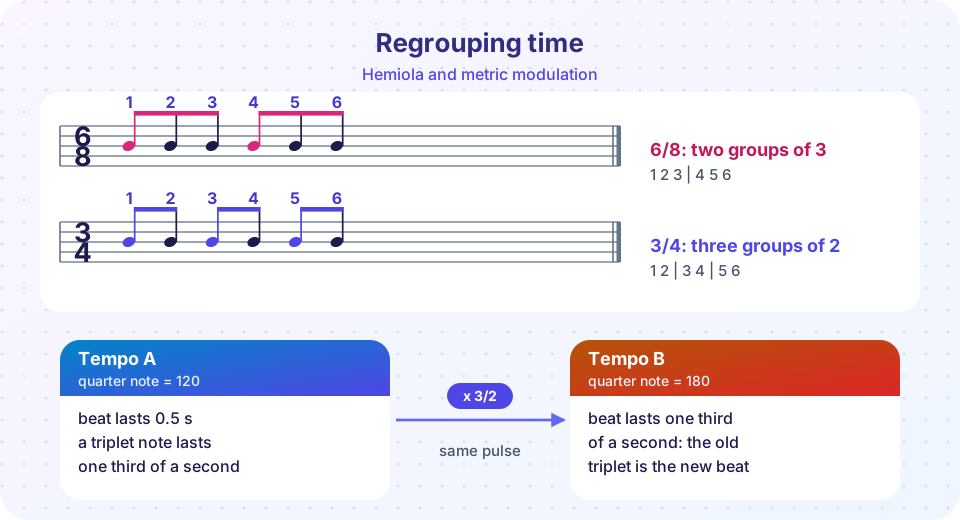
Count six eighth notes. You can group them as 1 2 3 4 5 6 (3 + 3) with strong accents on 1 and 4, which gives you two beats per bar, as in 6/8. Or you can group them as 1 2 3 4 5 6 (2 + 2 + 2) with accents on 1, 3 and 5, which gives you three beats, as in 3/4. Both groupings fit the same six notes. The "hemiola" is the moment when music moves from one to the other, or holds both at once. The ratio is three beats to two: two bars of 3/4 (six quarter notes) can be regrouped as three groups of two.
Leonard Bernstein's "America" from West Side Story is the classic demonstration. The accompaniment alternates between a 6/8 feel (two dotted quarter notes) and a 3/4 feel (three quarter notes), and the shifting accents give the song its jaunty lilt. You can feel the grouping change even though the speed of the eighth notes never changes.
Horizontal and vertical hemiola
- Horizontal (sequential) hemiola. One grouping replaces the other in time. In the Baroque and Classical periods composers used a cadential hemiola in 3/4 music: in the last two bars before a cadence the harmony and accents regroup the six beats as 2 + 2 + 2 (three "long" beats instead of two bars of three) and the music seems to slow down before arriving at the final chord. You will find this device in Handel, in Baroque dance suites and in the waltzes and symphonies of Brahms.
- Vertical (simultaneous) hemiola. The two groupings are played at once, for example the melody in 3/4 against an accompaniment that implies 6/8. This is the same relationship as the 3 against 2 polyrhythm from the previous lesson, but within one bar-pair and based on the same pulse.
Reading and playing a hemiola
Notation usually does not change the time signature. The bar lines stay, and the hemiola is shown by ties, accents, slurs, beaming or sometimes a bracket marked "3:2". In performance, players emphasize the new accents and often broaden the tempo slightly. When you analyze a score, look for a spot where the harmonic changes or bass notes come every two beats in a piece that is otherwise in three.
Metric modulation
Imagine a piece at 120 beats per minute. Suddenly the music starts playing groups of three notes per beat, triplets, and then, without a break, the triplet note becomes the new beat. The listener feels the music speed up smoothly by half again, to 180, because the new beat is as long as the old triplet note. That is metric modulation.
The method is a simple equation. Choose a note value that exists in the old tempo (the pivot). Declare that its length is the same as a different note value in the new tempo. Since the durations match, the transition is seamless: no gap, no stop, just a re-reading of the pulse. Here is the calculation.
Suppose the old value lasts x quarter-note beats at the old tempo, and the new value lasts y quarter-note beats at the new tempo. For their lengths to be equal:
new tempo = old tempo × y / x
| Old value becomes... | New value | x | y | New tempo from ♩ = 120 |
|---|---|---|---|---|
| triplet quarter | quarter | 2/3 | 1 | 120 × 1 ÷ (2/3) = 180 |
| eighth | quarter | 1/2 | 1 | 240 |
| dotted quarter | quarter | 3/2 | 1 | 80 |
| quarter | triplet quarter | 1 | 2/3 | 80 |
| dotted eighth | eighth | 3/4 | 1/2 | 80 |
Check the first row with a stopwatch. At 120 beats per minute a quarter note lasts 0.5 seconds. A triplet quarter note is two-thirds of that, one-third of a second. At 180 beats per minute each beat lasts 60 ÷ 180 = one-third of a second. The two lengths match, which is why the join is invisible.
The American composer Elliott Carter (1908 to 2012) is the composer most associated with the technique, which he developed in the late 1940s and 1950s; the term "metric modulation" itself was coined by the writer Richard Franko Goldman to describe his music. But the idea is older and wider than one composer. Any time a band plays the same groove at "half-time" or "double-time", or a drummer's sixteenth-note hi-hat becomes the new eighth-note pulse, a small metric modulation has occurred. Film composers use it to ramp up tension: the cellos play triplets, the percussion locks on the triplet, and the pulse accelerates by exactly half again.
Metric modulation versus tempo change
An ordinary tempo change (accelerando, or a new marking such as "Più mosso") is a decision of feel: the speed changes by an unspecified amount. A metric modulation is precise: the new tempo is determined by the ratio and can be notated exactly with an equation such as ♩ = ♩. (the new quarter equals the old dotted quarter). The effect on the listener is smoother because one pulse persists throughout.
Common misconceptions
"A hemiola is a mistake or a bar-line error." It is deliberate. The bar lines show the notated meter; the hemiola is a conflict between the notated meter and the felt one.
"Hemiola only occurs in 3/4." It also occurs in 6/8 and 6/4, and the tempo and notation vary. What defines it is a shift between two groups of three and three groups of two.
"Metric modulation is just a tempo change with a fancy name." The key is the shared pulse. If no note value is held constant across the change, it is an ordinary tempo change.
Try it
Listen to the same six pulses grouped three ways. The kick marks the accent. Try the "America" style alternation and the cadence version, where two bars of three become three groups of two.
Now try a metric modulation. Pick the old note value that becomes the new one. The program computes the new tempo and plays the old tempo, a bridge on the pivot value and the new tempo, so you can hear that the pulse never breaks.
Check your understanding
Quick check · 5 questions
of 5 answered You scored / 5 · perfect!
-
1. What does a hemiola do?
A hemiola is a 3:2 relationship: six pulses felt as two groups of three or three groups of two. -
2. Where is a cadential hemiola typically used?
It broadens the end of a phrase by regrouping the beats before the final chord. -
3. At quarter = 120, a triplet quarter note becomes the new quarter note. What is the new tempo?
The triplet quarter lasts one third of a second, so the new beat is 180 per minute. -
4. What must stay the same across a metric modulation?
The pivot value has the same duration before and after, so the change is seamless. -
5. Which pop or jazz technique is a simple kind of metric modulation?
Half-time and double-time feels re-read the same pulse as a different note value.
Summary
- A hemiola regroups six pulses between 3 + 3 and 2 + 2 + 2, a 3:2 relationship; it appears horizontally (in sequence) and vertically (together).
- Cadential hemiola broadens the end of a phrase in triple meter.
- Metric modulation changes tempo by turning one note value into another that lasts the same time; new tempo = old tempo × y ÷ x.
- Both techniques work by reinterpreting the pulse rather than changing it.
Next: Chapter 7 review
Track your progress
Create a free account to tick off lessons and pick up where you left off on any device.
of Music Theory lessons completed