


















Lesson 17 of 50 · Intervals and Chords
Chapter 4 overview: intervals and chords
See the big picture of intervals and chords: how the distance between two notes gets a name, how stacked thirds make triads and seventh chords, and what chapter 4 covers.
Play two notes one after the other and you hear a tiny melody. Play them at the same time and you hear a sound that is more than the sum of its parts: bright, hollow, sweet, tense or unsettled. The relationship between the two notes, the distance between them, is called an interval, and it is one of the most important ideas in music theory. Everything else in harmony is built from intervals, and once you can hear and name them you can understand why chords sound the way they do.
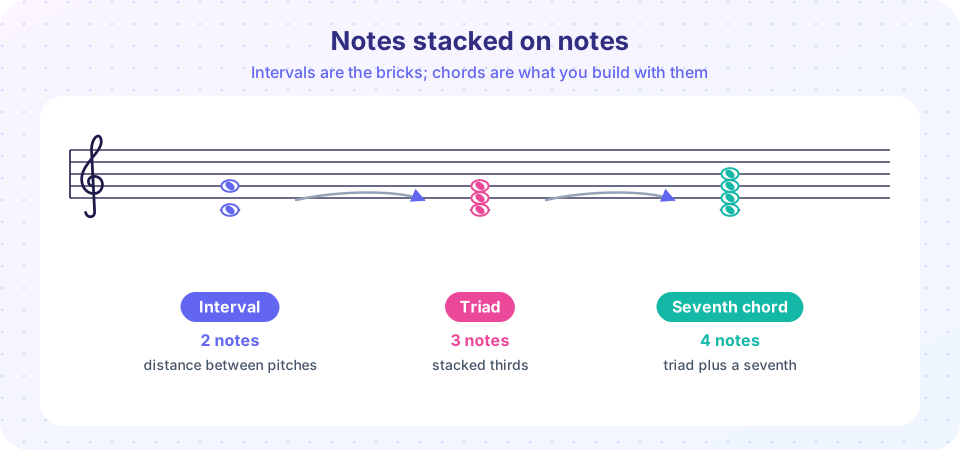
A chord is simply several notes sounding together. The most common chords stack intervals of a third on top of each other: two thirds make a triad, three make a seventh chord. This chapter teaches you to measure intervals, to name them by size and quality, to see how they turn upside down and how stacking them creates the chords of Western music.
What you will learn
- What an interval is, and the difference between melodic and harmonic intervals
- Why intervals are measured by both a number and a quality
- How chords grow from intervals by stacking thirds
- What each of the six lessons in this chapter covers
Key terms
Interval: the distance in pitch between two notes.
Melodic interval: two notes played one after the other.
Harmonic interval: two notes played at the same time.
Chord: three or more different notes sounding together.
Triad: a three-note chord built from two stacked thirds.
Intervals: measuring the gap
An interval is named in two parts, a number and a quality. The number counts letter names, including both notes: from C up to G the letters are C, D, E, F, G, which is five names, so the interval is a fifth. From C to E is a third. The quality tells you the exact size in half steps. A C to E♭ third is only three half steps and is called a minor third, while C to E is four half steps and is a major third. Both are thirds, because both span three letter names, but they sound different: one darker, one brighter.
The number says how many letter names. The quality says how many half steps. Together they say exactly how far apart the notes are. In the next two lessons you will learn the names: perfect, major, minor, augmented and diminished.
Intervals have two forms. In a melodic interval the notes are heard one after the other, as in the first two notes of a tune. In a harmonic interval they sound together, as in two voices singing in harmony. The same interval can be heard either way, but harmonic intervals reveal their character, smooth or rough, much more clearly. This is the basis of the old idea of consonance and dissonance: some intervals sound stable and blend together, while others sound tense and seem to want to move.
Chords: intervals stacked
Take the C major scale and pick every other note: C, E, G. That is a triad, the most basic chord. It contains the interval C to E (a major third) and E to G (a minor third), and the interval C to G (a perfect fifth) spanning the whole chord. Add another third on top, B, and you get C E G B, a seventh chord, because it spans a seventh from C to B.
Why thirds? Remember the harmonic series from chapter 2: the first harmonics of a note are the note itself, its octave, its fifth, then two octaves above, then a major third, and so on. A major triad is a built-in feature of every pitched sound. Stacking thirds gives chords that blend well but still have a distinct color: major, minor, diminished or augmented, depending on the sizes of the thirds. Other kinds of chords exist (stacks of fourths, for example), but those built from thirds form the core of traditional harmony and popular music.
Chords are named by their root, the note the stack is built on, and their quality. C major, A minor, G7 and so on. When a chord is turned so that a note other than the root is the lowest, it is inverted, a topic of the last lesson in this chapter.
What is in this chapter
Intervals
Chords
By the end you can
Chapter 5 uses these chords to make progressions.
The lessons:
- Interval size and quality teaches how to name every interval from a unison to an octave.
- Inversion and consonance shows how intervals flip and why some are stable.
- Triads builds major, minor, diminished and augmented chords.
- Seventh chords and inversions adds a fourth note and the idea of a chord's bass note.
- Chapter 4 review summarizes with an interval ruler and a quiz.
Common misconceptions
"An interval is the same as the number of half steps." The number of half steps gives the size, but the interval's name also depends on the letters. C to E♭ and C to D♯ both span three half steps, but one is a minor third and the other an augmented second.
"Chords must have exactly three notes." Two-note chords exist in some contexts, and four, five or more notes are common in jazz and classical music. Three-note triads are the starting point.
"Dissonance means bad." A dissonance is a tense sound that wants to resolve; it is essential for creating motion and expression.
Try it
Pick any two notes and hear them as a melodic interval (one after the other) and as a harmonic interval (together). The page names the interval size and counts the half steps.
Chords come from the scale by stacking thirds. This program takes the C major scale, builds a triad on every degree by taking every other note, measures the two thirds in half steps and names each chord's quality. You will see that a major scale contains three major chords, three minor chords and one diminished chord.
Press Run (or Ctrl + Enter) to see the console output here.
No output.
Check your understanding
Quick check · 5 questions
of 5 answered You scored / 5 · perfect!
-
1. How is the number of an interval counted?
C up to G passes through C D E F G, five letter names, so it is a fifth. The quality gives the half-step size. -
2. What is a harmonic interval?
Harmonic intervals sound together. Melodic intervals are heard in succession. -
3. A triad is built from:
A triad is a root, a third above it and a fifth above it: two stacked thirds. -
4. C to E and C to E-flat are both thirds. What distinguishes them?
C to E is four half steps (major third) and C to E♭ is three (minor third). -
5. Which seventh chord is built on C?
C E G B stacks three thirds, and the top note B is a seventh above C.
Summary
- An interval is the distance between two notes, named by a number (letter names counted) and a quality (half steps).
- Melodic intervals are heard in succession and harmonic intervals together.
- Triads stack two thirds; seventh chords stack three.
- The major scale yields three major triads, three minor triads and one diminished triad.
- Chapter 4 covers interval size and quality, inversion, consonance, triads, seventh chords and inversions.
Track your progress
Create a free account to tick off lessons and pick up where you left off on any device.
of Music Theory lessons completed