


















Lesson 4 of 50 · Getting Started
Reading notes: ledger lines, middle C and octaves
Extend the staff with ledger lines, learn where middle C lives on the grand staff, read octave marks (8va) and practice reading notes with a flashcard trainer.
Five lines and four spaces cannot hold every note an instrument can play. A flute reaches well above the treble staff and a double bass reaches far below the bass staff. Music solves this with short extra lines called ledger lines, and with signs that shift a passage by an octave. Learning to read these extensions fluently is what turns slow letter-by-letter decoding into real reading.
This lesson ties together the clefs and the keyboard. You will see how middle C connects the two staves of the grand staff, how to count ledger lines without losing your place, and how to build a quick reading routine based on landmark notes.
What you will learn
- What ledger lines are and how to name notes written on or between them
- Where middle C sits on the grand staff and why it can be written two ways
- How to read an 8va (octave) sign
- How accidentals and the barline interact
- A landmark-note strategy for reading quickly
Key terms
Ledger line: a short extra line drawn above or below the staff for notes outside its five lines.
Middle C (C4): the C that sits between the treble and bass staves; one ledger line below the treble staff or one above the bass staff.
8va (ottava): a sign meaning "an octave higher" (or lower if written 8vb or placed below); it saves ledger lines.
Accidental: a sharp, flat or natural sign written before a note.
Landmark note: a note you recognize at a glance and use to find its neighbors.
Ledger lines: extending the staff
A ledger line is drawn just wide enough for one note head, and it continues the same spacing as the staff. Think of the staff as continuing in both directions, but only drawing the pieces you need. Because the spacing stays the same, the rule of alternating line and space stays the same: a note on a ledger line is on a line, and a note between two ledger lines or between a ledger line and the staff is in a space.
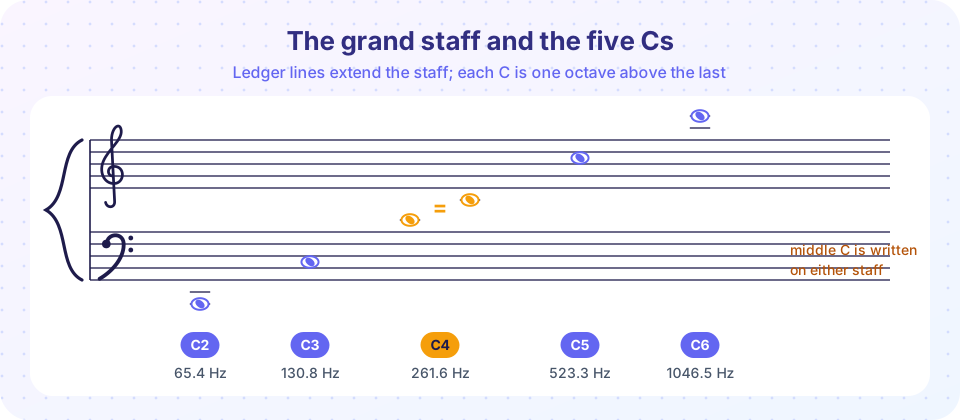
In the treble clef, the first ledger line below the staff holds middle C. The space under the bottom line is D, and the note immediately under that ledger line is B. Above the staff, the first space is G (above the top line F), the first ledger line is A, the space above that is B, and the second ledger line is C. That last note is C6, two octaves above middle C.
In the bass clef, middle C sits on the first ledger line above the staff. The space between the top line A and that ledger line is B. Below the staff, the first space is F (below the bottom line G), the first ledger line is E, the next space is D, and the second ledger line is C, which is C2.
The best way to avoid miscounting is to count from the nearest clef landmark, not from the middle of the staff. A note on the second ledger line above the treble staff? Start at the top line F, go up one letter per step: G, A, B, C.
Middle C, the hinge of the grand staff
Middle C is the only note that can be written conveniently on either staff of the grand staff. It is one ledger line below the treble staff, and one ledger line above the bass staff, and the two are the same key on the piano. Composers choose between them to keep the notation readable. A melody that is mostly high and dips down to middle C uses the treble staff; a bass line that rises to it uses the bass staff. You will often see the note written in the bass staff with a stem pointing down, and in the treble staff with a stem pointing up.
Look at the picture at the top of the page. The five Cs, C2 to C6, sit on or near the edges of the staves. Their frequencies double each time: about 65.4, 130.8, 261.6, 523.3 and 1,046.5 Hz. Every time you move up by the interval of an octave, the number of vibrations per second doubles, and the sound seems to be the "same note" in a higher voice. This relationship is why two voices, one male and one female, can sing "the same note" an octave apart.
The 8va sign: octave transposition
Very high passages need many ledger lines, which are hard to read. The sign 8va (short for ottava, Italian for octave) written above a passage tells the player to play it one octave higher than written. A dotted line shows how far the instruction lasts. 8vb, or 8va bassa, under a passage means an octave lower. A double version, 15ma (quindicesima), means two octaves. The sign changes only where you play the note, not what it is called in the score: a note written on the staff as G5 under an 8va sign sounds as G6.
Notice what happens to the reading problem: instead of counting five ledger lines, you read the same pattern in a comfortable location and apply the shift. Pianists see 8va often in the right hand of virtuoso music, and 8vb in the left hand.
Accidentals and the barline
You met sharps and flats on the keyboard. In notation they are written before the note they apply to, on the same line or space. An accidental affects every note of the same pitch (same letter and octave) for the rest of the measure, and is canceled automatically by the next barline. A natural sign cancels it earlier. Tied notes are the exception: if a note is tied across a barline, the accidental still applies to the held note. You will see how barlines divide music into measures in chapter 2.
Beginners are often surprised that an accidental on one F does not affect an F in a different octave. In a measure with F♯4 followed by F5, the second F is natural unless it too has a sign. In practice, composers often add a "courtesy" accidental in parentheses to remove doubt.
A reading routine
Fluent readers do not name every note. They anchor on a few landmarks and read the rest by distance. Learn these four:
- Treble G (G4), circled by the clef.
- Bass F (F3), flanked by the clef's dots.
- Middle C (C4), the hinge between the staves.
- Treble C5, the third space from the bottom. In the treble clef the C an octave above middle C is a handy landmark in the third space.
To read an unfamiliar note, find the nearest landmark and count: "one line up from G is B." Over time the counting disappears. Also read by shape: a note that moves from a line to the next line is a skip (a third); line to space is a step. Seeing the contour of a melody, steps and skips, is faster than naming each note.
Common misconceptions
"Notes on ledger lines are a different kind of note." They are ordinary notes; the staff just extends. The rule of alternating line and space continues unchanged.
"An 8va sign changes the note names in the score." It changes the sounding pitch. The notes are still read and named as written.
"An accidental lasts for the whole piece." It lasts only to the end of the measure (the key signature, which you will meet in chapter 3, is different: it lasts for the whole piece).
Try it
Practice makes reading fluent. This flashcard trainer shows a random note in the clef you choose, including ledger-line notes. Choose the letter, and the correct answer plays. Try 20 cards in each clef and watch your accuracy grow.
Finally, check the claim that each octave doubles the frequency, and print the first five Cs of the grand staff picture with the number of half steps between them.
Press Run (or Ctrl + Enter) to see the result here.
Program input · what you'd type while the program runs
Type the answers before you press Run, one per line. Each time the program reads a line (with input()), it gets the next line from this box.
Check your understanding
Quick check · 5 questions
of 5 answered You scored / 5 · perfect!
-
1. Where is middle C written on the treble staff?
Middle C sits on the first ledger line below the treble staff, and on the first ledger line above the bass staff. -
2. What does an 8va sign above a passage mean?
8va is short for ottava alta, an octave higher. 8vb (or 8va bassa below the staff) asks for an octave lower. -
3. How long does an accidental written before a note normally last?
An accidental applies to the same pitch for the rest of the measure and is canceled at the barline. -
4. The frequency of C5 compared with C4 is:
An octave doubles the frequency: 261.6 Hz for C4 becomes about 523.3 Hz for C5. -
5. In the treble clef, counting upward from the top line F, what is the first ledger line above the staff?
From the top line F, the space above is G and the first ledger line above is A.
Summary
- Ledger lines extend the staff; the line-and-space pattern continues unchanged.
- Middle C is one ledger line below the treble staff or above the bass staff, the same key either way.
- An 8va sign shifts a passage up an octave (8vb down); it changes sound, not note names.
- An accidental lasts until the end of the measure; a key signature lasts for the whole piece.
- Read by landmarks (treble G, bass F, middle C, treble C5) and by shape (steps and skips) instead of naming each note.
Next: Chapter 1 review
Track your progress
Create a free account to tick off lessons and pick up where you left off on any device.
of Music Theory lessons completed