


















Lesson 26 of 50 · Harmony and Progressions
Cadences: how musical phrases end
Learn the four main cadences, authentic, half, plagal and deceptive, how to hear and spot them, and how they punctuate phrases like full stops and commas.
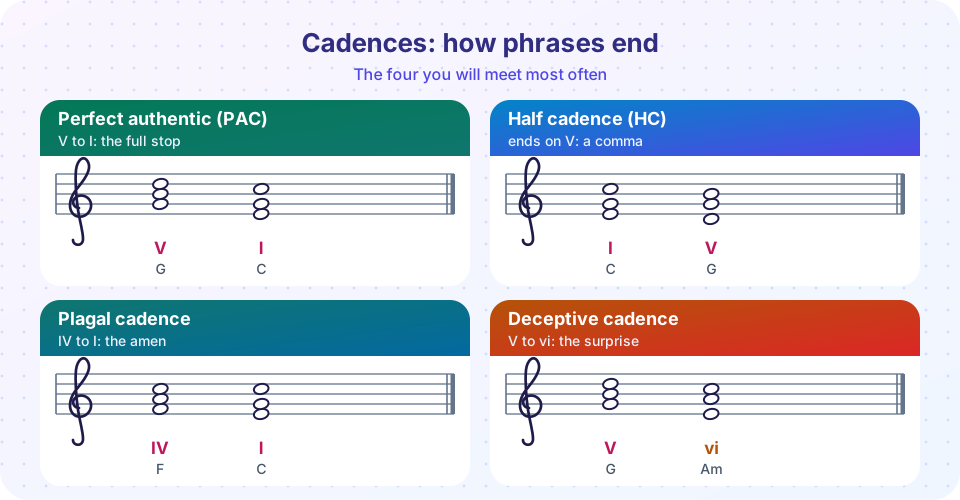
Read this sentence aloud: "The music stops" and now: "The music stops, but". Your voice tells you the difference. In the first the thought is complete; in the second you lean forward waiting for more. Music has the same punctuation. A cadence is a short chord formula, usually two chords, at the end of a phrase or section that tells the listener whether the music has finished, paused or turned a corner. Learn to hear cadences and you will be able to find the sentence boundaries of any tonal piece.
What you will learn
- The four standard cadences and the punctuation each one resembles
- The difference between a perfect and an imperfect authentic cadence
- How cadences work in minor keys and what the Phrygian half cadence is
- What the cadential six-four is and why it counts as a dominant chord
- How to find phrase endings in a score and in a recording
Key terms
Cadence: a harmonic and melodic formula that closes a phrase or section.
Authentic cadence: the dominant (V or V7) moving to the tonic (I). The strongest ending.
Half cadence (HC): a phrase that ends on V, whatever came before.
Plagal cadence: IV moving to I, sometimes called the "amen" cadence.
Deceptive cadence: V moving to a chord other than I, most often vi.
The authentic cadence: the full stop
Movement from the dominant to the tonic is the heart of tonal harmony, and it supplies the strongest ending available. In C major it is G to C (or G7 to C). The leading tone B rises to C, the seventh of G7 (F) falls to E, and the root motion is a descending fifth, the strongest in music.
Theorists divide authentic cadences into two grades.
- Perfect authentic cadence (PAC): both chords are in root position (the root is the lowest note) and the melody ends on the tonic (scale degree 1). This is the most conclusive ending of all.
- Imperfect authentic cadence (IAC): V to I, but with one condition unmet: either a chord is inverted, or the top note is not the tonic (it may be 3 or 5). It sounds like a conclusion with a small reservation: a semicolon rather than a full stop.
You will find PACs at the end of tunes, at the ends of sections in sonatas and, almost always, in the last bar of a piece. A composer might use several IACs to end smaller phrases and save one PAC for the end of a big section so that the true ending feels more final.
The half cadence: the comma
A half cadence ends on V. It does not matter what came before: I, ii, IV or something else. The point is that the phrase stops on the dominant, so the tension is not resolved. It sounds like a question, a comma or a breath before the answer.
Because V is unresolved, a half cadence usually ends a first phrase, and the next phrase answers by resolving to I. In a classic eight-bar period, the first four bars end on a half cadence and the second four bars end on a perfect authentic cadence. You saw this layout in the antecedent and consequent phrases of a period.
A special version in minor keys is the Phrygian half cadence. It uses the iv chord in first inversion followed by V: in A minor, D minor with F in the bass moves to E major. The bass falls by a half step (F to E), like the Phrygian mode, and the effect is dark and weighty. It is common in Baroque slow movements.
The plagal cadence: the amen
IV moving to I is the plagal cadence. There is no leading tone, so there is no strong pull. Instead it sounds soft and settled. It is the harmony of the "amen" at the end of hymns, and it often follows a PAC as an extra gesture of closure, a kind of afterglow. Because it lacks tension it cannot do the work of ending a phrase by itself as strongly as an authentic cadence can, but pop and gospel use it constantly.
The deceptive cadence: the surprise
Here the music sets up an authentic cadence, V is played, the ear expects I, and the composer gives vi instead. In C major: G then Am. The chords share two notes (C and E are in both I and vi), so the surprise is gentle: you arrive at a tonic-family chord, but not home. The leading tone still resolves up to the tonic note, which is now the root of a minor chord. It is a favorite tool for extending a phrase: after the deceptive cadence, composers usually repeat the approach and give a real PAC. The delay makes the final arrival sweeter.
The cadential six-four
Many authentic cadences are decorated with a chord that looks like a tonic but is not. Place the notes of C major over a G in the bass (G, C, E, G) and you have a six-four chord, a C major chord in second inversion. It occurs right before V and moves to V in a very predictable way: the notes a sixth and a fourth above the bass (E and C) fall by step to the notes of the dominant (D and B).
This is called the cadential six-four. Despite appearing as a tonic chord, it functions as a dominant: the bass G holds through both chords and the upper voices simply decorate it. Analysts label it either "I 6/4 to V" or "V 6/4 to 5/3". It is common wherever a composer wants to prolong the dominant, for example before the final chord of a concerto movement.
Cadences in minor
In a minor key the story is the same, with one proviso: you need a leading tone, so the dominant chord is usually major (the raised seventh degree). In A minor, the PAC is E major (E G♯ B) to A minor (A C E). The plagal cadence is iv to i. The deceptive cadence usually goes from V to VI (E to F major in A minor), because VI is the closest tonic-family chord. Finally, composers often end a minor-key piece on a major tonic chord, called a Picardy third, which brightens the last chord.
Common misconceptions
"Every phrase ends with a PAC." Most do not. A piece that ended every phrase with a PAC would sound as if it were made of full stops only. Variety of cadences gives music its rhythm of tension and release.
"A half cadence is a weak authentic cadence." They are different things. A half cadence ends on V and is deliberately unresolved. An imperfect authentic cadence ends on I.
"Plagal and deceptive cadences are rare." Both are common. Plagal endings are heard in hymns and rock; deceptive cadences are frequent in classical music and in songs that delay the final chorus.
Try it
Listen to each cadence in turn, and read the explanation below the buttons. Notice how much the half cadence feels like a question.
Now test your ear. A random cadence in a random key is played; name its type. The quiz uses the four basic types.
Check your understanding
Quick check · 5 questions
of 5 answered You scored / 5 · perfect!
-
1. Which cadence ends on the dominant chord?
A half cadence ends on V and leaves the phrase unresolved. -
2. What makes an authentic cadence perfect?
Root position V and I together with the tonic in the top voice produce the most conclusive close. -
3. In C major, which chord pair is a deceptive cadence?
V to vi withholds the expected tonic and gives a related chord instead. -
4. What is the function of the cadential six-four chord?
The bass note stays on the dominant, and the upper voices resolve down to the notes of V, so the chord acts as a dominant. -
5. What is a Picardy third?
The raised third brightens the final chord of a piece in a minor key.
Summary
- A cadence is a harmonic punctuation mark at the end of a phrase.
- Authentic (V to I) is the full stop, perfect when both chords are in root position and the melody ends on 1.
- A half cadence ends on V (comma); a plagal cadence is IV to I (amen); a deceptive cadence is V to vi (surprise).
- The cadential six-four decorates V, and in minor the dominant is major to keep the leading tone.
- Spotting cadences lets you find the phrase structure of a piece.
Next: Voice leading basics
Track your progress
Create a free account to tick off lessons and pick up where you left off on any device.
of Music Theory lessons completed