


















Lesson 14 of 50 · Scales and Keys
Minor scales: natural, harmonic and melodic
Learn the three forms of the minor scale, how relative and parallel minors work, why the harmonic minor has an augmented second and how to hear and spell each form.
Play C, D, E♭, F, G. Now play C, D, E, F, G. The only difference is one note, the third, and yet the mood changes. The first set sounds darker, more serious or more tender, and the second sounds bright and open. That one lowered note is the heart of the minor sound. The third degree decides whether a scale (and the chord on its tonic) is major or minor.
Minor keys are as important as major ones. Beethoven's Fifth Symphony begins in C minor, Mozart's Symphony No. 40 is in G minor, and countless folk, jazz and rock songs lean on minor scales. Unlike the major scale, which has one standard form, the minor scale comes in three versions. They differ in only two notes, the sixth and the seventh degrees, and each exists for a musical reason.
What you will learn
- The step pattern of the natural minor scale and how it differs from major
- The relative minor and the parallel minor
- How the harmonic and melodic minor scales alter degrees 6 and 7, and why
- How to spell all three forms
- How to recognize minor keys in music
Key terms
Natural minor scale: the minor scale with the pattern W H W W H W W, using only the notes of the key signature.
Relative minor: the minor scale that shares a key signature with a major scale; it starts on the major scale's sixth degree.
Parallel minor: the minor scale with the same tonic as a major scale (C major and C minor).
Harmonic minor: natural minor with the seventh degree raised by a half step.
Melodic minor: a minor scale with raised sixth and seventh degrees ascending and, traditionally, the natural minor descending.
The natural minor scale
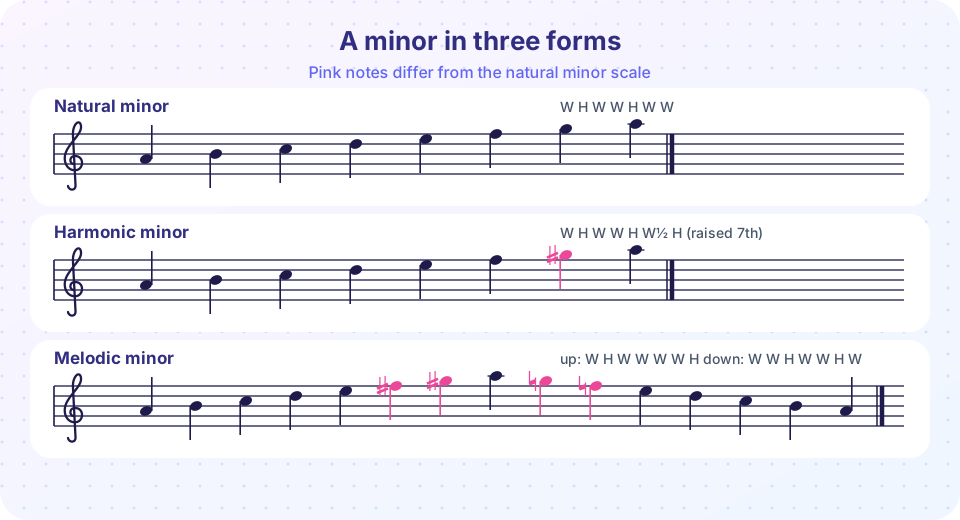
Take the C major scale and start on its sixth degree, A: A B C D E F G A. These are all white keys, played from A. This is the natural minor scale, here A natural minor. Its step pattern is
W H W W H W W (2 1 2 2 1 2 2 half steps).
Compare it with the major scale, W W H W W W H. The half steps have moved: in minor they fall between degrees 2 and 3 and between 5 and 6. Equivalently, relative to a major scale on the same tonic, natural minor has flatted degrees 3, 6 and 7. A major is A B C♯ D E F♯ G♯, and A minor is A B C D E F G: each of C, F and G is a half step lower.
The lowered third gives the minor triad (A C E), with a minor third from A to C. The lowered seventh means the seventh degree is a whole step below the tonic, so it no longer pulls strongly upward to it. That is part of why natural minor sounds darker and less "resolved".
Relative and parallel minors
Every major key has a relative minor that shares its key signature, because they use the same seven notes. To find it, go to the sixth degree of the major scale, or go down three half steps (a minor third) from the major tonic. The relative minor of C major is A minor (no sharps or flats), of G major is E minor (one sharp), of F major is D minor (one flat), and of E♭ major is C minor (three flats). The circle of fifths in the previous lesson shows the relative minors on its inner ring.
The parallel minor shares the tonic but not the key signature. C major and C minor are parallels: C D E♭ F G A♭ B♭ has three flats and the C major scale has none. Composers often switch between a key and its parallel minor to color the mood, a technique called modal mixture, which you will meet in the harmony chapter.
A minor key signature is the same as its relative major, so when you see a signature of one sharp, the music might be in G major or E minor. To decide, listen: where does the melody feel at rest? Look at the last chord, and check whether there is a recurring D♯ (the raised seventh of E minor), which would suggest minor.
The harmonic minor scale
The natural minor scale has a flaw for tonal harmony: its seventh degree is a whole step below the tonic, so the chord built on the fifth degree (the dominant) is minor and has no strong pull back to the tonic. In the major scale, the leading tone a half step below the tonic gives that pull. To restore it, composers raise the seventh degree by a half step. The result is the harmonic minor scale:
A B C D E F G♯ A, steps W H W W H 1½ H (2 1 2 2 1 3 1 half steps).
Notice the gap between F and G♯: three half steps, called an augmented second. It is larger than a whole step, and gives the harmonic minor a distinctive, dramatic or "exotic" sound heard in classical, Middle Eastern and Eastern European music. The raised seventh turns the dominant chord into a major chord (E G♯ B in A minor), and that chord pulls strongly to the tonic. That function, not the scale as a melody, is why the harmonic minor exists: it is the scale of the harmony.
The melodic minor scale
The augmented second is awkward to sing. Melodies that move up to the tonic need smoother steps, so composers raise the sixth as well as the seventh when ascending:
Ascending: A B C D E F♯ G♯ A (W H W W W W H).
Now only whole steps lead from E up to the tonic, and the seventh is a leading tone. When the melody turns around and descends, there is no need for a leading tone, and the raised notes would sound strange going down, so the traditional melodic minor reverts to natural minor:
Descending: A G F E D C B A (W W H W W H W).
This version is the classical melodic minor. Jazz musicians use the jazz melodic minor instead, which keeps the raised sixth and seventh in both directions. When writing a descending melodic minor scale, the raised notes of the ascent are cancelled with natural signs (G♮ and F♮ in A minor).
Here are all three forms in C minor, which has the key signature of three flats (B♭, E♭, A♭):
| Form | Notes |
|---|---|
| Natural | C D E♭ F G A♭ B♭ C |
| Harmonic | C D E♭ F G A♭ B♮ C |
| Melodic (ascending) | C D E♭ F G A♮ B♮ C |
| Melodic (descending) | C B♭ A♭ G F E♭ D C |
In practice, real music does not stick to one form. A tune might use F♯ and G♯ in A minor going up, G♮ and F♮ coming down, and a G♯ in the harmony at the same time. The three forms are menus of options, and the key signature stays the natural minor.
Common misconceptions
"Minor means sad." Minor often sounds darker in Western music, but many minor pieces are fierce, triumphant or dance-like. The effect depends on tempo, rhythm and context.
"The three forms are three different scales to choose between." They are variants of one scale, used together depending on melody and harmony.
"The harmonic minor has a raised sixth too." Only the seventh is raised. The sixth stays natural, which is why the augmented second appears.
"Relative minors start on the sixth note of a major scale, so parallel minors do too." A parallel minor starts on the same note as the major scale, the first degree.
Try it
Pick a tonic and a minor form and hear it. The melodic form plays up with the raised sixth and seventh and down with the natural notes. Compare each form to the major scale on the same tonic by switching the form to "Major".
In code, relative and parallel minors are easy to explore. This program builds major and natural minor scales on a tonic, lists the degrees that differ (the parallel minor) and finds the relative minor of each major key by taking the sixth degree.
Press Run (or Ctrl + Enter) to see the result here.
Program input · what you'd type while the program runs
Type the answers before you press Run, one per line. Each time the program reads a line (with input()), it gets the next line from this box.
Check your understanding
Quick check · 6 questions
of 6 answered You scored / 6 · perfect!
-
1. What is the step pattern of the natural minor scale?
Natural minor is W H W W H W W. The half steps are between degrees 2-3 and 5-6. -
2. Which minor key is the relative minor of C major?
The relative minor starts on the sixth degree of the major scale, A for C major. Both have no sharps or flats. -
3. Which note is raised in the harmonic minor scale?
The harmonic minor raises the seventh degree to make a leading tone, which creates an augmented second between degrees 6 and 7. -
4. How does the traditional melodic minor scale change when descending?
Descending, the sixth and seventh degrees return to natural minor, since no leading tone is needed. -
5. What is the parallel minor of G major?
A parallel minor shares the tonic: G major and G minor. E minor is the relative minor. -
6. The interval between degrees 6 and 7 in the harmonic minor is called:
Three half steps between degrees 6 and 7 make an augmented second.
Summary
- Natural minor follows W H W W H W W; compared with major it lowers degrees 3, 6 and 7.
- A relative minor shares its key signature with a major key and starts on its sixth degree (three half steps below); a parallel minor shares the tonic.
- Harmonic minor raises degree 7, creating a leading tone and an augmented second between degrees 6 and 7.
- Melodic minor raises degrees 6 and 7 ascending and (in the classical form) returns to natural minor descending.
- The three forms are options within one minor key, which keeps the natural-minor key signature.
Track your progress
Create a free account to tick off lessons and pick up where you left off on any device.
of Music Theory lessons completed