


















Lesson 50 of 50 · Projects and Practice
Where to go next: paths beyond this course
Six directions for further study after music theory: counterpoint, jazz harmony, orchestration, ear training, songwriting and history, plus links to related tracks on the site.
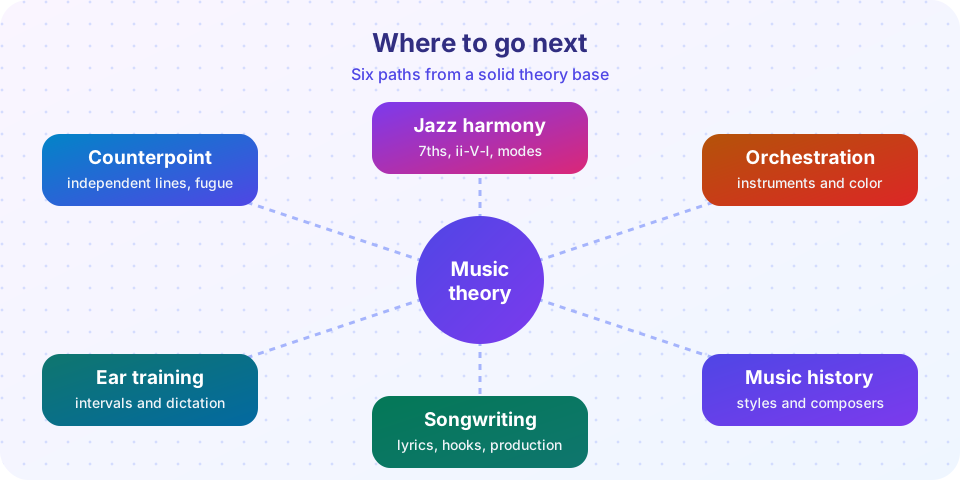
You have reached the end of the course map, and with it the usual question: what now? The honest answer is that music theory does not end here. What you have learned is the common core of tonal harmony, form and rhythm, the part that almost every style shares. From here the field branches, and the best next step depends on what you want to do with music. This lesson sketches six directions, says what each adds to what you already know, and points to other tracks on this site that connect to music from the sides of physics, signal processing and the mind.
What you will learn
- Six directions for further study and what each one builds on
- How to choose a path that fits your goals
- How music theory connects with physics, signal processing and psychology on this site
- Habits that keep learning going without a teacher
Key terms
Counterpoint: the art of combining independent melodic lines so that they sound good together.
Jazz harmony: the chord vocabulary of jazz: seventh and extended chords, ii-V-I progressions, substitutions and modes.
Orchestration: the art of assigning musical material to instruments in an ensemble.
Ear training: practice in recognizing pitches, intervals, chords and rhythms by ear.
Music cognition: the scientific study of how the mind perceives and remembers music.
Six paths
1. Counterpoint
Voice leading, as you met it in chapter 5, is the doorway to counterpoint: writing lines that are independent in rhythm and contour yet fit together. The classic training method is species counterpoint, described in Johann Joseph Fux's treatise Gradus ad Parnassum (1725), in which students add a line to a given melody in five stages from note-against-note to free combinations. The goal is the style of Palestrina and then the fugues of Bach. If you enjoyed the voice-leading detector and the harmony of four-part chorales, counterpoint is the natural continuation. It also makes you a better melody writer, because every line must be good alone.
2. Jazz harmony
Jazz builds on the same functions, tonic, predominant and dominant, but with a richer palette. You will learn seventh and ninth chords, the ii-V-I progression as the basic unit, tritone substitution (which you met in chapter 8), the modes that match each chord, and how to read lead sheets and improvise over changes. If you play guitar or piano and want to move from simple triads to colorful voicings, this is the path. The rhythm chapter, with its syncopation, polyrhythm and odd meters, is a direct preparation for jazz feel.
3. Orchestration
Orchestration is the craft of choosing who plays what. It combines theory with knowledge of each instrument's range, color and technique. Classic sources include Berlioz's Treatise on Instrumentation (1844) and Rimsky-Korsakov's Principles of Orchestration (published after his death in 1908). The skills you already have, chord spelling and voice leading, tell you which notes to write. Orchestration tells you which instruments will make them sound as you imagine. Studying scores while listening is the standard method.
4. Ear training
Theory on paper and theory in the ear are different skills. Ear training closes the gap: identify intervals, chords, cadences and rhythms by sound; write down a melody you hear (dictation); sing at sight (solfège). The interactive ear tests in this course are a start. Ten minutes a day is more effective than an hour a week, and regular practice with a keyboard or an app gives reliable progress. Everything you have learned becomes more useful when you can hear it.
5. Songwriting and production
If your goal is to write and record songs, the next step is the craft of lyrics, hooks, structure and sound design. The forms of chapter 6, verse-chorus, AABA and the blues, are the skeletons of songs, and the chord loops of chapter 5 are the harmony. What you add is the writing of words, the shaping of a hook and the technology: recording, mixing and arrangement. Theory helps you make deliberate choices and troubleshoot a song that is not working.
6. Music history and styles
Theory is a description of music written by humans in specific times and places. Studying history shows why the rules are what they are: how modal music became tonal, why the Classical period loved sonata form, how Romantic composers stretched harmony, how twentieth-century composers questioned tonality altogether (twelve-tone technique, set theory, minimalism). It also widens the lens beyond Western classical music to the scale systems and rhythmic cycles of other traditions: Indian classical music's tala, West African polyrhythm, the Turkish makam system.
Related tracks on this site
Music touches several other subjects, and you can follow those connections.
- Sound as a wave. Pitch, loudness and timbre are physical properties: frequency, amplitude and harmonic content. See Physics: Waves and Optics for the physics of vibration, resonance and the superposition of waves.
- Sound as a signal. Digital audio, filters, spectra and the Fourier transform, which turns a waveform into the notes it contains, are covered in Digital Signal Processing and Signals and Systems.
- Music and the mind. How we perceive pitch, form expectations and remember tunes is a part of Cognitive Psychology.
- Music in culture. Art History and World History place music in its social context.
Choosing a path
Ask yourself two questions. First, what do I want to be able to do? Play in a band, write songs, arrange for a choir, analyze scores, compose for film. Second, what is the smallest step toward it? If you want to improvise, listen to a standard and learn its changes. If you want to write for a choir, harmonize a hymn tune in four parts. Choosing a concrete project is more effective than studying in the abstract.
Habits that last
- Practice in short sessions. Fifteen minutes a day beats a long session once a week.
- Analyze what you love. Pick a song and write its chords as Roman numerals, mark the cadences and the form. This is theory used.
- Write something every week. Even eight bars.
- Keep an error log. Note what you got wrong and why.
- Listen actively. Ask what the composer is doing at each cadence and each change of texture.
Common misconceptions
"Theory kills creativity." Theory describes what musicians have found to work. It widens your choices rather than limiting them. Many great composers studied theory; many great musicians ignored it. The two are not opposed.
"You must master everything before moving on." Theory is not a ladder with a fixed top. Move on when you can use a skill, and return later with new questions.
"Western tonal theory is the theory of music." It is one system among many. This course teaches it because it underlies most of the music you hear today, but other traditions have their own sophisticated theories.
Try it
First, a little sound physics. The frequency of an equal-tempered note is f = 440 × 2^(n/12), where n is the number of semitones above A4. Choose a note, hear it and see the frequency. The slider moves in semitones.
Second, a small path finder. Choose your main interest and get a suggested first step.
Check your understanding
Quick check · 4 questions
of 4 answered You scored / 4 · perfect!
-
1. Which path teaches how to combine independent melodic lines?
Counterpoint is the art of writing independent lines that fit together. -
2. What is the formula for the frequency n semitones above A4 (440 Hz)?
Equal temperament multiplies the frequency by the twelfth root of 2 for each semitone. -
3. Which best describes ear training?
Ear training connects the symbols of theory with the sounds they stand for. -
4. What is a good first step for learning jazz harmony?
ii-V-I and the blues are the foundation of jazz harmony.
Summary
- Counterpoint, jazz harmony, orchestration, ear training, songwriting and music history are six paths from here.
- Music connects with physics (waves), signal processing (spectra) and psychology (perception).
- Pick a concrete project, practice in short regular sessions and analyze the music you love.
- Theory describes what works; it widens, not limits, your choices.
Return to the Music Theory course page to review any lesson.
Track your progress
Create a free account to tick off lessons and pick up where you left off on any device.
of Music Theory lessons completed