


















Lesson 24 of 50 · Harmony and Progressions
Diatonic triads and Roman numerals
Build a triad on every note of a scale, learn why they are major, minor or diminished, and name them with Roman numerals in any major or minor key.
A key is more than a scale. It is a small world of seven notes, and you can build a chord on every one of them using only those notes. Chords built this way are called diatonic, a word that means "belonging to the key". Once you know the seven diatonic triads of a key, you know most of the chords a typical song in that key will use. Better still, a simple numbering system lets you describe those chords in a way that works in every key at once.
What you will learn
- How to build a triad on each degree of a major scale by stacking thirds
- Why the qualities always fall in the order major, minor, minor, major, major, minor, diminished
- How to read and write Roman numerals, with uppercase, lowercase and the diminished sign
- How the triads change in a minor key
- How to find the chords of any major key quickly
Key terms
Triad: a three-note chord made of a root, a third above it and a fifth above it.
Diatonic: using only the notes of the key's scale.
Scale degree: a note's position in the scale, counted 1 to 7 from the tonic.
Roman numeral: a numeral naming a chord by the scale degree of its root. Uppercase means major, lowercase means minor.
Quality: major, minor, diminished or augmented, determined by the sizes of the thirds inside the chord.
Stacking thirds inside a key
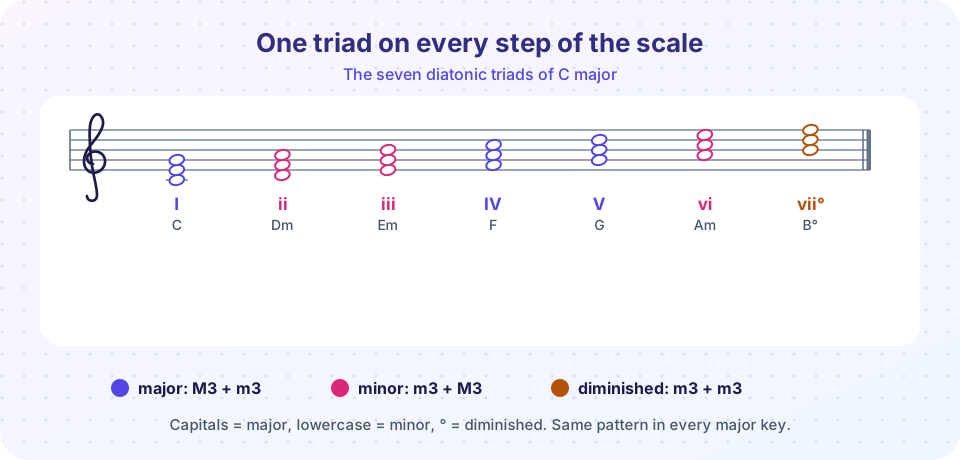
Write out the C major scale: C D E F G A B. To build a triad on D, take D as the root, skip a note to F for the third, skip again to A for the fifth. Every note came from the scale, so the chord D F A is diatonic. Do the same on every degree and you get seven triads. Wherever the stack runs past B, wrap back to the start of the scale: the triad on B uses B, D and F.
| Degree | Root | Notes | Quality | Numeral | Traditional name |
|---|---|---|---|---|---|
| 1 | C | C E G | major | I | tonic |
| 2 | D | D F A | minor | ii | supertonic |
| 3 | E | E G B | minor | iii | mediant |
| 4 | F | F A C | major | IV | subdominant |
| 5 | G | G B D | major | V | dominant |
| 6 | A | A C E | minor | vi | submediant |
| 7 | B | B D F | diminished | vii° | leading-tone |
Notice what happened without any effort on your part: the qualities are not all the same. Some chords came out major, some minor and one diminished. The scale itself decided this.
Why the qualities fall where they do
A major third is four semitones; a minor third is three. A triad's quality depends on which thirds are stacked. The major scale is a pattern of whole and half steps (whole, whole, half, whole, whole, whole, half), and that pattern makes the gaps between alternate notes uneven. Between C and E there are four semitones, a major third. Between D and F there are only three, a minor third, because there is a half step between E and F. The half steps of the scale (E to F and B to C) are the cause of every minor and diminished chord.
Here is how the thirds stack up on each degree of C major.
| Triad | Lower third | Upper third | Result |
|---|---|---|---|
| C E G | major (4) | minor (3) | major |
| D F A | minor (3) | major (4) | minor |
| E G B | minor (3) | major (4) | minor |
| F A C | major (4) | minor (3) | major |
| G B D | major (4) | minor (3) | major |
| A C E | minor (3) | major (4) | minor |
| B D F | minor (3) | minor (3) | diminished |
The seventh triad is special. Two minor thirds stacked make a fifth of only six semitones, a diminished fifth, and that tight, unstable sound is why the diminished triad wants to resolve. The same pattern, major minor minor major major minor diminished, holds in every major key, because every major scale has the same arrangement of whole and half steps.
Reading Roman numerals
A Roman numeral names a chord by the scale degree of its root and tells you its quality by its case.
- Uppercase (I, IV, V): major triad
- Lowercase (ii, iii, vi): minor triad
- Lowercase with a small circle (vii°): diminished triad
- Uppercase with a plus (III+): augmented triad
The numeral says nothing about which key you are in. That is its power. The progression I-IV-V-I means C, F, G, C in C major, but G, C, D, G in G major. When you learn the pattern once, you have learned it in all twelve keys.
To find the chords of any major key, write out its scale and then apply the quality pattern.
| Key | I | ii | iii | IV | V | vi | vii° |
|---|---|---|---|---|---|---|---|
| C major | C | Dm | Em | F | G | Am | B° |
| G major | G | Am | Bm | C | D | Em | F♯° |
| D major | D | Em | F♯m | G | A | Bm | C♯° |
| F major | F | Gm | Am | B♭ | C | Dm | E° |
A shortcut for guitarists and pianists
The three major chords (I, IV, V) are the "primary chords" of a key. They cover every note of the scale between them, which is why many folk songs use only these three. The three minor chords (ii, iii, vi) are their minor cousins: vi shares two notes with I, ii shares two with IV, and iii shares two with V (or I). That is why you can often swap them in for the major chords and get a gentler, more wistful color.
The triads of a minor key
Minor keys are trickier because there are several minor scales. Using the natural minor scale (A B C D E F G in A minor) and stacking thirds gives:
| i | ii° | III | iv | v | VI | VII |
|---|---|---|---|---|---|---|
| Am | B° | C | Dm | Em | F | G |
This is the same set of chords as C major, just starting from A, because A minor is the relative minor of C major. But natural minor has no leading tone: the seventh degree is a whole step below the tonic, and the v chord is minor, so the dominant lacks the pull that major keys enjoy. Composers fix this by raising the seventh degree to G♯ (the harmonic minor scale). That turns v into a major V (E, G♯, B) and vii into a diminished chord (G♯°), and it is why you will usually see V in a minor key, not v.
| Degree | Chord in A minor (with raised 7th) |
|---|---|
| i | Am |
| ii° | B° |
| III | C |
| iv | Dm |
| V | E |
| VI | F |
| vii° | G♯° |
Common misconceptions
"Lowercase numerals mean softer chords." No. Case marks quality only: lowercase is minor, not quiet. A minor chord can be played as loudly as a major one.
"The numeral tells me which notes to play." It tells you the chord's role in the key. You still need the key to find the notes: V is G major in C but D major in G.
"vii° is a dominant chord, so I can ignore it." It is built from the same notes as V7 without the root, so it behaves as a dominant, but it is rarer and sounds tenser than V. Treat it as a related but distinct chord.
Try it
Choose a key, then click each chord to see its notes and hear it. Notice that the pink chords (minor) and the teal chord (diminished) always occupy the same degrees.
Now test yourself. A key and a chord name appear; click the Roman numeral that fits. Pay attention to the diminished chord.
Check your understanding
Quick check · 5 questions
of 5 answered You scored / 5 · perfect!
-
1. Which triad in a major key is diminished?
The seventh-degree triad (vii°) stacks two minor thirds, giving a diminished fifth. -
2. What are the chords I, IV and V in G major?
G major scale is G A B C D E F#. The chords on degrees 1, 4 and 5 are G, C and D, all major. -
3. What does a lowercase Roman numeral mean?
Lowercase numerals mark minor triads. Uppercase marks major. -
4. Why is the V chord usually major in a minor key?
Raising the seventh degree (harmonic minor) gives a leading tone and makes V major, which strengthens the pull to the tonic. -
5. In D major, what is the vi chord?
D major scale: D E F# G A B C#. The sixth degree is B, and vi is minor, so Bm.
Summary
- A diatonic triad is built by stacking thirds on a scale degree using only the key's notes.
- In every major key the qualities run major, minor, minor, major, major, minor, diminished.
- Roman numerals name chords by degree; uppercase is major, lowercase is minor, ° is diminished.
- In minor keys the raised seventh degree makes V major and vii° diminished.
- The pattern is the same in every key, so you only learn it once.
Track your progress
Create a free account to tick off lessons and pick up where you left off on any device.
of Music Theory lessons completed