


















Lesson 23 of 50 · Harmony and Progressions
Chapter 5 overview: harmony and progressions
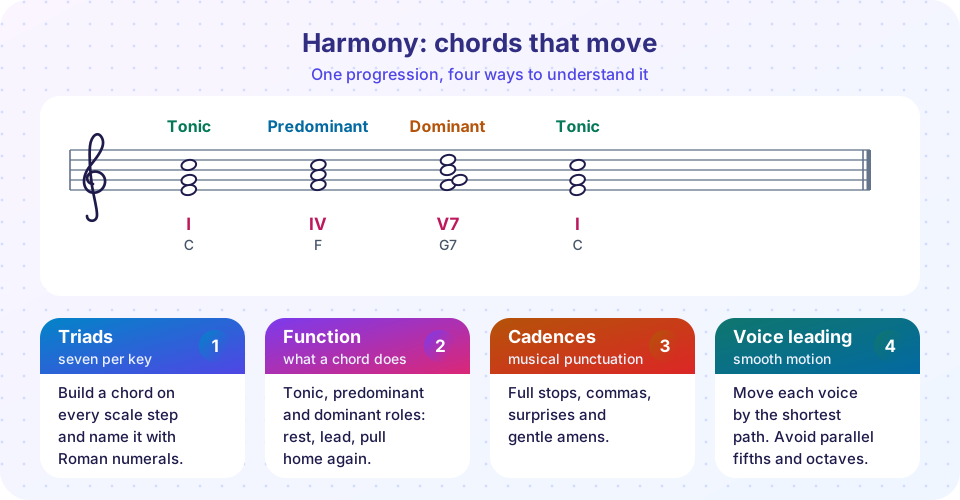
A map of the harmony chapter: diatonic triads, Roman numerals, chord function, cadences and voice leading, with a playable progression to hear it all.
Until now you have worked with notes one at a time: scales, intervals, single chords. Harmony is what happens when chords start to move. A melody tells you where the music goes; the harmony underneath tells you how it feels to get there. The same tune sounds happy over bright major chords, uneasy over a tense dominant, and finished once it lands on the tonic. This chapter shows you how those feelings are built, so that you can hear them, name them and write them.
What you will learn
- How to build a triad on every note of a major or minor scale and name it with a Roman numeral
- Why chords fall into three families (tonic, predominant, dominant) and how those families form a cycle
- How cadences end musical phrases, and which one sounds like a full stop, a comma or a surprise
- How to connect chords so that each voice moves smoothly
- How to hear and play common progressions such as I-IV-V-I, I-vi-IV-V and ii-V-I
Key terms
Harmony: the study of chords and how they follow one another.
Progression: a series of chords, usually written as Roman numerals so that it works in any key.
Function: the role a chord plays in the key: rest (tonic), departure (predominant) or tension (dominant).
Cadence: a short chord formula that ends a phrase, like punctuation.
Voice leading: how the individual notes (voices) inside chords move from one chord to the next.
The big picture
Western tonal music, from Bach chorales to pop songs, rests on a surprisingly small idea. One chord, the tonic, feels like home. Other chords feel like journeys away from it, and a few chords strongly pull you back. Composers organize those pulls into patterns. A pattern as plain as C, F, G7, C is the skeleton of thousands of songs, and a pattern as elaborate as a jazz turnaround is the same skeleton dressed in more notes.
You will learn the skeleton in four steps.
Chapter 5 at a glance
Chords have jobs
Punctuation
Smooth motion
Four voices, one clear line each.
What each lesson covers
- Diatonic triads and Roman numerals: stack thirds on every scale degree, read the qualities, and learn the numeral system.
- Chord function and progressions: tonic, predominant and dominant, the cycle they form, and the progressions built on it.
- Cadences: the four phrase endings and how to recognize each by ear and on the page.
- Voice leading basics: how to write four-part chords that flow.
- Chapter 5 review: one picture, one table and ten questions.
Hear it first
Press the button to hear the progression from the picture. Notice how the third chord seems to ask a question that the fourth answers. Then try the second demo, which plays the three function families by themselves.
How to study this chapter
Work with an instrument if you can, even one finger on a piano or a guitar with open chords. Harmony is learned by ear first and by symbol second. When a lesson introduces a progression, play it, sing the bass notes, and only then look at the numerals. Use the playable demos as a notebook: change a chord, listen, and ask what changed in the feeling. By the review lesson you should be able to look at an eight-bar chord chart and say, in plain words, where the music leaves home, where it builds tension and where it settles.
The chapter builds on the scales, keys and chord qualities from earlier chapters. If a term here feels unfamiliar, visit the track page and open the lesson that introduced it.
Check your understanding
Quick check · 3 questions
of 3 answered You scored / 3 · perfect!
-
1. Which chord family feels like home?
The tonic chord is the key's home base. The other two families lead away from it or pull back to it. -
2. In the progression C, F, G7, C, which chord has the dominant function?
G7 is built on the fifth scale degree of C major, which makes it the dominant chord. -
3. Why do musicians write progressions with Roman numerals?
A numeral names the chord's role in the key, so I-IV-V-I describes the same pattern in C, G or any other major key.
Summary
- Harmony is chords in motion; a progression is a series of chords.
- Chords have functions: tonic (rest), predominant (departure), dominant (tension).
- Cadences punctuate phrases; voice leading makes the motion smooth.
- Roman numerals let you describe a progression independent of key.
Track your progress
Create a free account to tick off lessons and pick up where you left off on any device.
of Music Theory lessons completed