


















Lesson 21 of 50 · Intervals and Chords
Seventh chords and inversions
Add a seventh to a triad to build major seventh, dominant seventh, minor seventh and diminished chords, then learn inversions, slash chords and figured bass numbers.
A triad is stable and simple. Add one more third on top, and the chord gains depth, color and often tension. The new top note is a seventh above the root, so the result is a seventh chord. Jazz musicians treat seventh chords as the basic chord, and pop, blues and classical music use them constantly. The most famous of them, the dominant seventh, contains the tritone and is the strongest signal in Western harmony that a piece is about to come home.
The second idea of this lesson is inversion. Take a chord and put a different note in the bass. The chord keeps its identity (C E G is still C major), but the sound changes character, and musicians use the choice to make smoother bass lines. Together, sevenths and inversions finish your toolkit of chord building.
What you will learn
- How to build a seventh chord and name its five common qualities
- Which seventh chords appear on each degree of the major scale
- Why the dominant seventh is special
- How inversions work, and how to name them with figured bass and slash chords
- When and why composers invert chords
Key terms
Seventh chord: a four-note chord made of a triad plus the note a seventh above the root.
Dominant seventh: a major triad with a minor seventh (C E G B♭); written C7.
Half-diminished seventh: a diminished triad with a minor seventh (C E♭ G♭ B♭); written Cø7 or Cm7♭5.
Inversion: a chord arranged so that a note other than the root is the lowest.
Figured bass: numbers written under a bass note that show the intervals above it, such as 6 or 6/4.
Building seventh chords
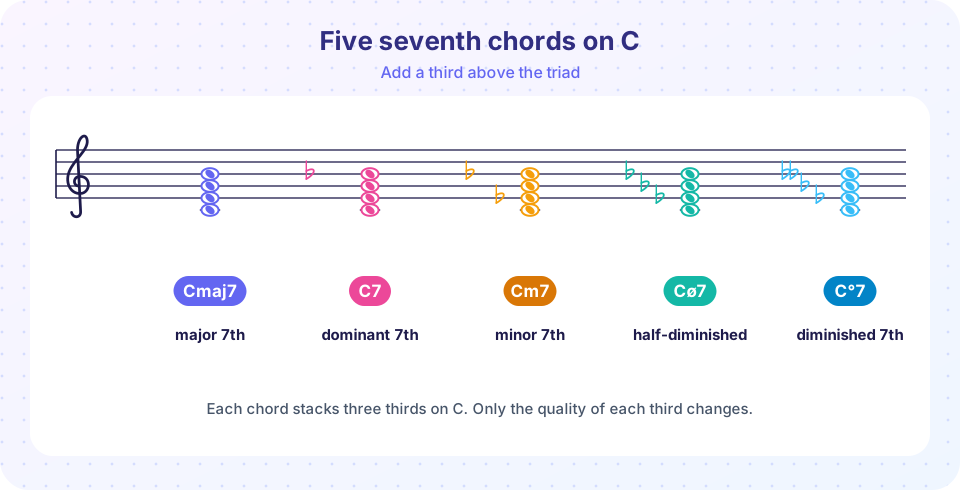
Start from a triad and add the next third above it. In C major, the triad C E G plus B gives C E G B. The new note is a seventh above the root, and it can be a major seventh (11 half steps from the root, B) or a minor seventh (10 half steps, B♭). Combined with the four triad types, this gives several chord qualities, five of them common:
| Chord | Name | Notes on C | Thirds stacked | Symbol |
|---|---|---|---|---|
| Major seventh | major triad + major 7th | C E G B | M3 + m3 + M3 | Cmaj7, CΔ7 |
| Dominant seventh | major triad + minor 7th | C E G B♭ | M3 + m3 + m3 | C7 |
| Minor seventh | minor triad + minor 7th | C E♭ G B♭ | m3 + M3 + m3 | Cm7, C−7 |
| Half-diminished seventh | diminished triad + minor 7th | C E♭ G♭ B♭ | m3 + m3 + M3 | Cø7, Cm7♭5 |
| Diminished seventh | diminished triad + diminished 7th | C E♭ G♭ B♭♭ | m3 + m3 + m3 | C°7 |
(The last chord's seventh is B double flat, which sounds like A. Spelling it as B♭♭ keeps the letters a third apart.)
A less common sixth type is the minor-major seventh (C E♭ G B), a minor triad with a major seventh, which has a mysterious sound often used in film music.
Pay attention to the confusing difference in names: "major seventh" describes the interval of the seventh, but "dominant seventh" describes a chord function. The chord C7 is called a dominant seventh not because it is on C (the dominant of F), but because a major triad with a minor seventh is the chord that naturally occurs on the dominant degree of a major key. Its symbol, C7, is a letter plus a plain 7. A major seventh needs the word "maj" or the symbol Δ.
Sevenths in a major key
If you build a seventh chord on every degree of the C major scale, using only scale notes, you get:
| Degree | Chord | Notes | Quality | Roman numeral |
|---|---|---|---|---|
| 1 | Cmaj7 | C E G B | major 7th | Imaj7 |
| 2 | Dm7 | D F A C | minor 7th | ii7 |
| 3 | Em7 | E G B D | minor 7th | iii7 |
| 4 | Fmaj7 | F A C E | major 7th | IVmaj7 |
| 5 | G7 | G B D F | dominant 7th | V7 |
| 6 | Am7 | A C E G | minor 7th | vi7 |
| 7 | Bø7 | B D F A | half-diminished 7th | viiø7 |
Only one chord is a dominant seventh: the one on the fifth degree. That is a very useful fact, because it means a dominant seventh chord tells you the key. If you see G7, the key is probably C major or C minor.
Why the dominant seventh is special
Look at the notes of G7: G B D F. Between B and F is the tritone, the most unstable interval. The B is the leading tone and wants to rise to C by a half step. The F, the seventh of the chord, wants to fall to E by a half step. When both move, the dissonant tritone B-F resolves into the stable third C-E, and the chord resolves to C major.
This is the strongest pull in tonal music, and it is why V7 to I is the basis of nearly every cadence you hear. You will study cadences in the next chapter, but you can already hear them in the demo below. Many other chords, such as the diminished seventh, derive their power from the same tritone.
Inversions
So far every chord has had its root as the lowest note. That is root position. But you can rearrange the notes. If the third is in the bass, the chord is in first inversion. If the fifth is in the bass, it is in second inversion. A seventh chord has a fourth possibility, third inversion, with the seventh in the bass.
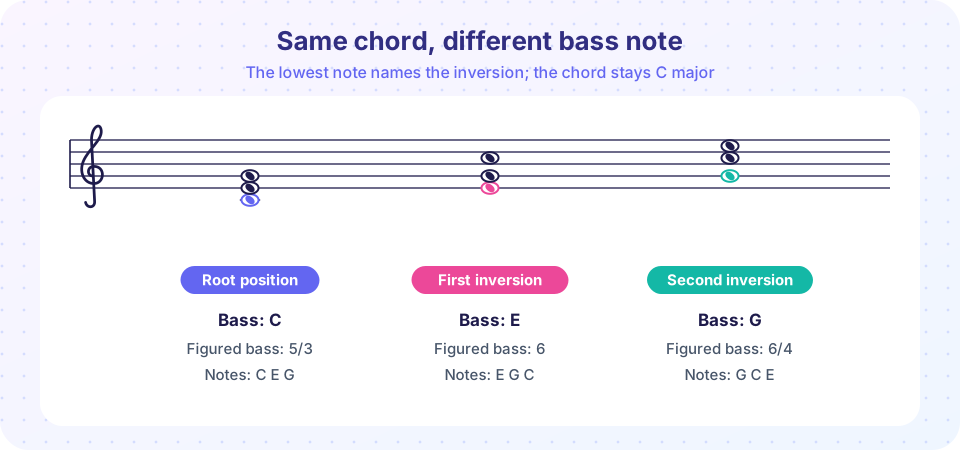
| Position | Bass note | C major triad (low to high) | Figured bass | Slash chord |
|---|---|---|---|---|
| Root position | root | C E G | 5/3 (usually omitted) | C |
| First inversion | third | E G C | 6 | C/E |
| Second inversion | fifth | G C E | 6/4 | C/G |
For seventh chords:
| Position | Bass note | G7 (low to high) | Figured bass |
|---|---|---|---|
| Root position | root | G B D F | 7 |
| First inversion | third | B D F G | 6/5 |
| Second inversion | fifth | D F G B | 4/3 |
| Third inversion | seventh | F G B D | 4/2 (or 2) |
The numbers of figured bass (a notation from the baroque era, when keyboard players read a bass line and improvised the chords) name the intervals above the bass note: in first inversion C major, the bass E has a G a third above it and a C a sixth above it. The sixth is the identifying number, so the chord is called "six". In popular music slash chords are used: C/E means a C major chord with E in the bass.
You can name an inversion by looking at the bass: find the lowest note, and decide whether it is the root, the third, the fifth or the seventh.
Why invert chords?
First, smooth bass lines. A bass that plays C, E, F, G moves by small steps, while one that plays C, C, F, G jumps. Playing C, C/E, F, G makes the bass walk in steps. Second, different colors: root position is solid and stable; first inversion is lighter and less final; second inversion is often unstable, and is used to prepare cadences. Third, voice leading: inverting chords keeps upper voices close together when moving from chord to chord, so the music flows. You will explore this in chapter 5.
Common misconceptions
"C7 is the seventh chord on C major, with a B." C7 has B♭, a minor seventh. A major seventh chord must be written Cmaj7.
"An inverted chord is a different chord." The chord's identity is its set of notes. C/E is still C major; only the bass changes.
"Figured bass numbers show the notes of the chord." They show intervals above the bass, and the numbers that are not written (such as 3 and 5 in a triad) are understood.
"Second inversion chords are wrong." They are common but have a specific role, such as the cadential 6/4, and sound less stable than root position.
Try it
Build any triad or seventh chord and choose the inversion. The page spells the chord, shows which note is in the bass and gives the figured bass. Press Play to hear it from the bass up and compare how each inversion feels.
Now build every seventh chord of the major scale with code, and list the inversions of G7. The program measures the thirds and seventh in half steps to decide each chord's name.
Press Run (or Ctrl + Enter) to see the result here.
Program input · what you'd type while the program runs
Type the answers before you press Run, one per line. Each time the program reads a line (with input()), it gets the next line from this box.
Finally, hear why the dominant seventh pulls so hard. Play G7 on its own (it sounds unsettled), C major on its own (it sounds at rest) and then G7 followed by C major. Notice the B rising to C and the F falling to E.
Check your understanding
Quick check · 6 questions
of 6 answered You scored / 6 · perfect!
-
1. Which notes make a C dominant seventh chord (C7)?
C7 is a major triad with a minor seventh: C E G B♭. Cmaj7 has B, and Cm7 has E♭ and B♭. -
2. On which degree of the major scale does the dominant seventh chord occur?
Only the chord on the fifth degree is a dominant seventh (G7 in C major). -
3. What is the bass note of a chord in first inversion?
First inversion has the third in the bass; second inversion has the fifth. -
4. What does the figured bass symbol 6/4 indicate?
6/4 means the intervals above the bass are a sixth and a fourth, which is a second-inversion triad. -
5. How is C major with E in the bass written as a slash chord?
The chord comes first, then a slash and the bass note: C/E. -
6. Which seventh chord is built from three stacked minor thirds?
The fully diminished seventh stacks m3 + m3 + m3, for example C E♭ G♭ B♭♭.
Summary
- A seventh chord adds a third on top of a triad, giving a seventh above the root.
- Five common qualities: major 7th, dominant 7th, minor 7th, half-diminished 7th and diminished 7th.
- A major key has Imaj7, ii7, iii7, IVmaj7, V7, vi7 and viiø7; only V7 is a dominant seventh.
- The dominant seventh contains a tritone that resolves to the tonic chord.
- Inversions put the third, fifth or seventh in the bass; they are labeled with figured bass (6, 6/4, 6/5, 4/3, 4/2) or slash chords (C/E).
- Inversions give smoother bass lines and different colors without changing the chord's identity.
Next: Chapter 4 review
Track your progress
Create a free account to tick off lessons and pick up where you left off on any device.
of Music Theory lessons completed