


















Lesson 9 of 50 · Sound, Notes and Rhythm
Time signatures, measures and tempo
Understand measures and barlines, read simple and compound time signatures like 4/4, 3/4 and 6/8, feel strong and weak beats and set tempo in beats per minute.
Tap along to almost any song and you will find that some beats feel stronger than others. A waltz goes ONE-two-three, ONE-two-three. A march goes ONE-two-three-four with a lighter accent on three. Rock usually leans on beats two and four. This regular pattern of strong and weak beats is called meter, and the time signature is the sign in front of the music that tells you what the meter is.
Meter organizes time into repeating containers called measures (or bars). If note values are the bricks of rhythm, measures are the rows of the wall. Once you read a time signature you know how many beats each container holds, which note is worth one beat and how to count along. This lesson covers all three, and ends with tempo, the speed of the beat.
What you will learn
- What measures and barlines are
- How to read the top and bottom numbers of a time signature
- The difference between simple and compound meter
- How to count and feel 2/4, 3/4, 4/4 and 6/8
- How tempo is measured and what the Italian tempo words mean
Key terms
Measure (bar): one container of beats, bounded by barlines.
Time signature (meter signature): two stacked numbers at the start of a piece, telling you how many beats are in a measure and which note value gets one beat.
Simple meter: each beat divides into two equal parts.
Compound meter: each beat divides into three equal parts.
Tempo: the speed of the beat, often given in beats per minute (BPM).
Measures and barlines
A barline is a vertical line across the staff. The space between two barlines is a measure, or bar in British English. Every measure holds the same total number of beats (unless the time signature changes). A double barline (two thin lines) marks a new section, and a final barline (thin then thick) marks the end of the piece. Measures are numbered, so a conductor can say "from bar 17" and the whole orchestra finds the same place.
Barlines do not stop the music. They are a reading aid, and notes can be tied across them. But they do carry meaning: the first beat of every measure, the downbeat, is accented.
Reading a time signature
A time signature looks like a fraction, but without the dividing line. The two numbers answer two questions.
- The top number says how many beats are in each measure.
- The bottom number says which note value gets one beat: 2 means a half note, 4 a quarter note, 8 an eighth note, and 16 a sixteenth note.
So 3/4 means three beats per measure with the quarter note as the beat. A full measure could hold three quarter notes, or a half note and a quarter note, or six eighth notes. And 4/4 means four quarter-note beats per measure. Because it is so common, 4/4 is also written as a large letter C (common time). A C with a vertical line is cut time (alla breve), the same as 2/2: two half-note beats per measure, usually felt as a quick two.
Notice something that surprises many learners: the bottom number is not a fraction of a second or a count of anything. It is a note name in code: the number 4 stands for the quarter note, because a quarter note is 1/4 of a whole note.
Simple meter: beats that divide in two
In simple meter, each beat naturally splits into two equal parts. The top numbers 2, 3 and 4 are the standard simple meters.
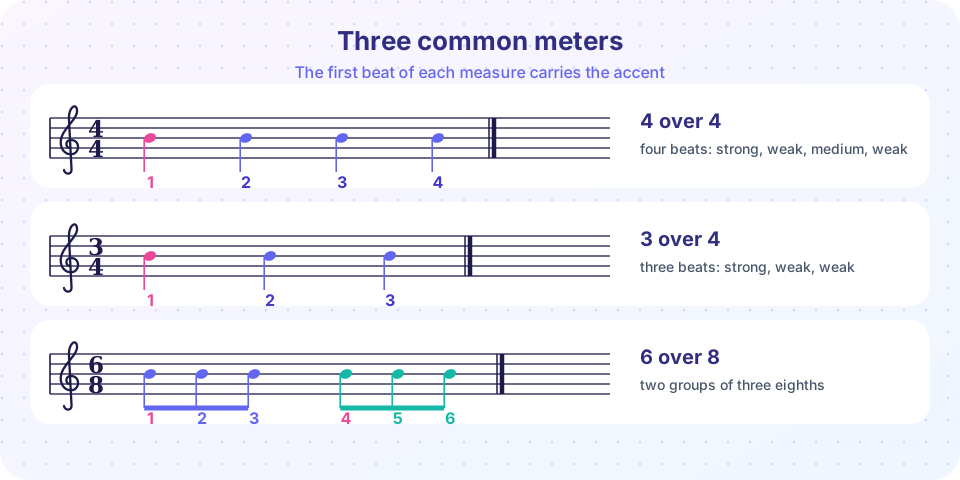
- 2/4 has two beats per measure: STRONG-weak. It feels like marching or walking.
- 3/4 has three: STRONG-weak-weak. It is the meter of the waltz.
- 4/4 has four: STRONG-weak-medium-weak. It is the most common meter in popular music, with the strongest accent on beat 1 and a lesser accent on beat 3.
To count simple meter you say the beat numbers and divide each beat with "and": "1 & 2 & 3 & 4 &".
Compound meter: beats that divide in three
If you try to count 6/8 as six equal beats you will find it feels wrong. In practice a measure of 6/8 is felt as two beats, each of which is a dotted quarter note that divides into three eighth notes: ONE-two-three FOUR-five-six, with a lesser accent on the fourth eighth note. This is compound meter: the beat divides in three instead of two.
You can recognize compound meters because the top number is a multiple of three (6, 9, 12) and the bottom number is usually 8. Compare:
| Time signature | Beats felt | Each beat divides into | Example feel |
|---|---|---|---|
| 2/4, 3/4, 4/4 | 2, 3, 4 | 2 | march, waltz, rock |
| 6/8 | 2 | 3 | jig, lilting ballad |
| 9/8 | 3 | 3 | slip jig |
| 12/8 | 4 | 3 | slow blues, gospel ballad |
6/8 and 3/4 both contain six eighth-note units, but they feel different: 3/4 groups them as 2+2+2 (three beats), while 6/8 groups them as 3+3 (two beats). Composers sometimes play with the tension between the two, a trick called hemiola, famous from the song "America" in West Side Story, which alternates between 6/8 and 3/4 feeling.
Odd meters such as 5/4 and 7/8 group their beats unevenly (for example 3+2 or 2+2+3). "Take Five", recorded by the Dave Brubeck Quartet in 1959, is the classic jazz piece in 5/4. Folk music of the Balkans uses meters such as 7/8 and 11/8 constantly.
Tempo: how fast is the beat?
Meter tells you how beats are grouped, and tempo tells you how fast they go. Tempo is measured in beats per minute (BPM). At 60 BPM the beat is one per second; at 120 BPM it is two per second. Notation indicates the beat unit too: ♩ = 120 means 120 quarter notes per minute. For a compound meter, the beat is the dotted quarter, written ♩. = 60.
A metronome, a device that clicks at an adjustable rate, makes tempo exact. Johann Maelzel patented a popular metronome in 1815, and Beethoven was among the first major composers to mark metronome numbers in his scores. Before then, composers used Italian words, which are still the standard way to describe tempo in classical music. Approximate ranges in BPM:
| Italian term | Meaning | Typical BPM |
|---|---|---|
| Largo | broad, very slow | 40 to 60 |
| Adagio | slow, at ease | 66 to 76 |
| Andante | at a walking pace | 76 to 108 |
| Moderato | moderate | 108 to 120 |
| Allegro | fast, cheerful | 120 to 156 |
| Presto | very fast | 168 to 200 |
These ranges overlap, and different sources vary, so treat them as rough guides. Tempo can change within a piece: ritardando (rit.) means gradually slowing down, accelerando (accel.) means gradually speeding up, and a tempo means "return to the original speed".
Common misconceptions
"The bottom number of a time signature counts something." It names a note value: 4 means quarter note, 8 means eighth note.
"6/8 has six beats." It usually has two main beats, each divided into three. You count 1-2-3-4-5-6 only at very slow tempos.
"A faster tempo means shorter note values." Note values stay relative. Playing a piece faster changes the tempo, not what the notes are called.
"Time signatures only matter for conductors." They tell every performer where the accents fall and how to count, which is essential for ensemble playing.
Try it
This metronome marks the beats of the time signature you choose. A high click marks beat 1 (the downbeat) and lower clicks mark the other beats. In 6/8 the click on the fourth eighth note is medium. Change the tempo while it runs, and try to tap along with your foot.
Tempo arithmetic is a good use of code. This program converts BPM to seconds per beat, computes how long a piece lasts from its number of measures, and shows the six-eight idea: at the same BPM, a dotted-quarter beat is three times as long as an eighth note.
Press Run (or Ctrl + Enter) to see the result here.
Program input · what you'd type while the program runs
Type the answers before you press Run, one per line. Each time the program reads a line (with input()), it gets the next line from this box.
Check your understanding
Quick check · 6 questions
of 6 answered You scored / 6 · perfect!
-
1. In the time signature 3/4, what does the bottom number 4 mean?
The bottom number names the note value that gets the beat: 4 stands for the quarter note. The top number, 3, is the beats per measure. -
2. Which meter is compound?
In 6/8 each beat (a dotted quarter) divides into three eighth notes. -
3. How is the common time signature 4/4 sometimes written?
Common time is written C. A C with a vertical line is cut time, 2/2. -
4. At 120 BPM, how long is one beat?
Sixty seconds divided by 120 beats gives half a second per beat. -
5. Which Italian tempo term means gradually slowing down?
Ritardando (rit.) slows down. Accelerando speeds up. A tempo returns to the original speed. -
6. How many main beats are usually felt in a measure of 6/8?
6/8 is felt as two beats, each a dotted quarter divided into three eighth notes.
Summary
- Barlines divide music into measures; the first beat of each measure, the downbeat, is accented.
- A time signature's top number gives beats per measure; the bottom number names the note that gets a beat (4 = quarter, 8 = eighth).
- Simple meter divides each beat into two (2/4, 3/4, 4/4); compound meter divides it into three (6/8, 9/8, 12/8).
- 6/8 is felt in two, 3/4 in three: same number of eighth notes, different grouping.
- Tempo is the speed of the beat in BPM; Italian words (Largo to Presto) give rough ranges, and rit. and accel. change speed.
Next: Chapter 2 review
Track your progress
Create a free account to tick off lessons and pick up where you left off on any device.
of Music Theory lessons completed