


















Lesson 36 of 50 · Rhythm and Meter in Depth
Odd and additive meters
Learn how 5/4, 7/8 and 9/8 are built from groups of twos and threes, how to count them naturally, and where to hear them in jazz, folk and classical music.
Waltzes are in three, marches in two or four, and most pop songs in four. These meters are so familiar that your body counts them without being told. Then a piece arrives in five or seven and everything feels uneven, as though someone has dropped a step on a staircase. But the unevenness is the point. Odd meters are used in the folk dances of the Balkans and the Middle East, in jazz, in film scores and in progressive rock, and once you learn the secret of how they are built, they are no harder to feel than a waltz. The secret is that a bar of five or seven is not five or seven equal beats. It is a pair of short groups and a long one stitched together.
What you will learn
- What makes a meter regular, compound or irregular (odd)
- How additive meters are built from groups of two and three
- How to count 5/4, 7/8 and 9/8 so that they feel natural
- How composers and folk traditions use these meters
- How to read the beaming and the grouping shown in time signatures
Key terms
Odd (irregular) meter: a meter whose beats cannot be grouped into equal sets of two or three, such as 5, 7 or 11 pulses.
Additive meter: a meter described as a sum of group sizes, such as 2 + 2 + 3.
Aksak: a Turkish and Balkan term for "limping" additive rhythms, typically with groups of 2 and 3.
Short and long beats: the two kinds of beat in an additive meter; a short beat has 2 subdivisions and a long beat has 3.
Mixed meter: a piece that changes its time signature from bar to bar.
Why 5 and 7 feel strange
Meters have a hierarchy. In 4/4 the four beats split into two pairs; in 6/8 the six eighths form two groups of three. In every case the bar divides into equal chunks, so the same movement repeats twice.
Now consider five beats. You cannot split five into equal groups of two or three, but you can split it into a three and a two, in either order. The bar becomes a long gesture followed by a short one, or the reverse. Seven splits as 2 + 2 + 3 or 3 + 2 + 2 or 2 + 3 + 2. Nine as 2 + 2 + 2 + 3 or as the regular 3 + 3 + 3. Eleven as 3 + 3 + 3 + 2 or 2 + 2 + 3 + 2 + 2. This is why such meters are called additive: the bar is the sum of groups, and the groups are twos and threes because those are the smallest groups people can easily feel and dance to.
Equal groups give a rocking, symmetrical motion. Unequal groups give a motion that lurches or limps, in the pleasant sense of a dance step that lopes. The Turkish term aksak, meaning "limping", describes this: the dancers' feet fall in alternating short and long steps.
Counting odd meters
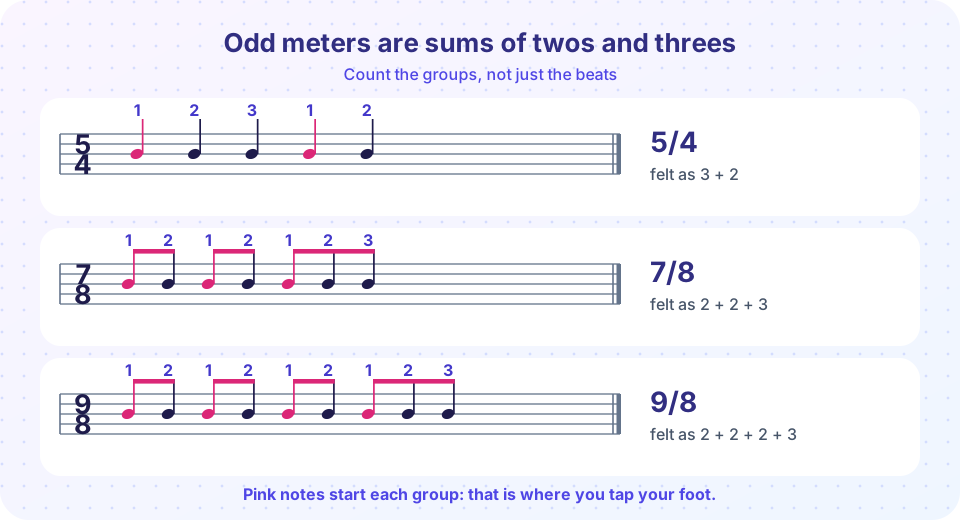
Count the groups, not each pulse. A good method is to say the number of the pulse inside each group and restart at 1 for each new group, with the first of each group accented.
| Meter | Groups | Counting | Feel |
|---|---|---|---|
| 5/4 | 3 + 2 | 1 2 3 1 2 | long, short |
| 5/4 | 2 + 3 | 1 2 1 2 3 | short, long |
| 7/8 | 2 + 2 + 3 | 1 2 1 2 1 2 3 | short, short, long |
| 7/8 | 3 + 2 + 2 | 1 2 3 1 2 1 2 | long, short, short |
| 9/8 | 2 + 2 + 2 + 3 | 1 2 1 2 1 2 1 2 3 | three short, one long |
| 11/8 | 3 + 3 + 3 + 2 | 1 2 3 1 2 3 1 2 3 1 2 | three long, one short |
At a lively tempo you stop counting the individual pulses and feel two or three big movements per bar, like steps in a dance: "long-short" for 5, "short-short-long" for 7. This is how folk dancers keep time without counting aloud.
How a bar is notated
A written time signature usually does not say how the bar is grouped. Composers show it through beaming (eighth notes beamed in twos and threes), through accent marks and often by writing the meter as an addition: (2+2+3)/8. In 5/4 and 7/8 the conductor usually does not beat every pulse; a 5/4 bar is often conducted in two big beats (one long, one short), the same way you tap your foot.
Where you will hear them
- Jazz. Dave Brubeck's quartet recorded the album Time Out in 1959, with the tune "Take Five" (written by saxophonist Paul Desmond) in 5/4 and Brubeck's "Blue Rondo à la Turk" in 9/8, grouped 2 + 2 + 2 + 3, before settling into 4/4. The album proved that audiences could swing in odd meters.
- Film and TV. Lalo Schifrin's theme for Mission: Impossible is in 5/4.
- Classical. The second movement of Tchaikovsky's sixth symphony, the "Pathétique", is a waltz in 5/4, sometimes called a "limping waltz". "Mars, the Bringer of War", from Holst's The Planets, drives along in a heavy 5/4. Bartók wrote a set of dances in Bulgarian rhythm in his Mikrokosmos.
- Folk music. Bulgarian folk dance uses meters such as 5/8 (the paidushko, 2 + 3), 7/8 (the ruchenitsa, 2 + 2 + 3) and 11/8. Turkish and Greek music uses 9/8 in the karsilama dance.
- Rock. Pink Floyd's "Money" is in 7/4 for its verses.
These examples all share a property: the groups keep the dance feeling alive, because the accents recur at a steady rate of long and short steps.
Mixed meters
Some music alternates time signatures as it goes: a bar of 3/4, a bar of 2/4, a bar of 4/4. The effect is like a speaker emphasizing different words. Stravinsky's The Rite of Spring (1913) is the best-known example in the concert hall: in some passages the meter changes nearly every bar while the eighth note stays constant. Mixed meters can be written as a sequence of bars or analyzed as an additive meter spanning several bars (for example, 3 + 2 + 2 + 3).
Common misconceptions
"Odd means weird or hard." "Odd" here means "not divisible evenly". Folk dancers feel these meters from childhood. Once the groups are learned, they are natural.
"A bar of 7/8 has seven equal beats." The seven eighth notes are equal in length, but the beats you feel are the groups. Accent the group starts, and the bar locks into place.
"The time signature tells you the grouping." It tells you how many pulses; the grouping comes from beams, accents, melody or the dance. The same 7/8 can be 2 + 2 + 3 or 3 + 2 + 2 and sound quite different.
Try it
Choose a meter and hear its grouping. The loud kick lands on the start of each group. Notice how the same seven pulses sound different when the long group comes first, in the middle or at the end.
Now invent your own meter. Type a grouping such as 2 2 3 or 3 3 2 2 (any numbers from 1 to 5), and listen to it as a repeating loop. Add a melody line that follows the groups.
Check your understanding
Quick check · 5 questions
of 5 answered You scored / 5 · perfect!
-
1. Which grouping of 7/8 is most common in Bulgarian dance?
The ruchenitsa is grouped 2 + 2 + 3, two short beats and a long beat. -
2. How is a 5/4 bar of 3 + 2 counted?
Restart the count at each group, accenting the first of each group: three, then two. -
3. What does 'aksak' mean?
Aksak describes rhythms with groups of unequal length that give a limping, lilting feel. -
4. How can a composer show the grouping in a 7/8 bar?
Beaming and accents show the grouping; the time signature alone does not. -
5. Which is a mixed meter?
A mixed meter changes time signature from bar to bar.
Summary
- Odd meters are sums of short groups (2) and long groups (3).
- Count the groups, not the pulses, and accent the start of each group.
- 5/4 = 3 + 2 or 2 + 3; 7/8 = 2 + 2 + 3 (or 3 + 2 + 2, 2 + 3 + 2); 9/8 = 2 + 2 + 2 + 3 or 3 + 3 + 3; 11/8 = 3 + 3 + 3 + 2.
- You will meet them in jazz, folk dance, film themes, classical works and rock.
- Beaming, accents and (2+2+3)/8 notation show the grouping.
Track your progress
Create a free account to tick off lessons and pick up where you left off on any device.
of Music Theory lessons completed