


















Lesson 28 of 50 · Harmony and Progressions
Chapter 5 review: harmony and progressions
Review chapter 5 in one picture and one table, then test yourself with ten mixed questions on triads, Roman numerals, function, cadences and voice leading.
You can now do something that sounds like magic to many beginners: look at a short string of chords and say what each one is doing. This review pulls the chapter into one picture, one table and a set of mixed questions. If any row of the table feels shaky, follow its link back to the lesson before you take the quiz.
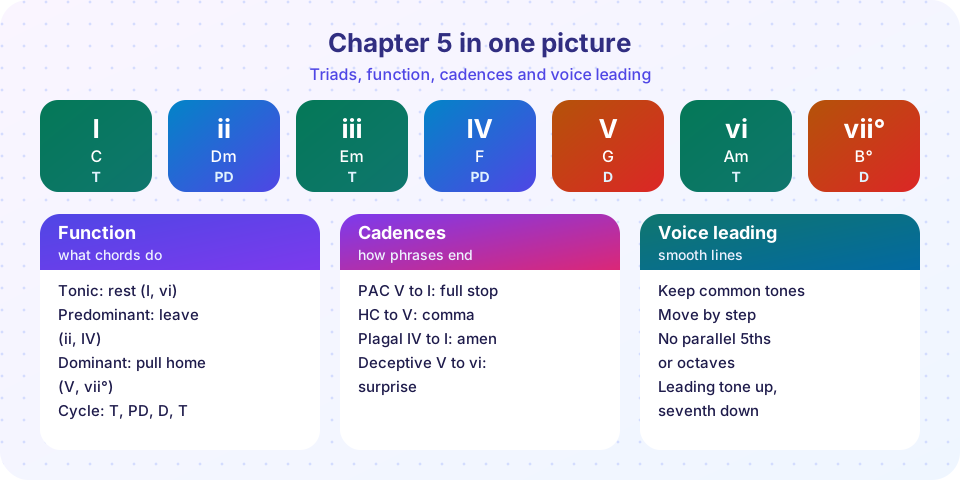
The chapter in one table
| Topic | The key idea | Quick test | Lesson |
|---|---|---|---|
| Diatonic triads | Stack thirds on each scale degree; qualities run M m m M M m dim | Name the chords of G major | Triads |
| Roman numerals | Uppercase major, lowercase minor, ° diminished; they work in any key | What is vi in D major? | Triads |
| Function | Tonic rests, predominant leaves, dominant pulls back | Which family is IV in? | Function |
| Progressions | T, PD, D, T; descending fifths are strongest | Spell ii-V-I in C | Function |
| Cadences | PAC full stop, HC comma, plagal amen, deceptive surprise | Which ends on V? | Cadences |
| Voice leading | Keep common tones, move by step, no parallel 5ths or 8ves | Resolve B and F in G7 | Voice leading |
Recall checklist
Read each line and decide whether you could do it right now, with no notes.
- Write the seven triads of any major key from its scale.
- State the function of each of them.
- Describe in plain words the difference between a half cadence and a perfect authentic cadence.
- Explain why V7 resolves to I the way it does (leading tone up, seventh down).
- Find parallel fifths in a four-part example.
Putting it together: analyze a phrase
Suppose you meet this four-bar chord chart in the key of G major: G | Em | C D7 | G. Here is how an analyst reads it, using everything from the chapter.
- Find the key. The chart starts and ends on G, and the D7 chord contains F#, the leading tone of G. So the key is G major.
- Label each chord. From the G major scale (G A B C D E F#) the chords are G = I, Em = vi, C = IV, D7 = V7.
- Assign function. I and vi are tonic, IV is predominant, V7 is dominant. The path reads T, T, PD, D, T. That is the cycle with the tonic prolonged at the start by a tonic substitute.
- Name the cadence. The last two chords are V7 to I, in root position. If the melody ends on G (the tonic) it is a perfect authentic cadence; if it ends on B or D it is an imperfect one.
- Check the voice leading. In D7 to G the leading tone F# should rise to G and the seventh C should fall to B. If you find a voicing where C stays or leaps up, you have a voice-leading flaw.
Notice that every step uses a different lesson. This is the habit to build: never stare at a chart as a pile of letters; read it as a key, a set of numerals, a path through three functions and a cadence.
Common slips to watch for
- Mixing up case. Writing IV when the chord is minor, or ii when it is major. Check the scale, then the qualities pattern.
- Calling every V a half cadence. A half cadence needs a phrase ending on V. A V in the middle of a phrase is just a chord.
- Forgetting the key signature in minor. The dominant in minor needs the raised seventh degree, so a lowercase v is only right in natural minor.
- Treating parallel fifths as always wrong. They are against the rules of this particular style. Know the rule, and know when other styles ignore it.
- Reading numerals as pitches. V is a role; the notes depend on the key.
Try it
Here is a final ear test that combines function, progression and cadence. A progression is played; choose its name. Each one comes from this chapter.
Check your understanding
Quick check · 10 questions
of 10 answered You scored / 10 · perfect!
-
1. Which of these is the correct set of triad qualities for degrees I to vii in a major key?
Every major scale has the same pattern of whole and half steps, so the qualities always run major, minor, minor, major, major, minor, diminished. -
2. What are the chords I, IV and V in D major?
D major has F# and C#. The chords on degrees 1, 4 and 5 are D, G and A. -
3. Which chords belong to the dominant family in C major?
Both contain the leading tone B and scale degree 2, the notes that pull to the tonic. -
4. Which function path matches ii-V-I?
ii is predominant, V dominant, I tonic: the cycle in miniature. -
5. A phrase ends on a G major chord in C major, so that the tension is left hanging. What cadence is it?
A phrase ending on V is a half cadence. -
6. What is true of a deceptive cadence in C major?
V moves to vi, which shares two notes with the expected tonic. -
7. How should the leading tone B normally move in a G7 to C resolution?
The leading tone is a half step below the tonic and rises to it. -
8. What is wrong with a progression in which two voices move from C and G up to D and A?
C to G is a perfect fifth and D to A is another; both voices move in the same direction. -
9. Which cadence is often called the amen cadence?
IV to I is the cadence used for the amen at the end of hymns. -
10. Which statement about Roman numerals is correct?
Roman numerals describe the degree and quality, which is why they work in every key.
Summary
- Triads are built by stacking thirds on every scale degree; Roman numerals name them in any key.
- Tonic, predominant and dominant describe what chords do, and the cycle T, PD, D, T drives most progressions.
- Cadences are the punctuation: authentic, half, plagal and deceptive.
- Voice leading keeps lines smooth: common tones, steps, contrary motion, resolved tendency tones, no parallel fifths or octaves.
Track your progress
Create a free account to tick off lessons and pick up where you left off on any device.
of Music Theory lessons completed