


















Lesson 48 of 50 · Projects and Practice
Glossary of harmony, melody, rhythm and analysis terms
A glossary of fifty-plus terms from chapters 5 to 8, from antecedent and augmented sixth to tonic and triad, each defined plainly and linked to its lesson, with flashcards.
Every field has a vocabulary, and music theory has a large one. The words matter because each names a concept that you can recognize, discuss and use. This glossary collects the terms from chapters 5 to 8 (harmony, melody and form, rhythm, analysis and composition) in alphabetical order, with a plain-language meaning and the lesson in which each appears. Use it for quick lookup, then try the flashcards at the end to turn recognition into recall.
What you will learn
- The meaning of more than fifty terms from chapters 5 to 8
- Which lesson to revisit for each term
- How to turn definitions into recall with flashcards
Key terms
Glossary: an alphabetical list of terms with definitions.
Active recall: trying to remember a definition before looking it up.
Term family: a group of related words, such as the names of the four cadences.
The glossary
| Term | Meaning | Lesson |
|---|---|---|
| Anticipation | A note or chord that arrives early, before its expected beat. | Method |
| Antecedent | The first, question-like phrase of a period, ending unresolved. | Phrases |
| Appoggiatura | A dissonant note approached by leap on a strong beat that resolves by step. | Method |
| Augmented sixth chord | A chromatic predominant whose raised fourth and lowered sixth degrees resolve outward to the dominant note. | Borrowed chords |
| Authentic cadence | V (or V7) moving to I; perfect when both are in root position and the melody ends on the tonic. | Cadences |
| Backbeat | An accent on beats 2 and 4 of a 4/4 bar. | Syncopation |
| Binary form | A two-part form, A B, usually with each part repeated. | Forms |
| Borrowed chord | A chord taken from the parallel major or minor key. | Borrowed chords |
| Cadence | A chord formula that ends a phrase, like punctuation. | Cadences |
| Cadential six-four | A tonic chord in second inversion that actually functions as a decoration of V. | Cadences |
| Chord tone | A note belonging to the chord that is currently sounding. | Composing |
| Clave | A repeating five-hit rhythm that organizes Afro-Cuban music. | Syncopation |
| Common tone | A note shared by two successive chords, usually held in the same voice. | Voice leading |
| Consequent | The second, answering phrase of a period, ending with a stronger cadence. | Phrases |
| Contour | The overall shape of a melody. | Contour |
| Deceptive cadence | V moving to vi, or another chord, instead of the expected I. | Cadences |
| Diatonic | Using only the notes of the key's scale. | Triads |
| Dominant | The chord on the fifth degree (V) or the family of chords, V and vii°, that creates tension. | Function |
| Elision | Two phrases overlapping on a shared note. | Phrases |
| Exposition | The first section of sonata form, which sets out the themes in two keys. | Forms |
| Function | The role a chord plays in a key: tonic, predominant or dominant. | Function |
| Half cadence | A phrase ending on V, leaving the harmony unresolved. | Cadences |
| Harmonic rhythm | How often the chords change. | Function |
| Hemiola | A shift between grouping six pulses as 3 + 3 and as 2 + 2 + 2. | Hemiola |
| Inversion | A chord with a note other than its root in the bass. | Method |
| Leading tone | The seventh scale degree, a half step below the tonic, which pulls up to it. | Function |
| Metric modulation | A tempo change in which a note value of the old tempo becomes a different note value in the new one. | Hemiola |
| Modal mixture | Using chords from the parallel key. | Borrowed chords |
| Modulation | A lasting change of key, confirmed by a cadence. | Modulation |
| Motif | A short musical idea that can be repeated and developed. | Contour |
| Neapolitan chord | A major chord on the lowered second degree, usually in first inversion. | Borrowed chords |
| Neighbor tone | A non-chord note that steps away from a chord tone and returns. | Method |
| Non-chord tone | A melody note that does not belong to the current chord. | Method |
| Odd meter | A meter whose beats group into unequal sets of twos and threes, such as 5/4 or 7/8. | Odd meters |
| Passing tone | A non-chord note that fills the step between two chord tones. | Method |
| Period | A pair of phrases, antecedent and consequent, forming question and answer. | Phrases |
| Phrase | A musical thought ending at a cadence or pause. | Phrases |
| Pivot chord | A chord that belongs to both the old and the new key in a modulation. | Modulation |
| Plagal cadence | IV moving to I, the amen cadence. | Cadences |
| Polyrhythm | Two different divisions of the same span of time sounding together. | Syncopation |
| Predominant | The chord family that leaves the tonic and prepares the dominant, such as ii and IV. | Function |
| Recapitulation | The part of sonata form where the themes return in the home key. | Forms |
| Retrograde | A motif played backwards. | Contour |
| Roman numeral | A numeral naming a chord by its scale degree and quality. | Triads |
| Rondo | A form with a returning refrain between contrasting episodes, such as A B A C A. | Forms |
| Secondary dominant | The dominant of a chord other than the tonic, such as V7/V. | Modulation |
| Sentence | A phrase structure: idea, repeat, then fragmented continuation. | Phrases |
| Sequence | A motif repeated at a different pitch level. | Contour |
| Syncopation | Accent on a weak position or between beats. | Syncopation |
| Ternary form | A three-part form with a return, A B A. | Forms |
| Tonic | The home chord (I) or the family of tonic chords that feel at rest. | Function |
| Tonicization | Briefly treating a chord other than I as if it were the tonic. | Modulation |
| Triad | A three-note chord of root, third and fifth. | Triads |
| Voice leading | The way individual voices move from chord to chord. | Voice leading |
How to use a glossary well
A glossary is more useful as a tool for recall than as a text to reread. Cover the right-hand column and try to define each term. Mark the ones you cannot define and return to the linked lesson. Better still, write a one-sentence example for each: "In C major, D7 resolving to G is a secondary dominant." An example proves understanding better than a definition does.
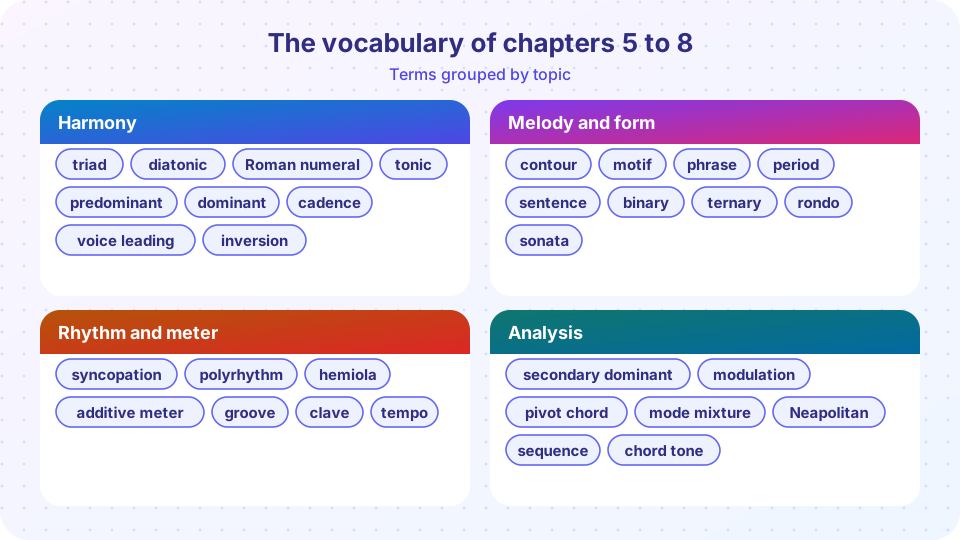
Notice also that terms come in families. The cadence names (authentic, half, plagal, deceptive) are one family; the non-chord tones (passing, neighbor, appoggiatura, anticipation) are another; the forms (binary, ternary, rondo, sonata) are a third. Learning a family together lets you contrast the members and avoid confusion.
Common misconceptions
"Different books use different words, so the terms don't matter." Vocabulary varies in details (some books call a secondary dominant an applied dominant), but the concepts are the same. Learn the concept and note the alternatives.
"Memorizing definitions is the same as understanding." You understand a term when you can find an example in music and explain why it fits. Use the glossary together with the interactive drills.
Try it
Flashcards for twenty key terms. Read the definition, choose the term, and see your score. The questions are drawn at random.
Check your understanding
Quick check · 4 questions
of 4 answered You scored / 4 · perfect!
-
1. Which term means a chord taken from the parallel key?
Borrowing from the parallel key is called modal mixture. -
2. A motif repeated at a different pitch level is a...
That is the definition of a sequence. -
3. What is the antecedent?
The antecedent ends unresolved; the consequent answers. -
4. Which pair are both cadences?
Plagal and deceptive are two of the four standard cadences.
Summary
- Terms fall into families: harmony, melody and form, rhythm and meter, analysis.
- Define terms from memory before checking the glossary, and give an example of each.
- Learn related terms together so you can tell them apart.
- Use the flashcards for repeated recall.
Next: One-page cheat sheet
Track your progress
Create a free account to tick off lessons and pick up where you left off on any device.
of Music Theory lessons completed