


















Lesson 16 of 50 · Scales and Keys
Chapter 3 review: scales and keys
Review the major scale, key signatures, the circle of fifths, natural, harmonic and melodic minor, modes, pentatonic and blues scales with a cheat sheet and a quiz.
Scales are the raw material of melody and harmony, and in this chapter you built them all: the major scale from a pattern of whole and half steps, the key signatures that summarize them, the three forms of minor, the seven modes, and the pentatonic and blues scales. This review puts the key facts on one page and checks them with a ten-question quiz.
What you will learn
- A one-page summary of chapter 3
- How the patterns of the major scale, minor scales and modes relate to each other
- How to find the key of a melody from its notes
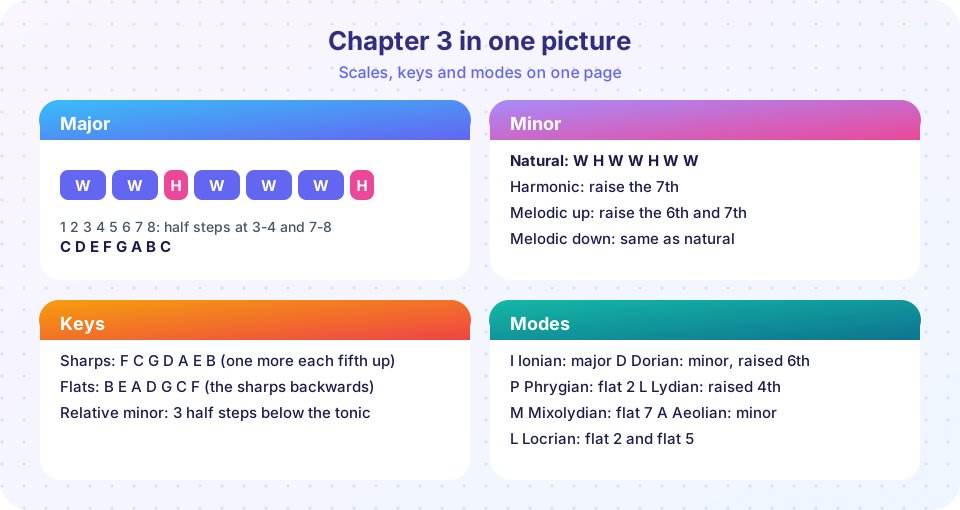
Chapter in one picture
The cheat sheet has four cards. The first is the major scale: W W H W W W H, with half steps between degrees 3 and 4 and between 7 and 8. The second is the minor scales: natural minor W H W W H W W, harmonic minor with a raised seventh, melodic minor with raised sixth and seventh going up. The third is keys: sharps come in the order F C G D A E B, flats in the reverse order, and the relative minor starts three half steps below the major tonic. The fourth is modes: the same notes with a different home, from bright Lydian to dark Locrian.
One idea connects all four: a scale is defined by its pattern of steps, not by its notes. Change the starting note and keep the pattern, and you get the same kind of scale in a new key. Change the pattern while keeping the starting note, and you get a different scale on the same tonic: major becomes minor by lowering degrees 3, 6 and 7, Dorian by lowering 3 and 7, and so on.
Recap table
| Topic | Key facts |
|---|---|
| Major scale | W W H W W W H; degrees tonic, supertonic, mediant, subdominant, dominant, submediant, leading tone; spell with each letter once |
| Key signatures | Sharps F C G D A E B; flats B E A D G C F; last sharp up a half step (or the second-to-last flat) names the major key; one flat is F |
| Circle of fifths | Clockwise adds a sharp, counter-clockwise adds a flat; neighbors share six of seven notes; inner ring holds the relative minors |
| Natural minor | W H W W H W W; lowered 3, 6, 7 compared with major; relative minor = sixth degree |
| Harmonic minor | Raised 7th, creating an augmented second between degrees 6 and 7 |
| Melodic minor | Raised 6th and 7th ascending, natural minor descending (classical) |
| Modes | Ionian, Dorian, Phrygian, Lydian, Mixolydian, Aeolian, Locrian: brightest is Lydian, darkest is Locrian |
| Pentatonic and blues | Five notes without half steps; blues adds the flat fifth |
Finding the key of a tune
Here is the practical use of everything in this chapter. Suppose a melody uses the notes G A B C D E F♯. To find its key, check which major scales contain all of them. Only G major contains F♯ and C natural. A melody with E♭ and B♭ but no A♭ would be in B♭ major, or its relative minor G minor, or even a mode like G Dorian. In practice you combine three clues:
- The accidentals that appear tell you the key signature.
- The last note of the melody is usually the tonic.
- The first and last chords are usually the tonic chord.
If the clues point at a relative pair (G major or E minor), the tonic decides: if the melody ends on E and the harmony rests on an E minor chord, it is E minor.
Where learners go wrong
Spelling scales with repeated letters. F♯ major has E♯, not F. Check that every letter A to G appears once.
Confusing relative and parallel minors. Relative: same key signature, different tonic (C major and A minor). Parallel: same tonic, different signature (C major and C minor).
Raising the wrong notes in harmonic minor. Only the seventh degree is raised. The sixth stays natural.
Thinking a mode is a key. Modes share the notes of a major scale, but the tonic is determined by the melody and harmony.
Reading the circle backwards. Clockwise from C: G, D, A, E, B, F♯ (sharps). Counter-clockwise: F, B♭, E♭, A♭ (flats).
Try it
Train your ear to identify scales. The game plays a random scale starting on a random note. Choose its name from the buttons. Start with major versus natural minor, then enable all the scales.
The key-finding procedure also works as code. This program takes a list of notes, converts them to pitch classes and reports which major keys contain all of them. Try your own melodies.
Press Run (or Ctrl + Enter) to see the result here.
Program input · what you'd type while the program runs
Type the answers before you press Run, one per line. Each time the program reads a line (with input()), it gets the next line from this box.
Check your understanding
Quick check · 10 questions
of 10 answered You scored / 10 · perfect!
-
1. What is the step pattern of the major scale?
Major is W W H W W W H. W H W W H W W is natural minor. -
2. A key signature of three sharps is which major key?
Three sharps are F♯ C♯ G♯. The last sharp is G♯, and a half step above it is A: A major. -
3. What is the relative minor of E-flat major?
The relative minor starts on the sixth degree of the major scale: C is the sixth degree of E-flat major. -
4. Which minor form has an augmented second between degrees 6 and 7?
The harmonic minor raises only degree 7, leaving a three-half-step gap from degree 6. -
5. Moving clockwise on the circle of fifths from G major, the next key is:
Clockwise by a fifth: C, G, D. D major has two sharps. -
6. Which mode is the major scale with a lowered seventh?
Mixolydian is major with a flat 7th. -
7. What notes make the A minor pentatonic scale?
A minor pentatonic is A C D E G, the same notes as C major pentatonic. -
8. Why does the 7th degree of F-sharp major have to be spelled E-sharp?
F♯ G♯ A♯ B C♯ D♯ E♯ uses every letter once. E♯ and F sound the same. -
9. Which pair of keys shares a key signature?
Relative keys (G major and E minor) share a signature of one sharp. Parallel keys do not. -
10. What does the flat fifth add to the minor pentatonic to make a blues scale?
The flat fifth is the blue note, adding tension between the fourth and fifth degrees.
Summary
- A scale is a pattern of steps: major W W H W W W H, natural minor W H W W H W W.
- Key signatures use the order F C G D A E B for sharps and B E A D G C F for flats; the circle of fifths organizes all twelve keys with their relative minors.
- Harmonic minor raises the 7th; melodic minor raises the 6th and 7th going up.
- Modes are the same notes with a different home; compare them with major or minor on the same tonic.
- Pentatonic scales drop the half steps, and the blues scale adds the flat fifth.
- To find a key, combine the accidentals, the last note and the first and last chords.
Track your progress
Create a free account to tick off lessons and pick up where you left off on any device.
of Music Theory lessons completed