


















Lesson 5 of 50 · Getting Started
Chapter 1 review: getting started
Review the staff, clefs, note names, the piano keyboard, half and whole steps and ledger lines, with a one-page picture, a recap table and a ten-question quiz.
You have now covered the alphabet of music. You can name the seven letters, find them on the keyboard, read them on the treble and bass staves, extend the staff with ledger lines and count distances in half steps and whole steps. This review gathers those ideas into one page, then tests them with a mixed quiz and two quick practice tools.
If you can complete the quiz at the end with at most two mistakes, you are ready for chapter 2. If not, return to the lesson named in the explanation of each question you missed.
What you will learn
- A one-page summary of chapter 1
- How the staff, the clefs and the keyboard describe the same pitches
- Which skills to practice before chapter 2
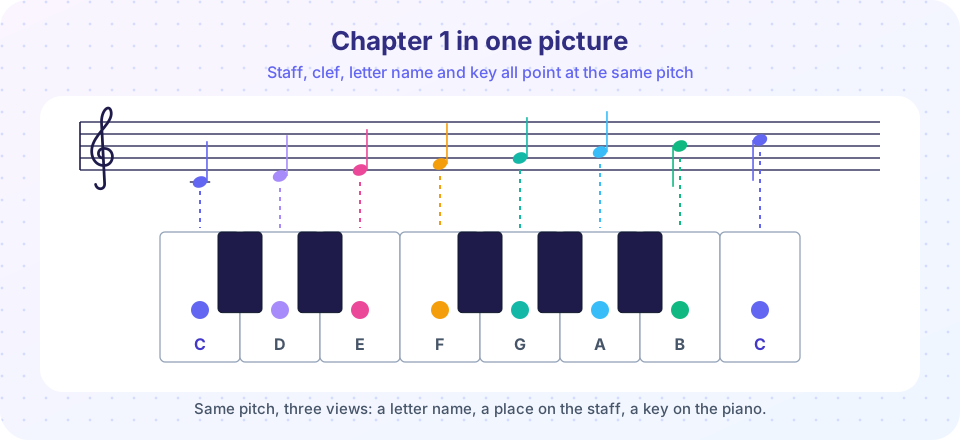
Chapter in one picture
The picture above is the whole chapter. Each colored note on the staff is joined by a dotted line to the key you press to play it. On the keyboard, the seven white keys C D E F G A B carry the letters, and the black keys fill in the gaps. On the staff, each step up from line to space to line raises the note by one letter. The clef is the key that tells you where the letters start: in the treble clef the second line is G, and in the bass clef the second line from the top is F.
Three ideas hold everything together. First, letters repeat every octave, and an octave is twelve half steps. Second, neighboring keys are a half step apart, and the white keys E to F and B to C are the two places where no black key lies between them. Third, the staff is a graph of pitch: higher on the page means higher in sound, ledger lines extend it, and an 8va sign shifts a passage by an octave.
Recap table
| Topic | The key idea | Remember |
|---|---|---|
| Note letters | Seven letters, A to G, repeat in every octave | After G comes A again |
| The staff | Five lines and four spaces, counted from the bottom | Each step up the page is one letter higher |
| Treble clef | G clef, second line is G4 | Lines E G B D F, spaces F A C E |
| Bass clef | F clef, second line from the top is F3 | Lines G B D F A, spaces A C E G |
| Grand staff | Treble above bass, joined by a brace | Middle C joins the two staves |
| Keyboard | White keys carry letters; black keys come in groups of two and three | C is left of the group of two |
| Octave | Twelve half steps, double the frequency | Middle C is C4, A4 is 440 Hz |
| Half and whole steps | A half step joins neighbor keys; a whole step is two half steps | No black key between E and F or B and C |
| Sharps and flats | Raise or lower a note by a half step | C sharp and D flat are enharmonic |
| Ledger lines | Short lines extend the staff | Middle C is on the first ledger line below treble or above bass |
| 8va | Shifts a passage an octave higher (8vb lower) | It changes sound, not note names |
Where learners go wrong
Mixing up the clefs. If you read bass notes with treble names, every answer is off by two letters. Always check the clef first.
Treating black keys as the only sharps and flats. E sharp is the white key F; C flat is the white key B.
Counting an octave as eight half steps. An octave contains eight letter names (C to C) but twelve half steps.
Skipping the landmark habit. Naming every note from scratch is slow. Learn the treble G, bass F, middle C and treble C5, then count from them.
Try it
First, train your ear for pitch direction, which every musician needs. This game plays two notes. Decide whether the second note is higher or lower than the first, and see how fast your accuracy rises. Increase the difficulty by choosing smaller gaps.
Second, convert note names to positions on both staves. A "step" is one line or space. Step 0 is the bottom line. Look at how middle C appears at step -2 in the treble clef (two steps below the bottom line) and at step 10 in the bass clef.
Press Run (or Ctrl + Enter) to see the result here.
Program input · what you'd type while the program runs
Type the answers before you press Run, one per line. Each time the program reads a line (with input()), it gets the next line from this box.
Check your understanding
Quick check · 9 questions
of 9 answered You scored / 9 · perfect!
-
1. Which notes are the lines of the bass clef, bottom to top?
Bass clef lines: G B D F A (Good Boys Do Fine Always). Treble clef lines are E G B D F. -
2. How many half steps make up an octave?
An octave spans twelve half steps. The word 'octave' counts eight letter names. -
3. Between which pair of white keys is there no black key?
B to C and E to F are the two natural half steps on the white keys. -
4. The A above middle C has a frequency of:
A4 is the tuning reference at 440 Hz. 261.6 Hz is middle C; 220 Hz is A3. -
5. What is another name for the pitch C sharp?
C sharp and D flat are enharmonic: the same black key. -
6. Around which line does the spiral of the treble clef wrap?
The treble clef is also called the G clef: its spiral circles the second line from the bottom, G4. -
7. An 8va sign under a passage in the bass clef (8vb) tells the player to:
8vb asks for an octave lower than written. Plain 8va means an octave higher. -
8. An accidental written in the middle of a measure normally lasts until:
Accidentals apply to the same pitch for the rest of the measure and are canceled at the barline. -
9. E sharp is played on the piano as:
E sharp is a half step above E. No black key lies between E and F, so the note is F.
Summary
- Notes use the letters A to G; an octave repeats them and doubles the frequency (twelve half steps).
- The staff is a graph of pitch; the clef fixes the names. Treble: lines E G B D F, spaces F A C E. Bass: lines G B D F A, spaces A C E G.
- On the keyboard C is left of the group of two black keys; E to F and B to C are half steps.
- Sharps, flats and naturals change a note by a half step; black keys have two names.
- Ledger lines and 8va extend the staff; middle C (C4) joins the treble and bass staves.
Track your progress
Create a free account to tick off lessons and pick up where you left off on any device.
of Music Theory lessons completed