


















Lesson 18 of 50 · Intervals and Chords
Intervals: size and quality
Learn to name any interval by number and quality: count letter names, count half steps, tell perfect from major and minor, and train your ear with famous song openings.
"How far apart are these two notes?" is a question musicians answer a hundred times a day, and the answer is always an interval. Learning to name them quickly is like learning the multiplication table of music: slow at first, then automatic. It gives you the vocabulary to say that a melody "leaps up a sixth", that a chord has "a minor third at the bottom" or that a song starts "with a perfect fourth".
Interval names look odd at first, because they mix two systems. A number (third, fifth) says how many letter names the interval spans. A quality (major, minor, perfect, augmented, diminished) says how many half steps it contains. This lesson teaches both in a few simple steps and shows a shortcut for naming any interval by comparing it with a major scale.
What you will learn
- How to find the number of an interval by counting letter names
- The five qualities and which numbers take which
- The size in half steps of every interval within an octave
- How to name an interval by comparing it with the major scale
- Compound intervals and the tritone
- How to hear intervals using familiar tunes
Key terms
Interval number: how many letter names the interval spans, counting both notes (C to G = a fifth).
Perfect intervals: unison, fourth, fifth and octave, which have a single "normal" size.
Major and minor intervals: seconds, thirds, sixths and sevenths, which come in two sizes; minor is one half step smaller.
Augmented / diminished: one half step bigger than perfect or major, or one half step smaller than perfect or minor.
Tritone: an interval of six half steps, an augmented fourth or diminished fifth.
Step 1: the number
Find the interval's number by counting letter names, starting with the lower note as 1. Ignore accidentals for this step.
- C up to E: C(1) D(2) E(3), so a third.
- C up to G: C D E F G, so a fifth.
- E up to C: E F G A B C, so a sixth.
- G up to G: the same letter is a unison (1), and G up to the next G is an octave (8).
Accidentals do not change the number. C to E, C to E♭ and C to E♯ are all thirds, because they all span three letter names. Likewise C to D♯ is a second, even though it sounds the same as C to E♭ (a third). The letters, not the sound, decide the number. That is why correct spelling matters.
Step 2: the quality
The quality depends on the number.
- Unisons, fourths, fifths and octaves are called perfect (P). The name is ancient: these intervals were considered the most stable.
- Seconds, thirds, sixths and sevenths are either major (M) or minor (m). Minor is always one half step smaller than major.
- Make a perfect or major interval one half step larger, and it becomes augmented (A). Make a perfect or minor interval one half step smaller, and it becomes diminished (d).
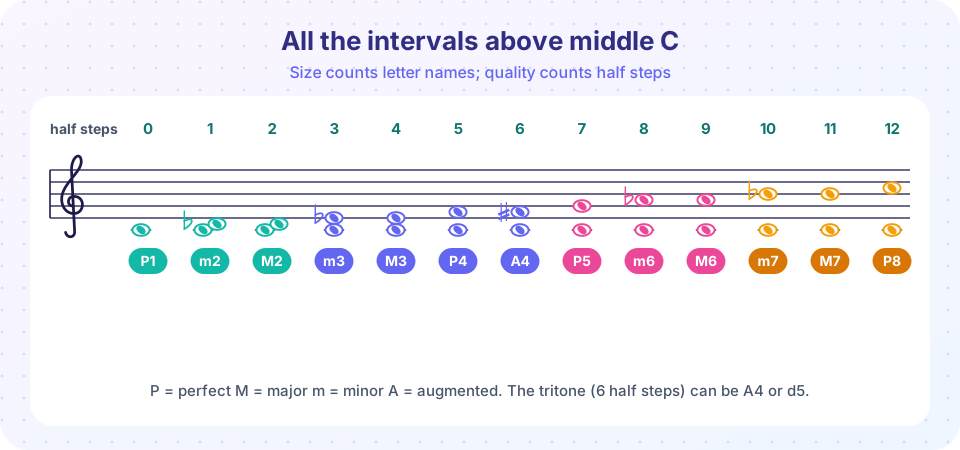
Here is the whole family measured in half steps from C:
| Half steps | Name | Abbreviation | Example up from C |
|---|---|---|---|
| 0 | perfect unison | P1 | C |
| 1 | minor second | m2 | D♭ |
| 2 | major second | M2 | D |
| 3 | minor third | m3 | E♭ |
| 4 | major third | M3 | E |
| 5 | perfect fourth | P4 | F |
| 6 | augmented fourth / diminished fifth | A4 / d5 | F♯ / G♭ |
| 7 | perfect fifth | P5 | G |
| 8 | minor sixth | m6 | A♭ |
| 9 | major sixth | M6 | A |
| 10 | minor seventh | m7 | B♭ |
| 11 | major seventh | M7 | B |
| 12 | perfect octave | P8 | C |
You can build this table from the white keys. Each interval above C that lands on a white key is perfect or major: D (M2), E (M3), F (P4), G (P5), A (M6), B (M7). Lower any of these by a half step and the major intervals become minor (M3 becomes m3) and the perfect intervals become diminished (P5 becomes d5). Raise them by a half step and they become augmented.
The major scale shortcut
You already know the major scale well. Here is the shortcut: to name an interval, imagine the major scale of the lower note.
- Take the lower note as the tonic of a major scale.
- If the upper note is in that scale, the interval is major (for 2nd, 3rd, 6th, 7th) or perfect (for 4th, 5th, 8th).
- If the upper note is a half step lower than the scale note, a major interval becomes minor and a perfect one becomes diminished.
- If it is a half step higher, the interval is augmented.
Example: what is the interval from D up to F? The number is 3 (D E F). The D major scale is D E F♯ G A B C♯. F is a half step below the scale's F♯, so the major third (D to F♯) becomes a minor third. Another: A up to E♭. Number: 5 (A B C D E). A major has E, but E♭ is a half step lower, so the perfect fifth becomes a diminished fifth.
The tritone
The interval of six half steps sits exactly in the middle of the octave. As an augmented fourth (C up to F♯) or a diminished fifth (C up to G♭) it is called the tritone, because it equals three whole tones. It is the most dissonant interval in the usual system and was nicknamed diabolus in musica ("the devil in music") by later writers, though the nickname is more legend than medieval ban. The tritone appears naturally between degrees 4 and 7 of the major scale (F and B in C major), and it is the engine of the dominant seventh chord, as you will see in later chapters. Spelling decides its name: C up to F♯ is an augmented fourth, and C up to G♭ a diminished fifth, even though they sound the same.
Compound intervals
Intervals larger than an octave are compound intervals. They are named by adding 7 to the simple interval's number: a ninth is an octave plus a second, a tenth an octave plus a third, and a twelfth an octave plus a fifth. Their qualities match the simple interval, so a major tenth is a major third plus an octave. Jazz musicians talk about ninth and thirteenth chords constantly, and the idea starts here.
Hearing intervals with familiar tunes
A reliable way to recognize intervals by ear is to link each one to the first two notes of a song you know well. Associations vary between people, but these are widely used (all ascending):
- m2: the shark theme from Jaws (two notes)
- M2: the first two different notes of "Happy Birthday"
- m3: "Greensleeves" (the first leap)
- M3: "Kumbaya"
- P4: "Here Comes the Bride"
- Tritone: "Maria" from West Side Story
- P5: "Twinkle, Twinkle, Little Star"
- M6: "My Bonnie Lies Over the Ocean"
- m7: "Somewhere" from West Side Story
- Octave: "Somewhere Over the Rainbow"
Descending versions need their own songs. The ear game below teaches intervals gradually.
Common misconceptions
"The number is the number of half steps." The number counts letter names. A fifth is seven half steps, but the number is five.
"C to D♯ and C to E♭ are the same interval." They sound the same but are named differently: an augmented second and a minor third. Context decides the spelling.
"All fourths are perfect." Most are, but the fourth from F to B is an augmented fourth (the tritone).
"Minor intervals are sad and major intervals are happy." The relationship is real in many contexts, but intervals have no fixed mood. A minor second in a film score sounds tense, and in a different style it may sound ordinary.
Try it
Here is the naming process as a program. It computes the number from the letter names and the size in half steps from the keys, then looks up the quality. Try several pairs, such as C4 D#4 (an augmented second) and C4 Eb4 (a minor third).
Press Run (or Ctrl + Enter) to see the result here.
Program input · what you'd type while the program runs
Type the answers before you press Run, one per line. Each time the program reads a line (with input()), it gets the next line from this box.
Now train your ear. The game plays an ascending interval from a random note. Choose its name. After each answer, the hint shows a song that starts with that interval.
Check your understanding
Quick check · 6 questions
of 6 answered You scored / 6 · perfect!
-
1. How many half steps are in a major third?
A major third has four half steps (C to E). A minor third has three. -
2. Which intervals are called perfect?
Unisons, fourths, fifths and octaves are perfect; the others are major or minor. -
3. What is the interval from D up to F natural?
D to F spans three letters (D E F) and three half steps, so it is a minor third. -
4. C up to G-flat is called:
G♭ is a fifth above C by letter name and six half steps by sound, a diminished fifth. C to F♯ is an augmented fourth, but the sound is the same. -
5. How many half steps are in the tritone?
The tritone spans six half steps, exactly half an octave. -
6. A compound interval is one that is:
Compound intervals span more than an octave, such as a ninth (an octave plus a second).
Summary
- Name an interval by number (letter names counted, both ends included) and quality (half steps).
- Unisons, fourths, fifths and octaves are perfect; seconds, thirds, sixths and sevenths are major or minor.
- Minor is a half step smaller than major; augmented is a half step bigger than perfect or major; diminished is a half step smaller than perfect or minor.
- Half steps: m2 1, M2 2, m3 3, M3 4, P4 5, tritone 6, P5 7, m6 8, M6 9, m7 10, M7 11, P8 12.
- The shortcut is to compare the upper note with the major scale of the lower note.
- Compound intervals add 7 to the number; familiar tunes help train the ear.
Next: Inversion and consonance
Track your progress
Create a free account to tick off lessons and pick up where you left off on any device.
of Music Theory lessons completed