


















Lesson 38 of 50 · Rhythm and Meter in Depth
Chapter 7 review: rhythm and meter in depth
Review syncopation, clave, polyrhythm, odd and additive meters, hemiola and metric modulation with one picture, one table, a rhythm ear test and ten questions.
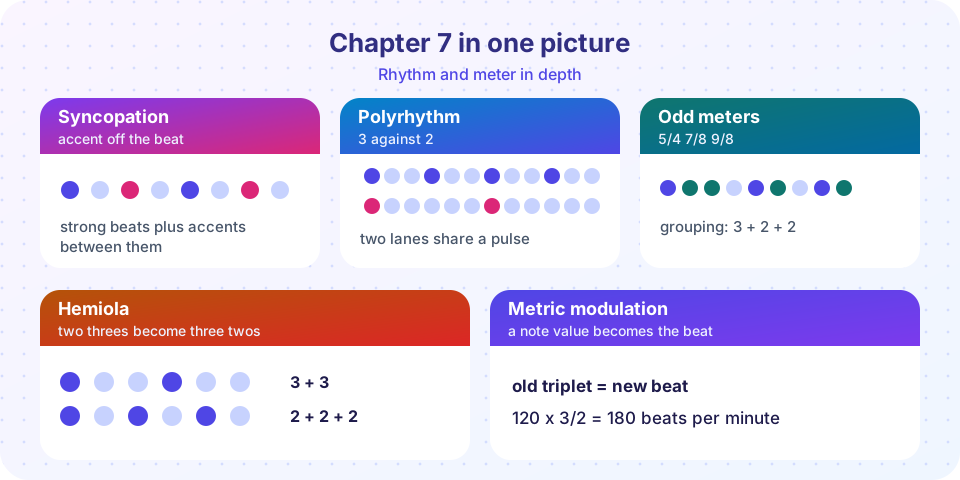
This chapter had one thesis: rhythm is a conversation between a steady pulse and the ways our minds group, accent and reinterpret it. Syncopation argues with the beat, polyrhythm layers two beats, odd meters stitch uneven groups together, hemiola swaps one grouping for another and metric modulation turns one note value into a new tempo. In this review you will gather those ideas in a single picture and a single table, practice hearing them, and test your recall.
The chapter in one table
| Idea | One-line definition | Quick test | Lesson |
|---|---|---|---|
| Syncopation | Accent on a weak position | Where does the backbeat land? (2 and 4) | Syncopation |
| Clave | Five-hit timeline over two bars | Which steps in the 3-2 son clave? (1, 4, 7, 11, 13) | Syncopation |
| Polyrhythm | Two divisions of one span | Grid size for 4 against 3? (12) | Syncopation |
| Odd meter | Sum of groups of 2 and 3 | Count 7/8 as 2 + 2 + 3 | Odd meters |
| Hemiola | Six pulses as 3 + 3 or 2 + 2 + 2 | Which song alternates 6/8 and 3/4? ("America") | Hemiola |
| Metric modulation | New tempo = old tempo × y ÷ x | Triplet quarter becomes quarter at 120? (180) | Hemiola |
Four steps to decode any rhythm
When you meet an unfamiliar rhythm, do not try to read every note at once. Work down this list.
- Find the pulse. Tap along. Whatever you tap steadily is the pulse, and it is almost always the quarter note or the eighth note.
- Find the groups. Listen for where the accent falls, usually from the bass drum or the lowest instrument. Count how many pulses sit between accents. Equal groups of 2, 3 or 4 mean a regular meter. Groups of 2 and 3 mixed together mean an additive meter.
- Compare the melody with the groups. If the tune stresses positions that the groups do not, that is syncopation. If two layers use different group lengths over the same time span, that is polyrhythm. If the groups switch between 3 + 3 and 2 + 2 + 2, that is a hemiola.
- Look for tempo relationships. If the pulse suddenly feels faster or slower but a rhythm from the old tempo seems to continue, you have heard a metric modulation. Work out the ratio from the two note values.
Try the method on three cases. A bass drum that lands on counts 1, 3 and 6 of an eight-step bar groups the bar as 2 + 3 + 3, a rotation of the tresillo. A bass line that repeats every seven pulses with accents on 1, 3 and 5 groups as 2 + 2 + 3, so it is 7/8. A tune that sits in two groups of three while the drums suddenly accent counts 1, 3 and 5 is a hemiola.
Common slips to watch for
- Confusing the pulse with the accents. In 7/8 the pulse is the eighth note, but the felt beats are the groups.
- Mixing up polyrhythm and polymeter. In a polyrhythm the same span of time is divided into different numbers of equal parts. In a polymeter the pulse stays the same and the bar lengths differ.
- Calculating metric modulation backwards. Always write the old value and the new value, then use new tempo = old tempo × y ÷ x; the sanity check is that the pivot lasts the same number of seconds on both sides.
- Thinking the time signature decides the grouping. It only tells you how many pulses; beaming and accents show the groups.
Try it
Here is a mixed ear test. A pattern is played; decide what kind of rhythmic device it uses. Press "Play one", listen twice if needed, then choose.
Check your understanding
Quick check · 10 questions
of 10 answered You scored / 10 · perfect!
-
1. In a standard rock beat, where does the snare usually fall?
The backbeat on 2 and 4 is a built-in syncopation. -
2. What is the grid size needed to notate 4 against 3?
The least common multiple of 4 and 3 is 12. -
3. Which count describes 7/8 grouped as 2 + 2 + 3?
Restart the count at each group; the long group comes last. -
4. What distinguishes a polymeter from a polyrhythm?
In polymeter the pulse is shared and the bar lengths differ; in polyrhythm the pulse is divided differently. -
5. A hemiola in 3/4 music most often occurs...
Cadential hemiola regroups the last bars to broaden the ending. -
6. At quarter = 100, a dotted quarter note becomes the new quarter note. What is the new tempo (to the nearest whole number)?
New tempo = 100 × 1 ÷ 1.5 = 66.7, about 67. -
7. What is the clave?
The clave is a repeating timeline pattern, and also the name of the paired wooden sticks that often play it. -
8. Why is a 5/4 bar often counted as 1 2 3 1 2?
Restarting the count at each group shows the additive structure. -
9. Which term means an arrival half a beat early, such as a chord due on beat 1 that arrives on the and of 4?
An anticipation is a note or chord that arrives before its expected beat. -
10. What must stay constant across a metric modulation?
The pivot lasts the same number of seconds before and after the change.
Summary
- Rhythm comes from the interaction of pulse, meter and pattern; every device here changes how the pulse is grouped or timed.
- Syncopation accents weak positions; the clave is a five-hit timeline; polyrhythm divides a span two ways.
- Odd meters are sums of groups of 2 and 3; hemiola swaps 3 + 3 for 2 + 2 + 2.
- Metric modulation changes tempo through a shared pivot: new tempo = old tempo × y ÷ x.
Track your progress
Create a free account to tick off lessons and pick up where you left off on any device.
of Music Theory lessons completed