


















Lesson 15 of 50 · Scales and Keys
Modes, pentatonic and blues scales
Meet the seven modes (Ionian to Locrian) as rotations of the major scale, compare each to major or minor, and learn the five-note pentatonic and the blues scale.
So far you have met two scales, major and minor. But the seven notes of the C major scale can be arranged in more ways than one. If you keep the same seven notes but treat a different note as home, the scale takes on a new character, and each of those characters has a name. These are the modes. At the other end of the size range, remove two notes from a scale and you get the pentatonic scale, which is so natural that it appears in the folk music of nearly every culture. Add one expressive note to a pentatonic scale and you get the blues scale.
This lesson covers all three. Modes are the key to understanding jazz, film music and much of modern pop. Pentatonic scales are the first tool of every guitarist and many singers, and the blues scale carries a distinctive sound that has shaped popular music for more than a century.
What you will learn
- What a mode is and the seven modes of the major scale
- How to describe each mode by comparing it with major or minor
- The pentatonic scales, major and minor, and how they relate
- The blues scale and the blue note
- Where to listen for each color
Key terms
Mode: a scale made by starting the major scale's notes on a different degree; each has its own pattern and character.
Ionian / Aeolian: the names for the major and natural minor scales as modes.
Characteristic note: the note that gives a mode its special flavor, such as the raised fourth in Lydian.
Pentatonic scale: a five-note scale, usually the major or minor pentatonic.
Blue note: a note, such as the flat fifth, that is bent or lowered for expressive effect in blues.
The seven modes
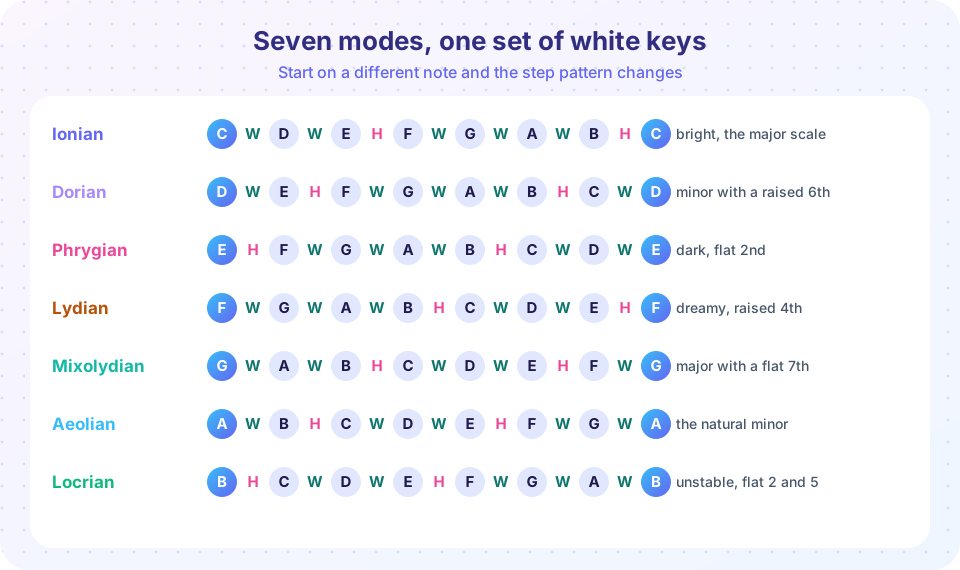
Play the white keys from C to C and you hear the major scale. Play the white keys from D to D, with no black keys, and you hear a different scale: its pattern is W H W W W H W. Play from E to E, from F to F and so on, and you get five more. Each is a mode, and the names come from the Greek-derived terminology of medieval church music theory, adopted by later theorists.
| Mode | White keys | Pattern | Compared with... |
|---|---|---|---|
| Ionian | C to C | W W H W W W H | the major scale |
| Dorian | D to D | W H W W W H W | natural minor with a raised 6th |
| Phrygian | E to E | H W W W H W W | natural minor with a lowered 2nd |
| Lydian | F to F | W W W H W W H | major with a raised 4th |
| Mixolydian | G to G | W W H W W H W | major with a lowered 7th |
| Aeolian | A to A | W H W W H W W | the natural minor scale |
| Locrian | B to B | H W W H W W W | minor with a lowered 2nd and 5th |
All seven use the same notes (the notes of C major), so they share one key signature. What differs is the tonic, the note that acts as home, and therefore the intervals above that tonic.
There are two ways to think about modes. The relative view says "D Dorian is the C major scale starting on D." That is true, but it is slow to use. The parallel view compares each mode with major or minor on the same tonic: "D Dorian is D minor with a raised sixth." That is what most musicians use, because it tells you directly what to change. In this view, building modes on C gives:
- C Ionian: C D E F G A B (the major scale)
- C Lydian: C D E F♯ G A B (raised 4th)
- C Mixolydian: C D E F G A B♭ (lowered 7th)
- C Dorian: C D E♭ F G A B♭ (minor with raised 6th)
- C Aeolian: C D E♭ F G A♭ B♭ (natural minor)
- C Phrygian: C D♭ E♭ F G A♭ B♭ (lowered 2nd)
- C Locrian: C D♭ E♭ F G♭ A♭ B♭ (lowered 2nd and 5th)
Order the modes by brightness, from most raised notes to most lowered: Lydian, Ionian, Mixolydian, Dorian, Aeolian, Phrygian, Locrian. Lydian is the brightest and Locrian is the darkest.
How each mode sounds and where you hear it
Each mode has a characteristic note: the one that sets it apart from major or minor.
- Ionian is the familiar major: stable, bright and resolved.
- Dorian is minor but hopeful, thanks to the raised 6th. It appears in many folk melodies (the English ballad "Scarborough Fair" is commonly cited) and in jazz: Miles Davis's "So What" (1959) uses D Dorian.
- Phrygian has a lowered 2nd, a half step above the tonic, which gives a dark, tense, Spanish-flavored sound. Flamenco uses a closely related scale.
- Lydian has a raised 4th that gives a floating, dreamy or wondering feel. Film composers use it for magic and wonder; the theme of The Simpsons is often cited as a Lydian melody.
- Mixolydian is major with a flat 7th, giving a relaxed, bluesy or folk quality. Much rock and folk, and some Beatles songs, use it.
- Aeolian is the natural minor scale.
- Locrian has a diminished fifth above the tonic, which makes the tonic chord unstable. It is rare as a home key but useful as a color.
These associations are tendencies, not rules. A mode only starts to sound like itself when the melody and chords keep returning to its tonic. If you play the notes of D Dorian over a C chord, you hear C major, not D Dorian. The harmony chooses the tonic.
Pentatonic scales: five notes
The word pentatonic means five tones. The major pentatonic takes the major scale and removes degrees 4 and 7, the two notes that form the half steps (and the tritone) of the scale. On C it is C D E G A: degrees 1, 2, 3, 5 and 6. Without half steps there are no strong clashes, so almost any combination of its notes sounds pleasant. That is why children's songs, folk tunes and many pop riffs use it.
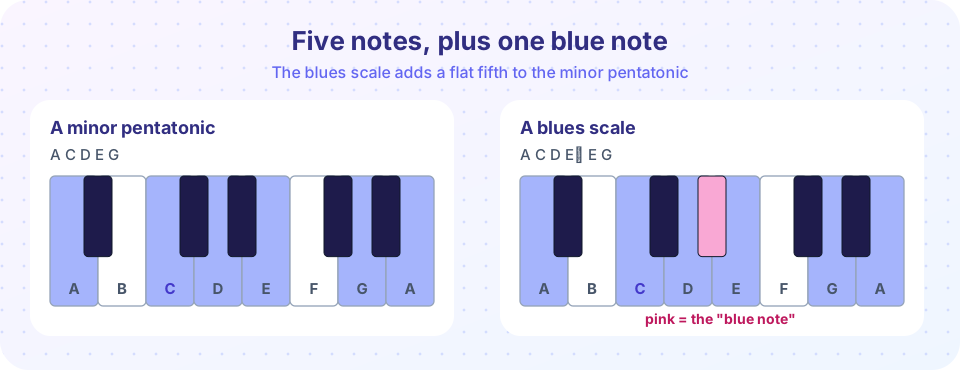
The minor pentatonic is the relative minor of the major pentatonic, rotated to start on the sixth: A C D E G (degrees 1, ♭3, 4, 5, ♭7 of A minor). Note that A minor pentatonic and C major pentatonic contain exactly the same five notes. This is the minor-pentatonic box that guitarists learn first.
You can find a pentatonic scale on any piano by playing only the five black keys: F♯ G♯ A♯ C♯ D♯ (F♯ major pentatonic). Every note sounds good together, which makes the black keys a favorite playground for beginners. Pentatonic music appears in Scottish and Irish folk, Chinese, Japanese and West African traditions, and many others.
The blues scale
Take the minor pentatonic and add one note between the fourth and fifth degrees: the flat fifth, or "blue note". On A: A C D E♭ E G. In blues, singers and guitarists often bend these notes, sliding between pitches that the piano cannot play, but the blues scale writes them as an approximation. The flat fifth is a tritone away from the tonic, so it creates tension that resolves when you slide up to E, which is why a blues solo often passes through E♭ quickly rather than resting on it.
The blues scale is the basis of blues, rock and jazz improvisation. A common blues form, the 12-bar blues, uses three chords built on degrees I, IV and V, and the blues scale fits over them all. You will study that in the harmony chapter.
Common misconceptions
"Modes are different keys." Modes share the notes of a major scale but treat a different note as the tonic. The tonic is established by the melody and harmony, not by the key signature.
"Dorian is just the major scale starting on the second note, so there is nothing new to learn." Practically, the parallel view (minor with a raised sixth) is what you hear and use. Both descriptions are true; they serve different goals.
"Pentatonic scales cannot be used in classical music." They appear in works from Dvořák's "New World" Symphony to Debussy's piano music.
Try it
Explore the modes on the same tonic. Choose a tonic and a mode, press Play, and a low drone on the tonic sounds under the scale so that your ear knows where home is. The characteristic note is marked in pink.
The modes are rotations of one pattern. This program takes the major scale's step pattern, rotates it to produce each mode's pattern, and builds each mode on C so that you can compare it with the major scale.
Press Run (or Ctrl + Enter) to see the result here.
Program input · what you'd type while the program runs
Type the answers before you press Run, one per line. Each time the program reads a line (with input()), it gets the next line from this box.
Finally, a pentatonic play pad. With the drone on, any of the pads sounds right, and the blue note adds spice. Tap the pads in any order and make a melody.
Check your understanding
Quick check · 6 questions
of 6 answered You scored / 6 · perfect!
-
1. Which mode is the major scale with a raised fourth degree?
Lydian raises the 4th of the major scale (C D E F♯ G A B). -
2. Which mode is the major scale with a lowered seventh?
Mixolydian is major with a flat seventh, as in C D E F G A B♭. -
3. D Dorian uses the same notes as which major scale?
D Dorian is the white keys D to D, which are the notes of C major, started on D. -
4. Which notes make up the C major pentatonic scale?
The major pentatonic leaves out degrees 4 and 7: C D E G A. -
5. What note is added to the minor pentatonic scale to make the blues scale?
The blues scale adds the flat fifth: A C D E♭ E G in A. -
6. Which mode is the darkest, with both a lowered 2nd and a lowered 5th?
Locrian lowers both the 2nd and the 5th of the minor scale, giving a diminished tonic triad.
Summary
- The seven modes are rotations of the major scale: Ionian, Dorian, Phrygian, Lydian, Mixolydian, Aeolian and Locrian.
- Compare modes with major or minor on the same tonic: Dorian = minor with raised 6, Phrygian = minor with lowered 2, Lydian = major with raised 4, Mixolydian = major with lowered 7.
- Brightness runs from Lydian (brightest) through Ionian, Mixolydian, Dorian, Aeolian and Phrygian to Locrian (darkest).
- The pentatonic scales have five notes and no half steps, so their notes rarely clash; the black keys form one.
- The blues scale is the minor pentatonic plus the flat fifth, the "blue note".
Next: Chapter 3 review
Track your progress
Create a free account to tick off lessons and pick up where you left off on any device.
of Music Theory lessons completed