


















Lesson 19 of 50 · Intervals and Chords
Interval inversion and consonance
Learn how to invert intervals with the rule of nine, why major becomes minor, which intervals are consonant or dissonant, and how simple frequency ratios shape tension.
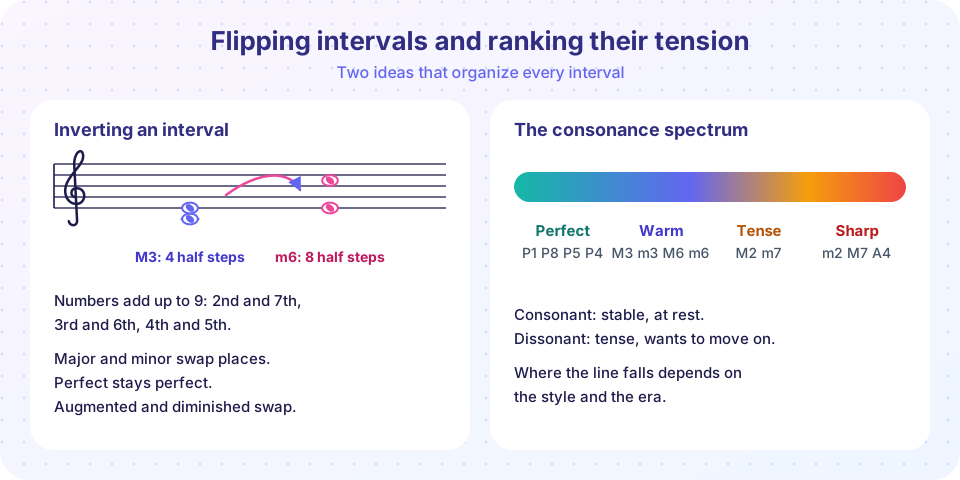
Take a major third, C up to E, and move the lower note up an octave. You now have E up to C, and the interval has become a minor sixth. Do this to any interval and the same thing always happens: the numbers add up to nine, major swaps with minor and perfect stays perfect. That is inversion, a tidy bit of arithmetic that saves you half of the work of learning intervals and explains many connections between chords.
The second half of this lesson asks a different question: why do some intervals sound smooth and stable while others sound tense? Musicians call this consonance and dissonance. The answer has a physical part (frequency ratios and the roughness of beating waves) and a cultural part (what a given musical tradition treats as a point of rest). Together they explain why music moves.
What you will learn
- How to invert any interval, and the rule that the numbers add up to 9
- What happens to the quality when an interval is inverted
- The classification of intervals as perfect consonances, imperfect consonances and dissonances
- Why simple frequency ratios sound smooth, and what roughness is
- How dissonance creates movement through resolution
Key terms
Inversion: turning an interval upside down by moving the lower note up an octave (or the upper note down an octave).
Consonance: an interval that sounds stable, smooth and at rest.
Dissonance: an interval that sounds tense and seems to need to move on.
Beating: the slow throbbing you hear when two frequencies are very close together.
Resolution: the movement from a dissonance to a consonance.
Inverting an interval
Here are two notes, C and E, a major third apart. Two ways to turn them upside down: move C up an octave (to C5, now above E4), or move E down an octave (to E3, now below C4). Either way the notes are the same pair of pitch classes, but the lower and upper notes have swapped, and the interval is now E to C: a minor sixth.
The rules never change:
- The numbers add up to 9. A second becomes a seventh (2 + 7), a third becomes a sixth (3 + 6), a fourth becomes a fifth (4 + 5). A unison becomes an octave, which is the exception as 1 + 8 = 9 as well.
- Major becomes minor and minor becomes major. A major third inverts to a minor sixth, a minor third to a major sixth.
- Perfect stays perfect. A perfect fifth inverts to a perfect fourth.
- Augmented becomes diminished and diminished becomes augmented. An augmented fourth inverts to a diminished fifth.
- The half steps add up to 12. A major third (4) plus a minor sixth (8) is 12, a full octave.
| Interval | Half steps | Inversion | Half steps |
|---|---|---|---|
| Perfect unison | 0 | Perfect octave | 12 |
| Minor second | 1 | Major seventh | 11 |
| Major second | 2 | Minor seventh | 10 |
| Minor third | 3 | Major sixth | 9 |
| Major third | 4 | Minor sixth | 8 |
| Perfect fourth | 5 | Perfect fifth | 7 |
| Tritone | 6 | Tritone | 6 |
Notice the last row: the tritone inverts into itself, since 6 + 6 = 12. C up to F♯ is an augmented fourth, and F♯ up to C is a diminished fifth.
Inversion is a shortcut for naming. A major seventh is hard to count (11 half steps), but it is the inversion of a minor second, so it is simply the note a half step below the octave: from C, that is B. A minor sixth above C is the inversion of the major third below the upper C, which gives A♭. Musicians also use interval class: the smaller of an interval and its inversion. Thirds and sixths belong to the same interval class, and so do seconds and sevenths.
Consonance and dissonance
Different intervals feel different even to a listener with no training. A perfect fifth sounds open and stable. A major third sounds warm and sweet. A minor second, with its two notes only a half step apart, sounds rough and tense, as if the notes are grinding against each other. These feelings are the basis of the three traditional categories:
- Perfect consonances: the unison, octave and perfect fifth. In traditional counterpoint, the perfect fourth also belongs here, but only when it is not between the bass and an upper voice. These are the most stable, hollow-sounding intervals.
- Imperfect consonances: the major and minor thirds and sixths. They are stable, but warmer and richer, so they fill most chords.
- Dissonances: the major and minor seconds and sevenths, the tritone, and all augmented and diminished intervals. They create tension.
Categories changed over history. Medieval music treated thirds and sixths as dissonances. Renaissance and baroque theory made them consonant. Later composers loosened the rules about dissonance so much that the sevenths and ninths of jazz chords can be restful. So the classification describes a tendency in a particular tradition (here, Western common-practice music), not an absolute fact.
Why do simple ratios sound smooth?
Remember from chapter 2 that every note has a harmonic series. When two notes are an octave apart (2:1), every harmonic of the upper note matches a harmonic of the lower one. When two notes form a perfect fifth (3:2), many harmonics coincide: the third harmonic of the lower note is the second harmonic of the upper note. The more harmonics line up, the smoother the sound. A major third is 5:4, still simple. But a minor second is 16:15, and its harmonics lie close together without coinciding.
When two frequencies are close but not equal, they interfere. The combined wave swells and fades at a rate equal to the difference in frequencies. This is beating. Slow beats (a few per second) produce a gentle wobble. Beating at about 20 to 30 times per second is heard as roughness, the harshness of dissonance. The physicist Hermann von Helmholtz explained this in the nineteenth century, and modern research on the "critical band" of hearing refines his account. Roughness depends on pitch range: the same interval in a low register sounds muddier than in a high one, which is why composers space low chords widely.
Culture also matters. Listeners who grew up with different musical systems rate intervals differently, and researchers have found that preference for consonant intervals is partly learned. Both physics and experience shape what sounds stable.
Dissonance makes music move
A piece that used only consonances would feel static. Dissonance creates a question, and resolution answers it. The classic example is the tritone between degrees 4 and 7 of the major scale. In C major the notes F and B clash. When F falls by a half step to E, and B rises by a half step to C, the tritone resolves outward into a stable major third (E and C, inverted to a sixth). This simple motion is the engine of the dominant seventh chord, one of the strongest forces in Western harmony. In the next lessons you will build such chords.
Common misconceptions
"A minor second inverted is a minor seventh." Major and minor swap: a minor second inverts to a major seventh (1 + 11 = 12 half steps).
"Dissonant intervals are wrong notes." They are intentional, and they give music tension and motion. Even Bach used dissonance extensively.
"Consonant intervals are always pleasant." Consonance and dissonance describe stability, not beauty. Music made only of perfect fifths and octaves can sound empty.
"The ranking of intervals is a law of nature." It reflects acoustics and also tradition; other musical cultures draw the lines elsewhere.
Try it
First, the inversion arithmetic. This program inverts every interval from the table and checks that the numbers add up to 9 and the half steps add up to 12. It also swaps the qualities.
Press Run (or Ctrl + Enter) to see the result here.
Program input · what you'd type while the program runs
Type the answers before you press Run, one per line. Each time the program reads a line (with input()), it gets the next line from this box.
Now hear it. Choose an interval above A4 and play it. The page shows the frequency of each note, how far apart they are in hertz and the equal-tempered ratio next to the simple whole-number ratio of just intonation. Notice how the ratios of the consonant intervals are simpler. Listen for roughness when the two notes are close.
Check your understanding
Quick check · 6 questions
of 6 answered You scored / 6 · perfect!
-
1. What is the inversion of a major third?
The numbers add to 9 (3 + 6) and major becomes minor: a minor sixth. The half steps add to 12 (4 + 8). -
2. A perfect fourth inverts to:
Perfect stays perfect, and the numbers add to 9: 4 + 5. -
3. Which interval inverts into itself?
The tritone is six half steps, and 6 + 6 = 12, so its inversion is also a tritone. -
4. Which group lists only perfect consonances?
Unisons, octaves and fifths are the perfect consonances. Thirds and sixths are imperfect consonances. -
5. What is beating?
Two close frequencies interfere, and the combined sound swells and fades at a rate equal to their difference. -
6. A minor second inverts to:
Numbers 2 + 7 = 9, and minor becomes major: a major seventh (1 + 11 = 12 half steps).
Summary
- Inverting an interval moves the lower note up an octave; the numbers add to 9 and the half steps add to 12.
- Major and minor swap, augmented and diminished swap and perfect stays perfect; the tritone inverts into itself.
- Perfect consonances (unison, fifth, octave) are the most stable; thirds and sixths are imperfect consonances; seconds, sevenths, the tritone and altered intervals are dissonant.
- Simple frequency ratios share many harmonics and sound smooth; close frequencies beat and sound rough.
- Dissonance creates tension and resolution moves music forward; the classifications depend on tradition as well as physics.
Next: Triads
Track your progress
Create a free account to tick off lessons and pick up where you left off on any device.
of Music Theory lessons completed