


















Lesson 33 of 50 · Melody and Form
Chapter 6 review: melody and form
Review contour, motifs, phrases, periods, sentences and the classical forms in one picture and one table, then answer ten mixed questions on melody and form.
You have now looked at music at three scales: the shape of a single line, the sentence structure that groups lines into phrases and the large plans that arrange whole pieces. This review gathers them in one place. Use it to decide which parts you can already do and which need a second pass, then take the ten-question check at the end.
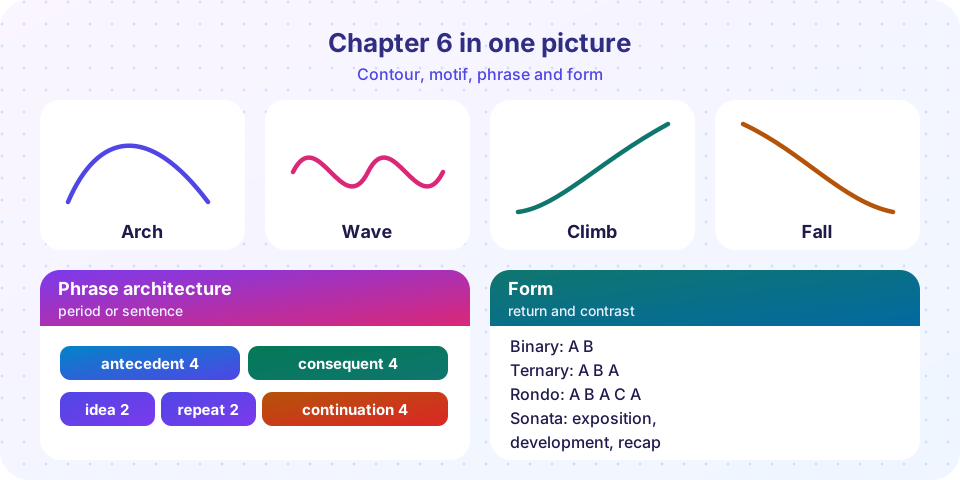
The chapter in one table
| Scale | Key idea | What to listen for | Lesson |
|---|---|---|---|
| Contour | The shape of a line; arches are most common; leaps are usually answered by turning back | Where is the climax? Steps or leaps? | Contour and motifs |
| Motif | A small idea that is repeated and transformed | Same rhythm, different pitch (sequence); flipped intervals (inversion) | Contour and motifs |
| Phrase | A musical sentence ending in a cadence or pause | Breath, long note, cadence | Phrases |
| Period | Antecedent (half cadence) plus consequent (authentic cadence) | Same start, stronger ending | Phrases |
| Sentence | Idea, repeat, then fragments and acceleration | Speeding rhythm | Phrases |
| Form | Binary AB, ternary ABA, rondo ABACA, variations, sonata | What returns, what changes key | Forms |
Putting it together: read a theme like an analyst
Take the opening of Beethoven's "Ode to Joy" again, E E F G, G F E D, C C D E, E D D, then a second phrase that begins the same way but ends C C D E D C C.
- Contour. It is a gentle wave. It spans only a fifth (C up to G) and moves almost entirely by step. The climax is the repeated G in bar 1 and 2, early, and the line then settles. This is why the tune is so easy to sing.
- Motifs. The opening is a rising four-note step pattern (E E F G); its mirror image falls (G F E D); then it comes back to rise (C C D E). The tune is built of steps going up and steps going down, that is, inversion-like symmetry.
- Phrase. Four bars end on D, the second note of the scale, over a dominant chord. The ear hears a half cadence: a question.
- Period. The next four bars begin the same way and end on C. That is a parallel period, with an authentic cadence in the consequent.
- Form. In the symphony's finale the tune is first played quietly by the low strings and then returns in several varied settings, each with new accompaniment. That is the theme-and-variations idea at work.
Notice how one tune can be described on four different levels without contradiction.
Common slips to watch for
- Calling any repeated section "A". Letters mark material, not position. If a section returns changed, it is A', not A.
- Confusing period and sentence. A period is two phrases that ask and answer. A sentence is one phrase built as idea, repeat, fragments.
- Forgetting key in sonata form. Sonata form is not only about themes; it is about where the second theme is in the exposition versus the recapitulation.
- Treating contour rules as laws. "A leap is followed by a step back" is a strong tendency, not a rule that composers must obey.
Try it
Train your ear on contour. A random melody in one of five shapes is played; choose the name of the shape.
Check your understanding
Quick check · 10 questions
of 10 answered You scored / 10 · perfect!
-
1. What is the main difference between a period and a sentence?
A period pairs antecedent and consequent phrases. A sentence is a single structure: presentation then continuation. -
2. Which technique produces G G G E-flat followed by F F F D?
The same motif repeated at a different pitch level is a sequence. -
3. Which cadence usually ends the antecedent of a period?
The antecedent ends unresolved, usually on V, so the consequent can answer it. -
4. A melody makes a leap of an octave. What does it usually do next?
Leaps tend to be balanced by a change of direction. -
5. Which form is described by ABACA?
A refrain that returns after each contrasting episode is a rondo. -
6. In a major-key sonata form, what key plan does the second theme follow?
The key tension is created in the exposition and resolved in the recapitulation. -
7. What is fragmentation?
Breaking a motif into smaller pieces and repeating them creates intensity, as in the development. -
8. What does rounded binary add to a simple AB form?
The return of A's opening in the second half makes the shape A B A'. -
9. Which of these is a contrasting period?
In a contrasting period the second phrase opens differently but still answers the first. -
10. Which sentence about form is true?
Forms are habits, not laws, and every style of music uses some kind of form.
Summary
- Contour is a melody's shape; steps and leaps give it character, and one climax gives it direction.
- Motifs are small ideas developed by sequence, inversion, retrograde, augmentation, diminution and fragmentation.
- Phrases combine as periods (question and answer) or sentences (idea, repeat, continuation).
- Forms organize whole pieces by return and contrast: binary, ternary, rondo, variations and sonata.
Track your progress
Create a free account to tick off lessons and pick up where you left off on any device.
of Music Theory lessons completed