


















Lesson 29 of 50 · Melody and Form
Chapter 6 overview: melody and form
A map of the melody and form chapter: contour, motifs, phrases, periods, and the classic forms binary, ternary, rondo and sonata, with a playable famous tune.
Ask someone to hum a song and they will hum its melody. The melody is the part of music that lives in your head: a line of notes with a shape and a rhythm that you can recognize after one hearing and remember for decades. Harmony supports it, rhythm moves it, but the melody is what people sing. In the last chapter you studied the chords underneath. This chapter studies the line on top, and then zooms out to see how melodies are arranged into complete pieces.
What you will learn
- How to describe the shape of a melody (contour) and why steps and leaps matter
- What a motif is and the standard ways composers transform one
- How phrases combine into periods and sentences
- How whole pieces are organized into binary, ternary, rondo and sonata forms
- How to hear a question-and-answer structure in a tune
Key terms
Melody: a sequence of notes that the ear hears as one line, shaped by pitch and rhythm.
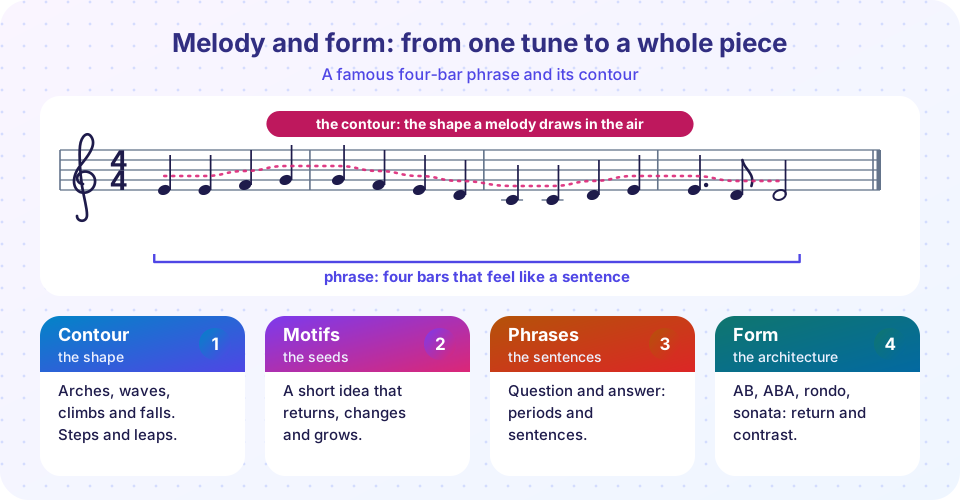
Contour: the up-and-down shape of a melody.
Motif: a short musical idea, as small as two or three notes, that a composer can repeat and develop.
Phrase: a musical sentence that ends with a cadence or a pause.
Form: the overall plan of a piece: what comes back, what changes and where.
From notes to architecture
Music works on several scales at once. At the smallest scale a melody is a string of notes, each with a pitch and a length. Look slightly wider and you find a motif, a few notes with a recognizable rhythm. Group motifs and you get a phrase, the equivalent of a sentence. Two or three phrases make a period or a sentence, the paragraph of music. At the largest scale, paragraphs combine into form, which decides whether the piece is a simple song, a dance with a middle section, or a sprawling symphony movement.
The remarkable thing is how similar the principles are at every level: repetition builds familiarity, contrast keeps interest, and tension that is released feels satisfying. A tune that only repeats is boring and a tune that never repeats is confusing. The art lies in the balance, and this chapter shows how composers strike it.
Contour
Motifs
Phrases
Form
How to listen to a melody
Before the lessons begin, try a simple habit that will pay off throughout the chapter. Choose a tune you know well and listen to it three times, each with a different question. The first time, follow only the shape: does the line climb, fall, arch or wave, and where is its highest point? The second time, listen for repetition: which short figures come back, and are they exact or changed? The third time, listen for endings: where does the music seem to take a breath, and does each breath feel like a question or an answer? These three questions, shape, repetition and endings, are exactly contour, motif and phrase, the first three topics of the chapter. After a week of asking them, you will hear structure in music that used to sound like a continuous stream.
What each lesson covers
- Contour and motifs: the shape of a line and how to grow a whole melody from a tiny cell.
- Phrases, periods and sentences: how question and answer shape a tune.
- Binary, ternary, rondo and sonata form: the big plans.
- Chapter 6 review: the whole chapter in one picture, then ten questions.
Hear it first
The tune in the picture is the main theme of the last movement of Beethoven's ninth symphony, known as the "Ode to Joy". It is useful because it is almost all steps, spans only a fifth, and has a perfectly clear question and answer. Play both halves and listen for the difference in how they end.
Check your understanding
Quick check · 3 questions
of 3 answered You scored / 3 · perfect!
-
1. What is a motif?
A motif is a small cell, such as three notes with a distinctive rhythm, that a composer can repeat and transform. -
2. In the Ode to Joy phrase, why does the first four-bar phrase sound like a question?
Ending on scale degree 2 leaves the tune unresolved, and the answer phrase resolves to C. -
3. Which is the correct order from smallest to largest?
Motifs combine into phrases and phrases into larger forms.
Summary
- A melody has pitch, rhythm and contour; its shape and repetitions make it memorable.
- Motifs grow into phrases, phrases into periods and sentences, and those into forms.
- Questions and answers are produced by where a phrase ends: unstable note or tonic.
- Forms organize repetition and contrast on a large scale.
Next: Contour and motifs
Track your progress
Create a free account to tick off lessons and pick up where you left off on any device.
of Music Theory lessons completed