


















Lesson 32 of 50 · Melody and Form
Binary, ternary, rondo and sonata form
Understand how pieces are organized: binary AB, ternary ABA, rondo ABACA, theme and variations and sonata form, with listening cues and a playable form demo.
If melody is the sentence and the phrase is the grammar, form is the plot. It answers the question: what does this piece do from beginning to end? Does it state an idea and leave it? Go somewhere else and come home? Keep returning to a refrain? Forms are not molds that composers must obey; they are habits that generations of musicians developed because they work on listeners. Once you know a handful of these plans you will recognize them in a Bach dance, a pop song and a symphony.
What you will learn
- How to label sections with letters and primes
- What binary, ternary, rondo and variation forms are and how to hear them
- How sonata form uses key as well as themes to build a journey
- How popular forms such as AABA and verse-chorus relate to classical ones
- How to find the form of a piece by listening for returns
Key terms
Form: the large-scale organization of a piece into sections.
Section: a stretch of music with its own character, labeled A, B, C and so on.
Prime (A'): the same material returning in a changed version.
Refrain and episode: in a rondo, the refrain is the returning theme and an episode is a contrasting interlude.
Exposition, development, recapitulation: the three main parts of sonata form.
Labeling form
Musicians describe form with letters. The first section is A. A new, contrasting section is B. If A returns exactly, write A again; if it returns changed, write A' (A prime). Using these letters you can sketch the skeleton of any piece, and you can hear the plan by asking at each section: is this new, or have I heard it before?
Binary form (A B)
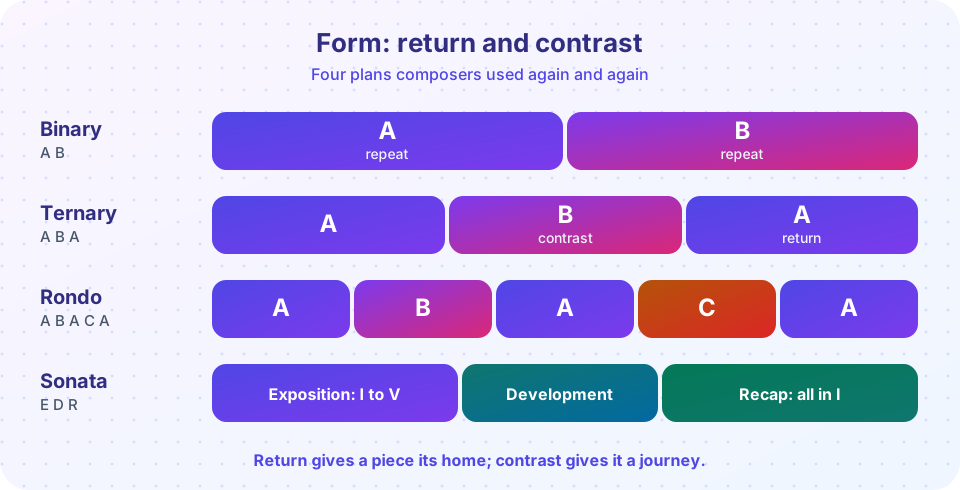
Binary form has two sections of roughly similar length, usually each repeated: ||: A :||: B :||. The two parts are linked by harmony, not only melody. Section A typically starts at the tonic and ends in a closely related key (the dominant in a major piece, the relative major in a minor piece). Section B begins in that new key and then travels back to the tonic. The listener hears an outgoing journey and a return.
Many Baroque dance movements in suites (allemandes, courantes, gigues, minuets) are binary. A common refinement is rounded binary: after the contrasting middle of B, the opening melody of A returns briefly, so the overall shape is A B A' even though the form is still divided into two repeated halves.
Ternary form (A B A)
Ternary form has three parts, the third a return of the first. The contrasting middle section often changes key (for instance to the relative minor or the dominant), mood, texture or register. The return feels like arriving home because we have just been away.
Examples include the Baroque da capo aria, in which the singer performs the A section, then B, then "from the head" (da capo) repeats A with added decoration. The classical minuet and trio is a ternary form of dances: the minuet, then a lighter trio, then the minuet again. The name "trio" is a historical echo from the time when the middle section was scored for three instruments.
A compound ternary form is one in which each of the three big sections is itself a small binary or ternary form. The minuet and trio is exactly that.
Rondo form (A B A C A)
In a rondo a refrain (A) keeps coming back, separated by contrasting episodes (B, C and so on). The refrain is always in the tonic; the episodes visit other keys. The common patterns are the five-part ABACA and the seven-part ABACABA. Beethoven's popular piano piece "Für Elise" is a textbook five-part rondo, with its famous opening theme returning after each contrasting section. Rondos are often used for fast, playful finales because the returning refrain gives the music a feeling of cheerful recurrence.
When you listen for a rondo, hold on to the refrain: you will know it by its familiar tune and its always-stable key. Everything else is an episode.
Theme and variations
Instead of contrasting with new material, a theme and variations repeats the same theme again and again, each time changed. A variation might add faster notes, alter the harmony, change the mode or move the tune to a new instrument, but the underlying structure (often the harmony and the phrase lengths) remains recognizable. Mozart's twelve variations on the French tune known as "Ah, vous dirai-je, Maman" (K. 265) are built on the melody we now know as "Twinkle, Twinkle, Little Star". Another variation technique is the repeating bass pattern of the passacaglia or chaconne, where a short bass line loops while the upper parts vary.
Sonata form
Sonata form (also called sonata-allegro form) is the most important structure of Classical instrumental music, often used for the first movement of a sonata, quartet or symphony. It is a drama in three acts, and it is organized by key as much as by tune.
| Part | What happens | Key plan |
|---|---|---|
| Exposition | The first theme in the home key, a transition that modulates, then a second theme in a new key, then a closing section. Often repeated. | tonic, then dominant (major) or relative major (minor) |
| Development | The themes are broken apart, combined, sequenced and passed through many keys. Tension builds. | unstable, many keys |
| Recapitulation | Both themes return, but now the second theme is in the home key. The conflict is resolved. | tonic throughout |
The point of the form is a tension in key. The exposition sets up two keys that clash, the development heightens the uncertainty, and the recapitulation resolves both themes into the same key. A short coda (tail) may round things off, and some movements begin with a slow introduction.
Two examples: In the first movement of Mozart's piano sonata K. 545 in C major, the second theme appears in G major in the exposition (the dominant) and in C major in the recapitulation. In the first movement of Beethoven's fifth symphony, in C minor, the second theme appears in E-flat major, the relative major, in the exposition and returns in the home key in the recapitulation.
Forms in popular music
The same ideas appear in songs. Strophic form repeats the same music for every verse (A A A). AABA or 32-bar song form was the standard of American popular song for decades: two statements of the main tune, a contrasting "bridge", then a return. Verse-chorus form alternates sections of narrative (verse) with a repeated refrain (chorus), often with a bridge near the end, which is a rondo-like returning refrain. The 12-bar blues is a form too: a fixed harmonic pattern repeated, with new words each time. Through-composed music, by contrast, has no returning sections at all.
How to find the form of a piece
- Listen once without writing anything. Notice where the music feels like it starts over or changes character.
- On a second listening, mark section boundaries (cadences, silences, texture changes).
- Give each new section a letter; give returning ones the same letter, with a prime if changed.
- Check the keys. If the second section is in a new key and the last section returns to the tonic, you probably have binary or ternary. If a refrain returns again and again, it is a rondo.
Common misconceptions
"Form is a rigid template." Real pieces bend the plans. Mozart and Beethoven constantly surprised listeners by altering sonata form. Form describes a common shape, not a law.
"Sonata form is only for sonatas." It is used in symphonies, concertos and quartets, and in the first movement more than anywhere else.
"A rondo has no contrast." The episodes provide contrast. What marks the rondo is that the refrain returns every time.
Try it
Choose a form and listen as its sections play in order. Each block lights up when its section is sounding. The themes are tiny: A is bright and stable, B moves around, C is slower and in a lower register. Listen for what returns.
Test yourself on naming forms from their letter patterns.
Check your understanding
Quick check · 5 questions
of 5 answered You scored / 5 · perfect!
-
1. Which form follows the pattern A B A C A?
A returning refrain (A) separated by contrasting episodes (B, C) is the rondo plan. -
2. In a major-key sonata form, where is the second theme normally heard in the exposition?
The exposition moves to a contrasting key, normally the dominant in major. -
3. What does the recapitulation do that the exposition does not?
Resolving the second theme into the tonic is the key event of the recapitulation. -
4. What is a minuet and trio?
The minuet, then a contrasting trio, then the minuet again, with each section itself a small form. -
5. Which form uses a repeating bass pattern over which the upper parts vary?
A passacaglia (or chaconne) loops a short bass line while the other parts change.
Summary
- Form is the large-scale plan of a piece, written in letters.
- Binary has two parts (AB); ternary has three with a return (ABA); a rondo keeps returning to a refrain (ABACA).
- Theme and variations repeats a theme in changed versions.
- Sonata form is a drama of key: exposition sets up two keys, development destabilizes, recapitulation resolves.
- Popular song forms (strophic, AABA, verse-chorus) use the same ideas of return and contrast.
Next: Chapter 6 review
Track your progress
Create a free account to tick off lessons and pick up where you left off on any device.
of Music Theory lessons completed